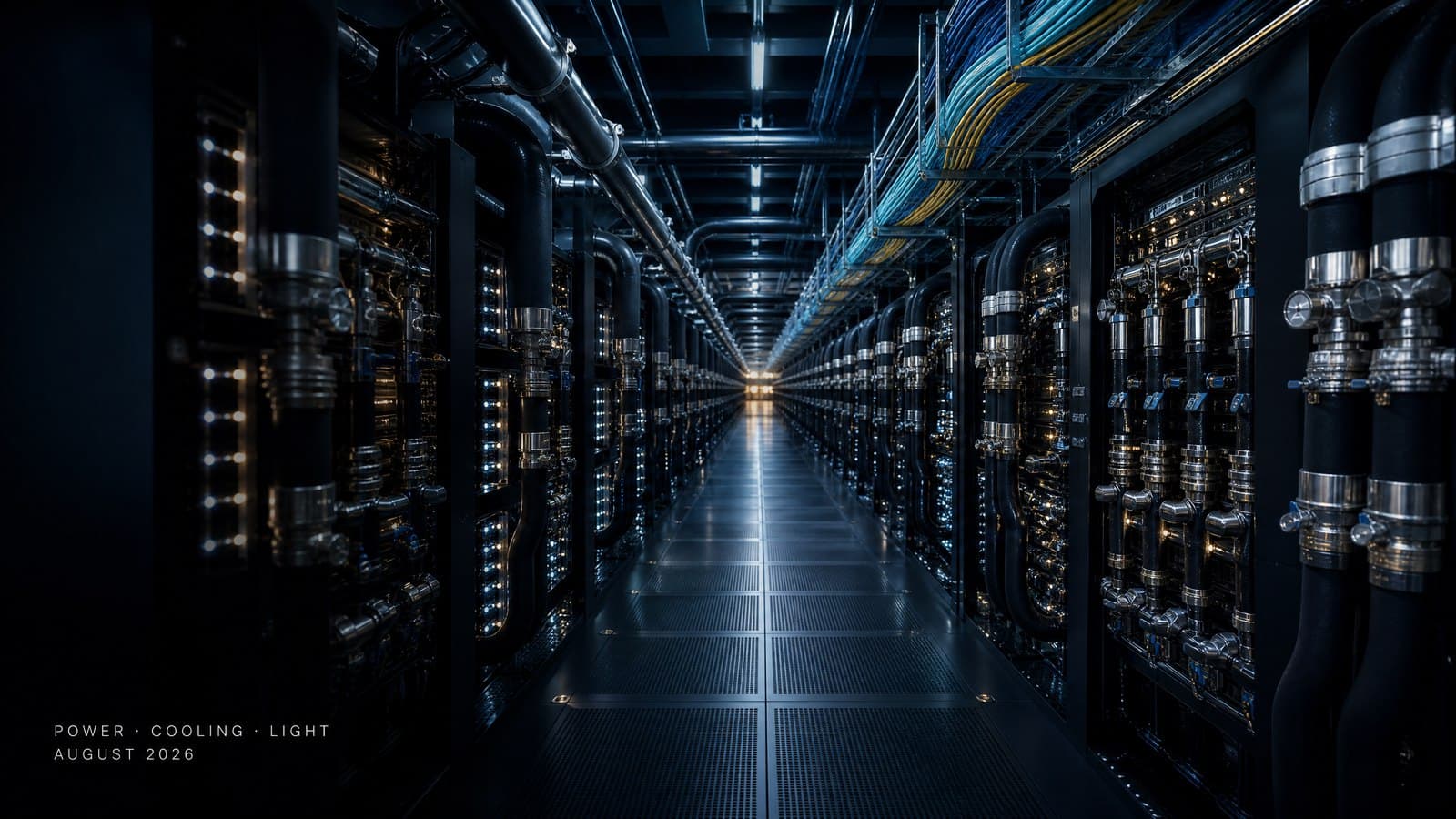
The four largest companies will spend roughly $700 billion on capital investment this year - almost double 2025. And the bottleneck is no longer the chip.
It has become three physical things - power, heat and light - and a fourth constraint that is not physical at all.
Errors or inaccuracies are possible. Spotted something that looks wrong? Write to me and I will correct it.
The Order of Magnitude, First
| Capital expenditure guidance for 2026 | |
|---|---|
| Amazon | about $200 billion |
| Microsoft | about $190 billion (calendar year) |
| Alphabet | $175-185 billion |
| Meta | $130-145 billion |
These figures were revised upward during the year, which is why different sources quote different numbers. The combined range in circulating estimates runs from about $690 billion to about $725 billion - against roughly $410 billion in 2025.
And looking at that sum, the interesting question is not where the money goes but what it runs into. Because money is not the constraint here - and that is the starting point for everything below.
The First Vector: Power
This is the tightest bottleneck at present, and the numbers explain why.
| US data centre electricity consumption, 2023 | 176 TWh - about 4.4% of national consumption |
| The forecast for 2028 in the same report | 325 to 580 TWh - 6.7% to 12% |
| Consumption of a single AI site today | 100 to 750 megawatts |
These figures are not an investment bank's estimate. They come from the Lawrence Berkeley National Laboratory report of December 2024, mandated by Congress - and between 2017 and 2023 consumption had already more than doubled.
And this is the ratio that turns it from an engineering problem into a structural one:
| Time to build a data centre campus | two to three years |
| Wait for a grid connection in major hubs | four to seven years |
That is, the building is ready before it has power.
And this inverts what was true for the whole life of this industry. For decades the structure was the slow resource and power was a given. Today power is the scarce resource, and concrete is the fast part.
And the explanation for the queue is not only bureaucracy. An AI load is the hardest load to plan for that the grid knows: very high power density, rapid and unpredictable ramping, and very low tolerance for interruption. A grid planner receiving such a request is not adding a customer - they are adding a factory.
And the market's response is what makes this vector an investment matter rather than merely an operational one. When a grid connection takes years, operators move to local generation: gas turbines on site, direct purchase agreements with power stations, and fuel cells.
Which explains why companies that look far removed from AI keep appearing in coverage of the sector - turbine makers, power producers, infrastructure contractors and fuel cell makers. I went into the structure of this bottleneck separately in the grid constraint and data centres.
The Second Vector: Cooling
Heat is not a side effect. It is exactly the same energy, after it has passed through the chip.
| Power density per rack | |
|---|---|
| Traditional rack | 5 to 15 kilowatts |
| AI rack | 30 kilowatts and above - up to over 100 |
And above about 30 kilowatts per rack, air cooling stops working. Not becomes expensive - stops.
The reason is physical: air has a low heat capacity. To remove tens of kilowatts from a square metre you have to move a volume of air that becomes a problem in itself - noise, velocity, and fan power that starts consuming a meaningful share of the electricity you brought in to begin with.
So the shift is to liquid, in two main forms: liquid direct to the chip - a cold plate on the processor, with fluid carrying the heat away - and full immersion, where the server sits inside a dielectric fluid.
And why this is an economic matter and not only an engineering one: every watt spent on cooling is a watt that did not become computation. In a world where power is the scarce resource, cooling efficiency translates directly into how much AI can be run at a site given a fixed grid connection.
It is exactly the same dollar, and the same megawatt - only divided differently between them.
Industry research firms put the data centre liquid cooling market at about $4.07 billion in 2026, reaching roughly $27.65 billion by 2033. Forecasts like these should always be read with care - but the direction itself is not in dispute, and it follows from the physics of the rack rather than from a demand estimate.
And the supplier already reporting it in its accounts is the power and cooling infrastructure provider - see the quarter at Vertiv.
The Third Vector: Light
And here the story is more interesting, because it is not about how much computation there is but how much of it can be connected together.
A large model does not run on one chip. It runs on thousands, sometimes hundreds of thousands, and they have to talk to each other at something approaching the rate at which they compute. The moment the connection is slower than the computation, expensive accelerators sit and wait.
And the problem with copper is that it runs out - not in inventory, but in physics.
The faster the transfer rate, the more quickly an electrical signal in a copper cable degrades. The result is that doubling the rate requires shortening the distance, or adding amplifiers - and both cost electricity.
At the rates and distances of a modern AI cluster, that equation no longer closes.
Light does not suffer from this to the same degree. Optical fibre carries more, further, and with less energy per bit. The price is that you have to convert electricity to light and back - and that conversion itself consumes power and takes up space.
So the engineering direction is to bring the conversion closer to the chip itself - what is called co-packaged optics: instead of a separate optical component at the end of the cable, an optical engine sitting on the same package as the switching chip.
And what makes 2026 the year this stops being a slide deck:
| Nvidia InfiniBand photonics switches | early 2026 |
| Ethernet photonics switches | the second half of 2026 |
| Stated bandwidth | up to 409.6 terabits per second |
| Power saving, per the company | up to 3.5 times |
| First formal industry standard | targeted for the fourth quarter of 2026 |
The standard is the detail I would emphasise. A coalition of twenty companies published an architecture document running to some three hundred pages, and set the fourth quarter of 2026 as the target for the first formal specification. A technology gets a standard when it moves from trial to procurement - that is precisely the stage at which multiple suppliers begin competing for the same slot.
I went into the structure of this chain in the photonics value chain, and into Marvell's angle in the deal with Google.
And the Fourth Constraint, Which Nobody Counts
The three vectors above are physical. The fourth is not - and it is the one that began to crack this month.
| AI-related debt issuance, 2026 forecast | about $570 billion - more than double 2025 |
| of which hyperscalers and joint ventures | $250 to $300 billion |
| Hyperscaler bond issuance in 2025 | about $121 billion - four times the five-year average |
| AI's share of net issuance in the investment-grade market | about 30% |
And the figure that gives the change away is not the size but the demand.
| Order cover on hyperscaler issues | |
|---|---|
| February 2026 | 5 times the size of the issue |
| July 2026 | below 2 times |
That is, within five months, demand for exactly the same paper contracted by more than half.
And this does not happen in a vacuum. By October 2025 AI-related debt had reached $1.2 trillion, making it the largest sector in the investment-grade index - larger than US banks.
And from here the line runs straight to yesterday's piece: one of the reasons cited for the rise in long yields since July is the growth in debt issuance by AI companies, alongside the federal deficit. That debt competes for exactly the same buyers who buy the debt of the United States.
And when the risk-free 30-year yield stands at 5.25%, the return hurdle every new megawatt must justify rises with it.
What Connects the Three
And here I want to state what I think is the real thread.
The three vectors are not three separate markets. They are three ways of answering the same question: how much computation can be extracted from one watt.
| The vector | What it solves | The unit measured |
|---|---|---|
| Power | How many watts can be brought to the site at all | megawatts connected |
| Cooling | How many of them become computation rather than wasted heat | energy efficiency |
| Light | How much of the computation is used rather than waiting on a link | energy per bit |
And once you see them that way, it is clear why they arrive together rather than in sequence. A 100-kilowatt rack simultaneously requires a grid connection that will carry it, liquid cooling that will remove the heat, and an optical link that will not choke the accelerators inside it. A company solving one of them and not the other two is not selling a solution - it is selling a component.
הזווית שלי
דעה אישית של אילן אברמוב - לא ייעוץ ולא המלצה
What interests me about these three vectors is that they are all measurable, and that is rare in this story.
"How much AI there will be" is a question with no answer. But "how many megawatts were connected to the grid this quarter" is a question with an answer, and so are "how many liquid-cooled racks were delivered" and "when does the standard land". In a sector saturated with declarations, those are three lines you can count.
And what I try to hold onto is that the investment here is not in a technology but in a bottleneck. A bottleneck is a place where demand exceeds supply for long enough that the price rises. And when the wait for a grid connection is four to seven years, that is not a bottleneck of one quarter.
And what cuts the other way - and this has to be said plainly - is that bottlenecks open. In every infrastructure cycle in history, high prices drew supply, and supply eventually arrived. The railways, the optical fibre of 2000, solar energy - in all of them the bottleneck that looked permanent turned out to be temporary, and sometimes supply arrived in such excess that it destroyed the pricing. Anyone buying a bottleneck should know they are buying a window, not a permanent state.
And the thing that changed this month, and that in my view gets less attention than it deserves, is the fourth constraint. Order cover falling from 5 times to below 2 times in five months is not a technical statistic - it is a vote. The debt market is saying it is still buying, but with less enthusiasm and at a higher price.
So the three lines I will be checking in the coming quarters are not any company's revenue: how many megawatts were connected, what happened to the standard in the fourth quarter, and at what pricing the next issue comes to market. The first measures the physical bottleneck, the second the maturity of the technology, and the third - the patience of whoever is funding all of it.
(It is important to stress: this is my personal opinion only, and nothing herein constitutes a recommendation to take any action.)


