Of all Tuesday's reports, this one carries the highest growth rates - by a wide margin. Bloom Energy (NYSE: BE) reported revenue surging 165%, operating profit flipping from a loss, and a doubling of full-year guidance.
And the explanation for all of it sits in one problem that has become central over the past two years: there is not enough electricity.
What Bloom Energy Sells
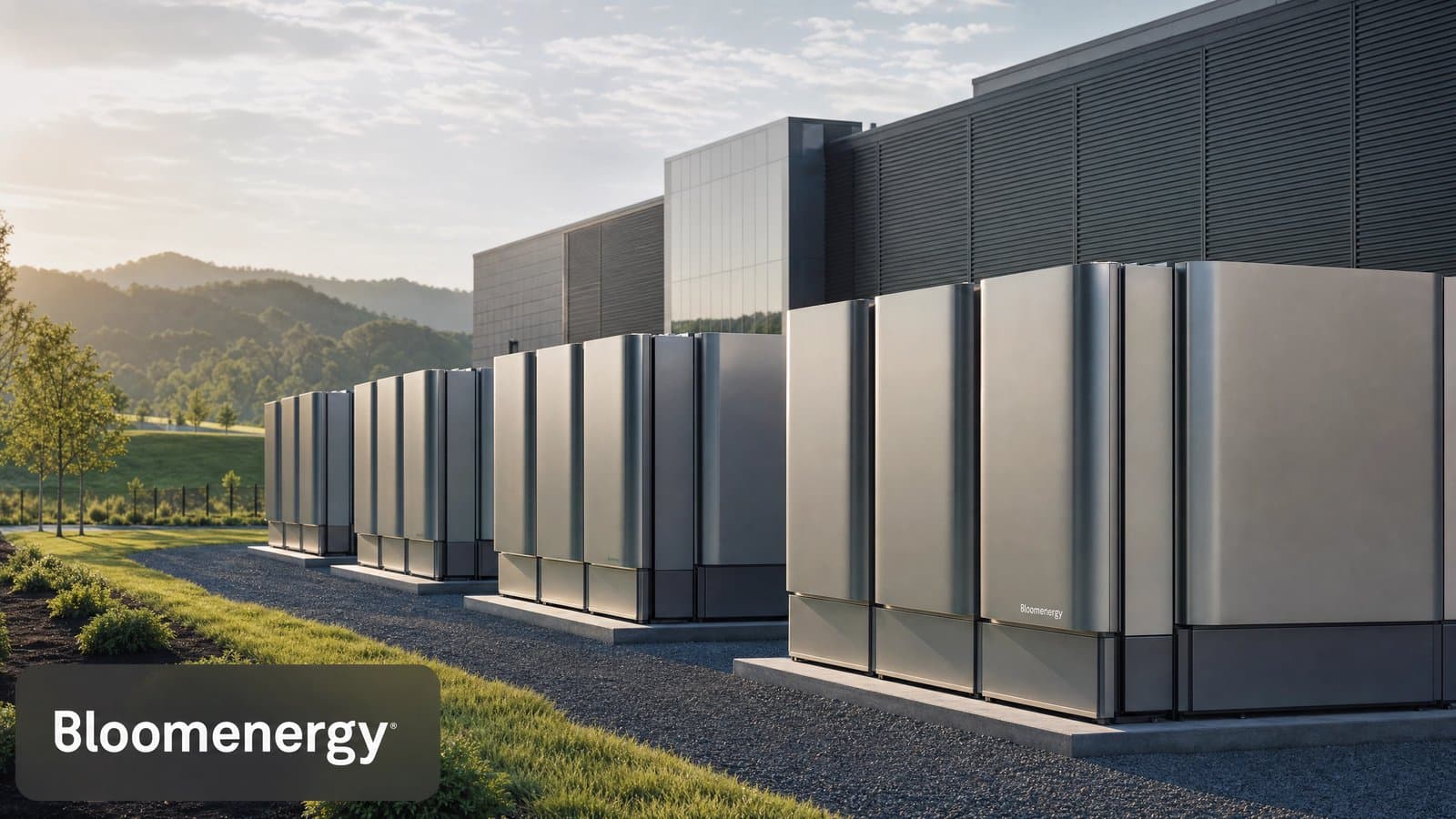
The company makes solid oxide fuel cells - installations that generate electricity on site, on the customer's premises.
And the difference from a conventional generator is material. A generator burns fuel to drive an engine that spins a turbine. A fuel cell burns nothing - it produces electricity through a direct electrochemical reaction from the fuel. The result: higher efficiency, lower emissions, and almost no noise.
But the real advantage is not technical. It is the timeline.
The problem this company solves
A large data center consumes electricity on the scale of a small city. And to connect such a facility to the grid you need an interconnection approval from the regional utility. And in the United States, waiting queues for grid connection are measured in years. Not months - years. That has become the central bottleneck in building AI infrastructure: you can buy chips, you can construct a building - but you cannot run it without power. And that is exactly what Bloom sells: a pulled-in timeline. A facility you can place on site and run within months, instead of waiting in the queue. The customer is not buying cheaper electricity - they are buying earlier electricity.
What Was Reported
And this is a table you do not see often:
| Metric | Current quarter | Prior quarter | Year ago |
|---|---|---|---|
| Revenue | $1,065.4 million | $751.1 million | $401.2 million (+165.5%) |
| Product revenue | $935.4 million | - | $296.6 million (+215.4%) |
| Gross margin | 33.4% | - | 26.7% (+668 bps) |
| Adjusted gross margin | 34.3% | - | 28.2% (+604 bps) |
| Operating profit | $182.2 million | - | $(3.5) million |
| Adjusted operating profit | $239.6 million | - | $28.6 million |
| GAAP EPS | $0.62 | - | $(0.18) |
| Adjusted EPS | $0.78 | - | $0.10 |
This is the first time the company has crossed a billion dollars of revenue in a quarter. And beyond the year-over-year growth, the sequence is impressive too: from $751 million to $1,065 million - a 42% increase in a single quarter.
And cash flow - perhaps the most important number of all:
| Metric | Current quarter | Year ago |
|---|---|---|
| Operating cash flow | +$226.4 million | $(213.1) million |
That is a swing of $439.5 million. A company that was burning cash at more than $200 million a quarter is now generating more than $200 million. That is the most meaningful transition an industrial company can make.
And the balance sheet: $2.667 billion in cash and equivalents, against $2.454 billion at the end of 2025.
Guidance: A Doubling
The company raised full-year revenue guidance to $3.9-4.2 billion - reflecting growth of about 100% at the midpoint versus the prior year.
And for a sense of scale: the first half produced about $1.82 billion ($751 million plus $1,065 million). Which means the guidance implies a second half of about $2.1-2.4 billion - continued acceleration, not stabilization.
Why This Is Happening Now
The company's CEO, KR Sridhar, described demand as accelerating quarter by quarter, and said customers who previously defaulted to combustion technologies are now choosing Bloom.
And the figure he gave is the most significant in the release: according to him, all major U.S. hyperscalers - as well as more than a dozen newer cloud providers, AI labs and colocation data center operators - have validated and approved the company's power solutions for their AI facilities.
And why that matters: in the infrastructure world, the approval process is the barrier. A customer like a data center does not install a new power source without a long evaluation of reliability, safety and maintenance. Once approval is granted - it stays. A repeat order does not require going through the process again.
The CFO, Simon Edwards, characterized the quarter as the strongest in the company's history, with profitable growth and positive operating cash flow.
The Link That Completes the Picture
This report does not stand alone. It is part of a picture built over the season:
- The electricity shortage became the limiting factor in building AI infrastructure
- Corning showed that the physical connection between chips is surging 65% in enterprise networks
- KLA guided to a 9% quarterly jump in chip inspection equipment
And Bloom adds the layer beneath all of them: without power, none of it works. And that is also why its growth is faster than all of theirs - it is solving the narrowest constraint in the chain.
The Bull Thesis
Whoever reads it positively will point to a rare combination of three things at once: growth of 165%, a margin expanding by 668 basis points, and cash flow swinging by $440 million. Companies usually achieve one of the three, not all three.
Beyond that: the doubling of guidance is not a good quarter rolled forward - it implies continued acceleration in the second half.
And the positioning. Approval from all the major hyperscalers is a barrier to entry for competitors, not merely a sales achievement. And a balance sheet with $2.67 billion in cash allows capacity expansion without raising money.
The Bear Thesis
Whoever reads it critically will note first the concentration. The growth rests almost entirely on one segment - data centers - and on a small, highly concentrated customer group. If the pace of data-center construction slows, there is no second segment to compensate.
Second, the fuel. The fuel cells run mostly on natural gas. They are cleaner and more efficient than combustion - but they are not emission-free. Organizations with net-zero targets may view this as an interim solution rather than a final one.
Third, inventory and working capital. Inventory rose to $758 million from $643 million. In a company doubling itself that is logical - but inventory growing faster than sales is always a sign that warrants monitoring.
Fourth, one quarter is not a trend. Bloom lost money for many years. One quarter of profitability and positive cash flow is a promising inflection, but it needs to be seen repeating.
And fifth, competition. Gas turbines, storage solutions, and the grid itself all compete for the same customer. And as interconnection queues shorten - the company's central advantage, the timeline, erodes.
The debate in one line
The bulls see growth of 165%, a margin expanding 668 basis points, cash flow swinging by $440 million, guidance doubled and approval from every major hyperscaler. The bears see near-total dependence on one segment, a solution still based on natural gas, growing inventory, and a single profitable quarter after years of losses. Both sides are reading the same report.
My Angle
A personal opinion of Ilan Abramov - not advice, not a recommendation
What catches me here is not the growth rate - it is what this company is actually selling.
Bloom is not selling cheap electricity. Grid power is almost always cheaper. It is selling time. A customer who can run a data center two years before their competitor - in an era when every month of compute capacity is worth real money - will happily pay a premium.
And that also explains the margin. A gross margin jumping from 26.7% to 33.4% while volumes surge is not just scale. It is a sign the customer is not haggling. People who haggle over price haggle when they have time.
And what I hold as caution precisely because of that: this advantage depends on a bottleneck. Bloom profits because grid connection takes years. The day the queues shorten - and they will, because money is flowing there - the central argument weakens. Not disappears, but weakens.
So the number I will follow is not revenue but the margin. As long as it keeps expanding, it means customers are still under pressure. The day it starts to compress while revenue is still rising - that will be the early sign the shortage is beginning to resolve, and the company is moving from selling urgency to selling a product.
And one last thing, honestly: this is a company that lost money for many years and has now posted one exceptional quarter. An inflection proves itself in its second quarter, not its first. The guidance the company gave implies continued acceleration - and that is exactly a promise that can be checked in three months.
Summary
Bloom Energy published the strongest quarter in its history: revenue of $1.065 billion - the first time above a billion - a surge of 165.5%, with product revenue up 215%. Gross margin expanded to 33.4%, operating profit flipped to $182.2 million from a loss, and EPS came to $0.62 on GAAP and $0.78 adjusted.
And the most significant figure: operating cash flow swung by $439.5 million - from negative $213 million to positive $226 million.
And full-year guidance was raised to $3.9-4.2 billion - a doubling, implying continued acceleration in the second half.
And beyond the company, this is the data point that completes the week's AI infrastructure picture: beneath the chips, the fiber and the inspection equipment - there is a layer of electricity, and it is the narrowest of them all. The question for the investor is not whether the demand exists - the report answers that clearly - but how long this bottleneck stays open.
Sources: Bloom Energy's official results announcement for the second quarter of 2026 (July 28, 2026), as filed with the U.S. Securities and Exchange Commission on Form 8-K, including revenue and its breakdown, GAAP and adjusted gross margins, operating profit, earnings per share, operating cash flow, cash and inventory balances, management commentary and updated full-year guidance. Data accurate as of the time of writing. The chart is shown in real time via TradingView. Nothing herein constitutes a forecast, recommendation or advice - see the full disclaimer at the bottom of the page.


