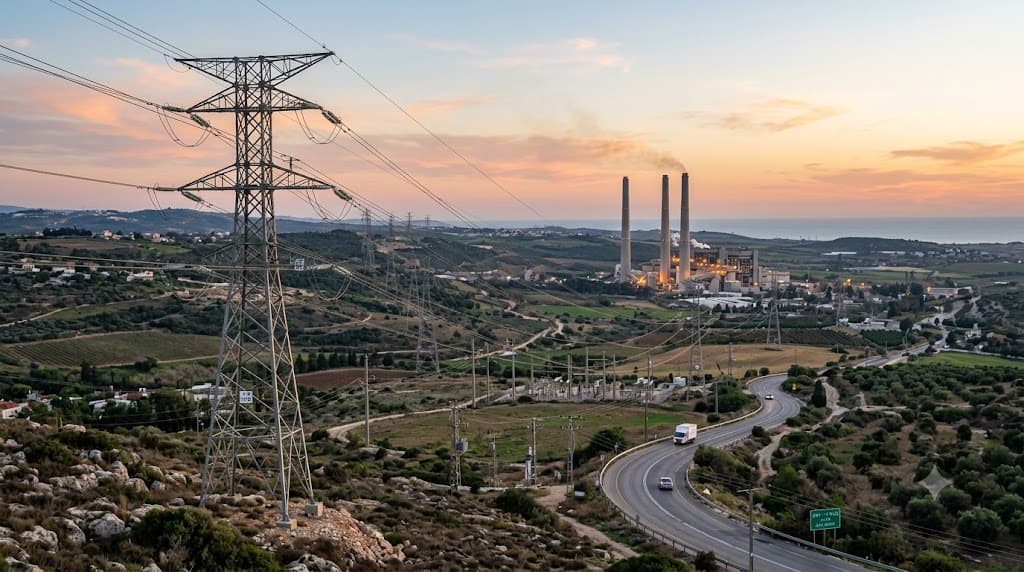
A week ago the Electricity Authority published an unusual decision: Noga, the national grid system operator, will temporarily stop - for 140 days - accepting new requests to connect data centers to the grid. At first glance this looks like a technical decision that mainly concerns data-center developers, but beneath it hides a far bigger story: it touches the future of the electricity economy, the pace at which the AI industry can grow in Israel, and the question of where the significant investment opportunities of the coming years may form.
The Number That Lit the Red Light
To understand the decision you have to start with the numbers, and they are unequivocal. Per Electricity Authority data, the volume of requests filed to connect data centers reached about 27,000 megawatts - roughly three times the average consumption of the entire economy, which currently stands at about 9,000 megawatts. Even against the economy's historical demand peak, about 17,000 megawatts recorded in last August's heat wave, the data-center requests alone are far higher.
This gap is what led to the halt. Noga made clear to the regulator that the system's capacity is simply not prepared for such volumes, and that a blanket approval would force it to reject an enormous volume of requests - more than 25,000 megawatts. Instead of such a sweeping wave of refusals, the Authority chose to stop the clock, and use the timeout to reformulate the rules of the game.
It is important to distinguish between the theoretical requests and the actual commitments: so far the electricity system has committed to connect data centers with a total capacity of only about 1,500 megawatts. Even this relatively modest volume is enough to constitute about 10% of Israel's electricity consumption early next decade, if all the projects are indeed built - a rate that would place Israel among the countries where data-center consumption is among the highest in the world relative to total consumption.
In the Electricity Authority's words
Per the Authority's announcement, the aim of the freeze is not to stop the industry but to "prevent a sweeping rejection of most of the requests" and to allow a re-examination of the connection policy. During this period, among other things, the underlying assumptions on which the system is planned, the impact on generation and transmission redundancy, competition in the economy, electricity prices and the use of natural-gas reserves will be examined. (Source: the Electricity Authority's decision, gov.il.)
Why Data Centers in Particular Weigh So Heavily
The uniqueness of a data center, from the electricity system's standpoint, is in its consumption profile. Most large consumers in the economy "breathe": a factory slows at night, a shopping center calms after operating hours. A data center does not breathe. The servers process, the systems cool, and the load stays high and constant around the clock, every day of the year. And because demand for cloud and AI is only expanding, every new farm adds another layer of constant load to the system.
Against this stands a built-in timing gap, and it is the heart of the problem. Building a data center is a relatively fast project in the infrastructure world; increasing the grid's feed capacity is the exact opposite. It involves long-term planning, permits, enormous investment and sometimes added generation capacity too - all on the scale of years. The result: the demand side races at the pace of a technology industry, and the supply side advances at the pace of a national project. When the two meet, a bottleneck forms - not at the farms themselves, but in the grid that is supposed to feed them.
So Why Not Just Approve Everything?
Ostensibly, if there are developers willing to invest billions - let the state approve and build. In practice, two mechanisms make this dangerous. The first is the reservation mechanism: the moment a large connection is approved, the system operator must hold capacity and infrastructure to its credit - long before a single building goes up on the ground. Mass approval of requests would lock up an enormous share of the grid in favor of plans, some of which, by their nature, will never mature - meanwhile blocking real consumers.
The second mechanism is the question of financing. National transmission infrastructure is not a developer's private matter; its cost is spread across the whole economy. If new power stations and lines are required to serve a handful of mega-consumers, someone will pay - and there is a scenario in which part of the bill ultimately reaches the household tariff. So the examination the Authority opened is deliberately broad: how to allocate capacity in scarcity, what guarantees to demand from developers, and how to ensure the public does not subsidize speculative projects. The stated goal is not to choke the industry, but to let it grow at a pace the system can bear.
The Distinction That Separates the Winners From the Laggards
For investors, the decision is not a uniform blow to everyone entering the field. It creates a sharp separation between two situations: a project that already holds a connection commitment, a signed customer and financing, versus a future pipeline still in the planning stage. The freeze does not necessarily stop the projects that already received a commitment - it mainly hits expansions and plans not yet backed by a binding approval. In fact, whoever is already connected may actually benefit: a grid connection becomes a scarce resource, and this creates a barrier to entry against new competitors.
This separation explains why the market reaction should not be identical for all the companies. A company that made data centers a central growth engine, invested in land and presented investors with large future capacities - is more exposed, especially if a substantial part of its pipeline still depends on answers from Noga. So, for example, per reports, at Mega Or the data-center activity became a material component of the growth forecasts, with some of the projects (including in Haifa and Idan HaNegev) already backed by contracts and commitments - while a broader pipeline of planned campuses remains in the planning stage, and exposed to delays. At Nofar, which bought land in Shoham for a data center that per report received Noga approval, the challenge is not necessarily in the single project but in the ability to replicate the model at additional sites. Enlight is advancing a project in Ashalim, but for it this is one activity within a broad global portfolio of renewables and storage, so the impact focuses mainly on expectations rather than the core. At players like Doral and Ampa (in a Har Tov project) and Kardan Israel, the distinction recurs: the connected assets keep working, while most of the risk sits in the future expansions.
(The data in this section is based on company filings, and current as of the time of writing. Nothing herein is a reference to valuation or a recommendation on any security.)The Israeli companies mentioned - price trend in real time:
Where the Opportunity May Open
And here comes the part that is truly interesting for the long-term investor. Scarcity is not just a problem - it is also a compass. When a real need meets limited supply capacity, the economy's next investments are almost predetermined: they will flow to where the neck is narrow. And in this case, the neck is not at the data-center operators - it is across the whole supply chain of electricity itself: generation, transmission, distribution, storage, cooling and demand management.
Whoever wants to map this chain as an investor should know a common professional distinction between two families of solutions:
- On the grid side (known in the industry as Front of the Meter, FTM): all the infrastructure upstream, before the consumer's connection point. This family includes power stations, solar fields, grid-scale storage facilities, transmission lines and substations - and its purpose is one: that there be more electricity, and that it can be transported.
- On the consumer side (Behind the Meter, BTM): everything installed on the farm's own site that lets it maximize what it already has - backup with batteries and generators, efficient cooling, and software that manages the loads intelligently and maintains operational continuity even during a fault.
Both families enjoy the same tailwind: when the grid is loaded, both expanding supply and improving consumption efficiency become critical, and investment is expected to grow on both axes in parallel.
For the investor, the meaning is that the AI revolution creates demand not only for chips, software and cloud services, but also for infrastructure once seen as the slow and less exciting part of the economy. On the local exchange, companies in the field include Ormat (ORA) in generation and storage, OPC Energy (OPCE) in building and operating power stations, Doral (DORL), Nofar (NOFR) and Enlight (ENLT) in renewables and storage, and Electra (ELTR) and Electra Power (ELEC) in infrastructure and electricity supply. On the global stage, the industry's "toolmakers" stand out - GE Vernova (GEV) in power-generation equipment, Eaton (ETN) in power-management and distribution equipment, and Vertiv (VRT) in cooling and power systems dedicated to data centers.
The global "toolmakers" - price trend in real time:
And of course, the mandatory warning: a positive sector trend is a starting condition, not an insurance certificate. Inside every hot sector also hide companies that are too leveraged, too expensive, or dependent on a single contract. The basic questions - growth, profitability, backlog, debt and valuation - do not become redundant just because the macro backdrop is supportive. The analysis here maps the arena; picking the players within it, every investor must do themselves.
From Today's Halt to the Decade's Investments
Let us sum up the picture. Halting the connections is not a sign that demand vanished - on the contrary, it is the official proof of its strength. The regulator did not halt because no one wants to connect; it halted because too many want to, too fast, relative to what the grid can give. In the immediate term this translates into delays, stricter conditions for developers and a filtering of projects. But looking years ahead, the very existence of this gap requires a wave of investment in generation, transmission and all the supporting systems - because the demand of the AI era does not intend to wait politely.
In my eyes, this is the right way to read the event: not "an industry that stopped," but a signpost that points precisely to the links where the economy is too narrow. Where there is a persistent scarcity and a necessity to solve it - there, historically, the big investments are born. And whoever studies the electricity chain today will understand tomorrow why the very companies expanding it may be the quiet beneficiaries of the AI revolution.
Sources: the Electricity Authority's decision and official announcement (gov.il) and the filings of the companies mentioned, current as of the time of writing. The charts are shown in real time via TradingView.


