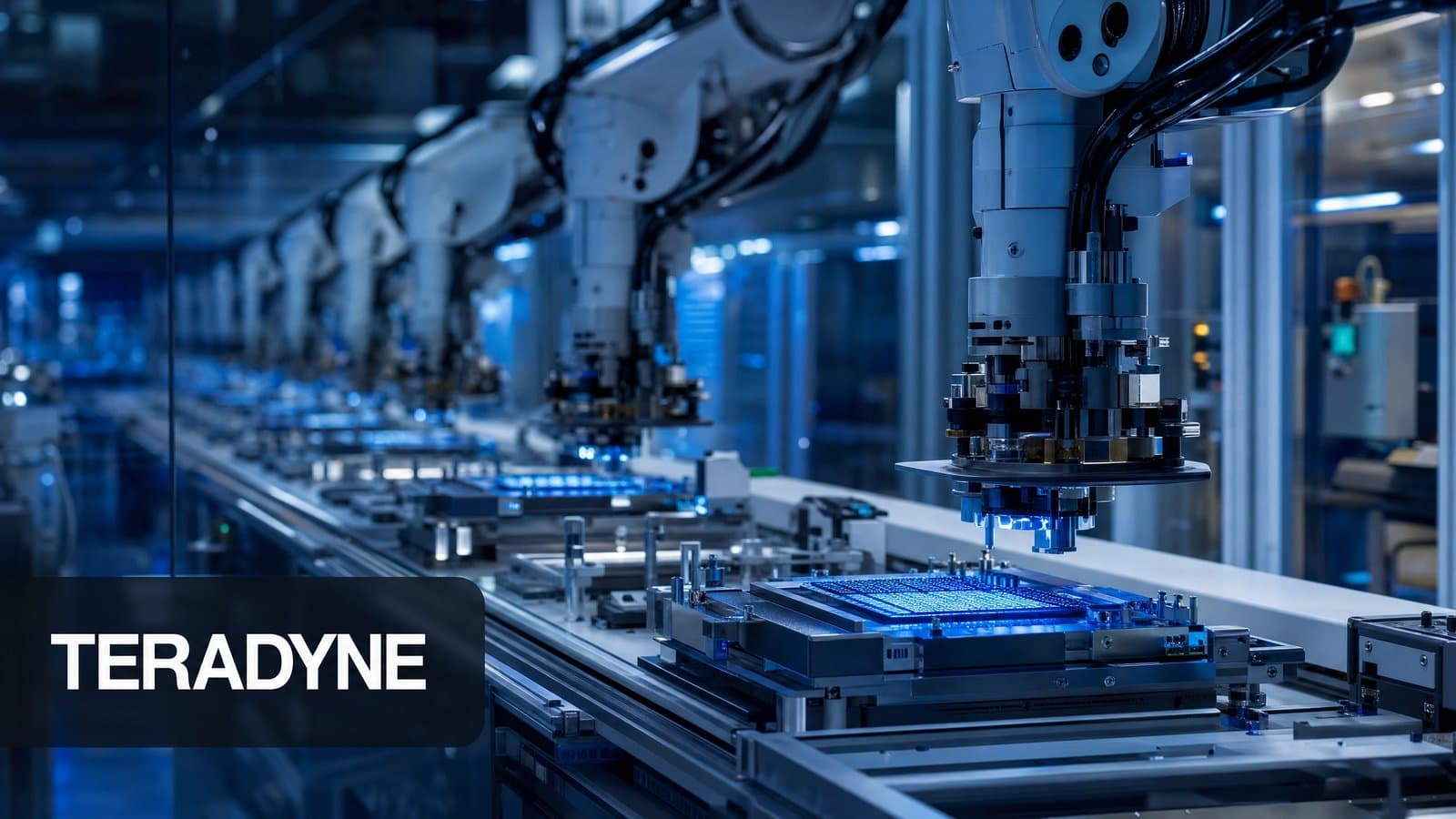
If KLA checks that a chip was made correctly, Teradyne checks that it works correctly. And this quarter, this company posted one of the highest growth rates of the entire earnings season: revenue more than doubled.
What Teradyne Does - and the Difference From KLA
Both companies sell equipment to chipmakers, but at entirely different stages of the process.
KLA does process control - it inspects the wafer during production, looking for physical defects and measuring layers. The goal: catch a problem early, before dozens more steps have been invested in the chip.
Teradyne does final test - it connects the finished chip to a machine that runs it through thousands of scenarios and verifies it functions: that every transistor responds, that speed meets specification, that it does not overheat.
And why that is critical in the AI era: a modern AI processor costs tens of thousands of dollars per unit. A defective chip that reaches a customer is not merely the loss of the chip - it takes down an entire rack in a data center. The more expensive and complex the chip, the longer and costlier its test - and therefore the more equipment required.
And in addition: HBM memory, built from stacked layers, requires testing at every stage of the stack. Every additional layer adds test time.
What Was Reported
| Metric | Current quarter | Year ago |
|---|---|---|
| Revenue | $1,329 million | $652 million (+104%) |
| GAAP net income | $374.5 million | - |
| GAAP diluted EPS | $2.38 | $0.49 |
| Adjusted net income | $389.0 million | - |
| Adjusted diluted EPS | $2.47 | - |
| Gross margin | 59.8% | - |
| GAAP operating margin | 32.9% | - |
| Adjusted operating margin | 33.7% | - |
Consensus stood at about $2.04. The result: $2.47 - a beat of more than 40 cents.
And beyond that, the company blew past its own guidance. Its outlook for the quarter called for revenue of $1.15-1.25 billion and adjusted EPS of $1.86-2.15. The actual result was above the top of the range on both lines.
And a gross margin of 59.8% deserves a pause. An industrial equipment maker with a margin near 60% is an unusual phenomenon. That is a software company's number - and it attests to positioning that is very hard to replicate.
The Breakdown
| Segment | Revenue |
|---|---|
| Semiconductor Test | $1,122 million |
| Product Test | $107 million |
| Robotics | $100 million |
In other words, about 84% of revenue comes from one segment - chip testing. That is the engine, and it is also the source of the growth.
The Robotics segment, which includes collaborative robotic arms, accounts for about 7.5% of revenue. It is strategically interesting but does not move the needle right now.
Capital Returns
The company paid a dividend of $0.13 per share ($20.3 million in total) and executed $68.7 million of buybacks in the quarter.
Guidance - and Here Caution Is Required
| Metric | Next-quarter guidance |
|---|---|
| Revenue | $1,200-1,300 million |
| GAAP EPS | $1.79-2.09 |
| Adjusted EPS | $1.85-2.15 |
And note: the midpoint of the revenue range is $1.25 billion - below the $1.329 billion of the current quarter. And the midpoint of adjusted EPS is $2.00, against $2.47 actual.
In other words, management is guiding to a sequential decline of about 6% in revenue and about 19% in earnings.
How to read a sequential decline in this industry
A quarter-to-quarter decline in semiconductor equipment is not necessarily a slowdown. Orders in this industry arrive in large waves rather than at a steady pace - a customer equipping a new fab orders all at once, and then it is quiet until the next cycle. So the relevant comparison is annual, not sequential. The $1.25 billion guidance midpoint is still substantially above the $652 million of the comparable quarter a year ago. Annual growth continues even if the sequence moderates. But it should be said honestly: a record quarter followed by lower guidance is a pattern that warrants monitoring, not just an explanation.
What Management Said
The company's CEO, Greg Smith, described the quarter as another record, and tied it to a strategy he framed as spanning the range from wafer to AI data center.
He cited robust AI-related demand for the third quarter, and pointed to a rapid increase in wafer fab equipment investment as the basis for continued growth into 2027 and beyond.
The Fifth Link of the Evening
This report adds a layer to the picture built through the evening:
| Layer | Company | What was reported |
|---|---|---|
| Process control | KLA | Guidance jumping to $4 billion |
| Final test | Teradyne | Revenue +104%, 59.8% margin |
| Optical connection | Corning | Enterprise networks +65%, but a carrier warning |
| Power | Bloom Energy | Revenue +165% |
| Storage | Seagate | Margin from 37% to 52% |
And the two chip-equipment companies said the same thing in two ways: KLA guided to a 9% quarterly jump, and Teradyne reported doubled revenue. Demand for chip production and test equipment is currently the strongest part of the chain.
The Bull Thesis
Whoever reads it positively will point to the size of the beat: revenue that doubled, adjusted EPS of $2.47 against $2.04 expected, and a result above the top of management's own guidance range.
Beyond that: a gross margin of 59.8% and an operating margin near 34% attest to real pricing power. Management signals continued growth into 2027, and the company is returning capital through dividends and buybacks.
And the model: testing is a mandatory step for every chip, from every manufacturer. There is no need to guess who wins.
The Bear Thesis
Whoever reads it critically will note first the guidance below the current quarter - an implied decline of about 19% in adjusted earnings. Even if that is natural in a cyclical industry, a record quarter is by definition a point that is hard to repeat.
Second, the cyclicality itself. Semiconductor equipment is among the most volatile industries there is. Growth of 104% in one year also says something about the depth of the decline that preceded it.
Third, concentration. 84% of revenue from one segment, and within it a small number of customers. A decision by one large customer changes the picture.
And fourth, robotics is not taking off. $100 million out of $1,329 million - the segment meant to diversify the company remains marginal.
The debate in one line
The bulls see revenue that doubled, a 40-cent beat, a gross margin near 60% and management signaling growth into 2027. The bears see guidance below the current quarter, an unusually cyclical industry, 84% concentration in one segment, and robotics that is not taking off. Both sides are reading the same report.
My Angle
A personal opinion of Ilan Abramov - not advice, not a recommendation
What catches me here is the position in the chain.
Teradyne does not sell chips, does not sell servers and does not sell models. It sells the step you cannot skip. Every chip leaving a fab must be tested - and the more expensive it is, the more thorough the test.
And that explains the margin. 59.8% gross at an industrial equipment maker is not a normal figure. It says the customer is not haggling, because an alternative does not really exist on their timeline.
And what I take from this evening as a whole: we saw five companies supplying different layers of the same wave - test, process control, optical fiber, power and storage. Four reported acceleration. One signaled caution. And the one that signaled caution (Corning) did so in the part unrelated to data centers.
The cautious conclusion: the wave is still strong in the layer adjacent to the chip.
And what I will follow here: whether next quarter's guidance proves conservative. Teradyne guided this quarter to $1.15-1.25 billion - and delivered $1.329 billion. If it does that again, this is management that guides systematically cautiously. If it lands inside the range - that will be a sign the wave has begun to moderate, and that would be an indication far broader than this company.
Summary
Teradyne published a record quarter: revenue of $1.329 billion - a 104% surge from $652 million a year ago - adjusted EPS of $2.47 against about $2.04 expected, and GAAP EPS of $2.38 against just $0.49 a year ago. Gross margin came to 59.8% and the operating margin to nearly 34%.
The breakdown is concentrated: Semiconductor Test produced $1,122 million - about 84% of total revenue.
And the point that warrants monitoring: next quarter's guidance - $1.2-1.3 billion and adjusted EPS of $1.85-2.15 - is below the current quarter on both lines.
The question for the investor is not whether demand exists - doubled revenue answers that - but whether a record quarter is a starting point or a peak. Management signals continued growth into 2027; the quarterly guidance signals moderation. Both statements can hold at once, and that is exactly what makes the coming quarters interesting.
Sources: Teradyne's official results announcement for the second quarter of 2026, published on July 28, 2026 at 4:35 p.m. Eastern Time via the company's investor relations site, including revenue, GAAP and adjusted earnings, gross and operating margins, segment breakdown, capital returns, management commentary and third-quarter guidance; the company's prior guidance and analyst consensus ahead of the report. The investor call was scheduled for Wednesday, July 29, at 8:30 a.m. Eastern Time. Data accurate as of the time of writing. The chart is shown in real time via TradingView. Nothing herein constitutes a forecast, recommendation or advice - see the full disclaimer at the bottom of the page.


