While Corning signaled a possible slowdown in spending by wireless carriers and its stock plunged, another company in the artificial-intelligence supply chain reported exactly the opposite - and guided to the best quarter in its history.
What KLA Actually Does, and Why It Matters
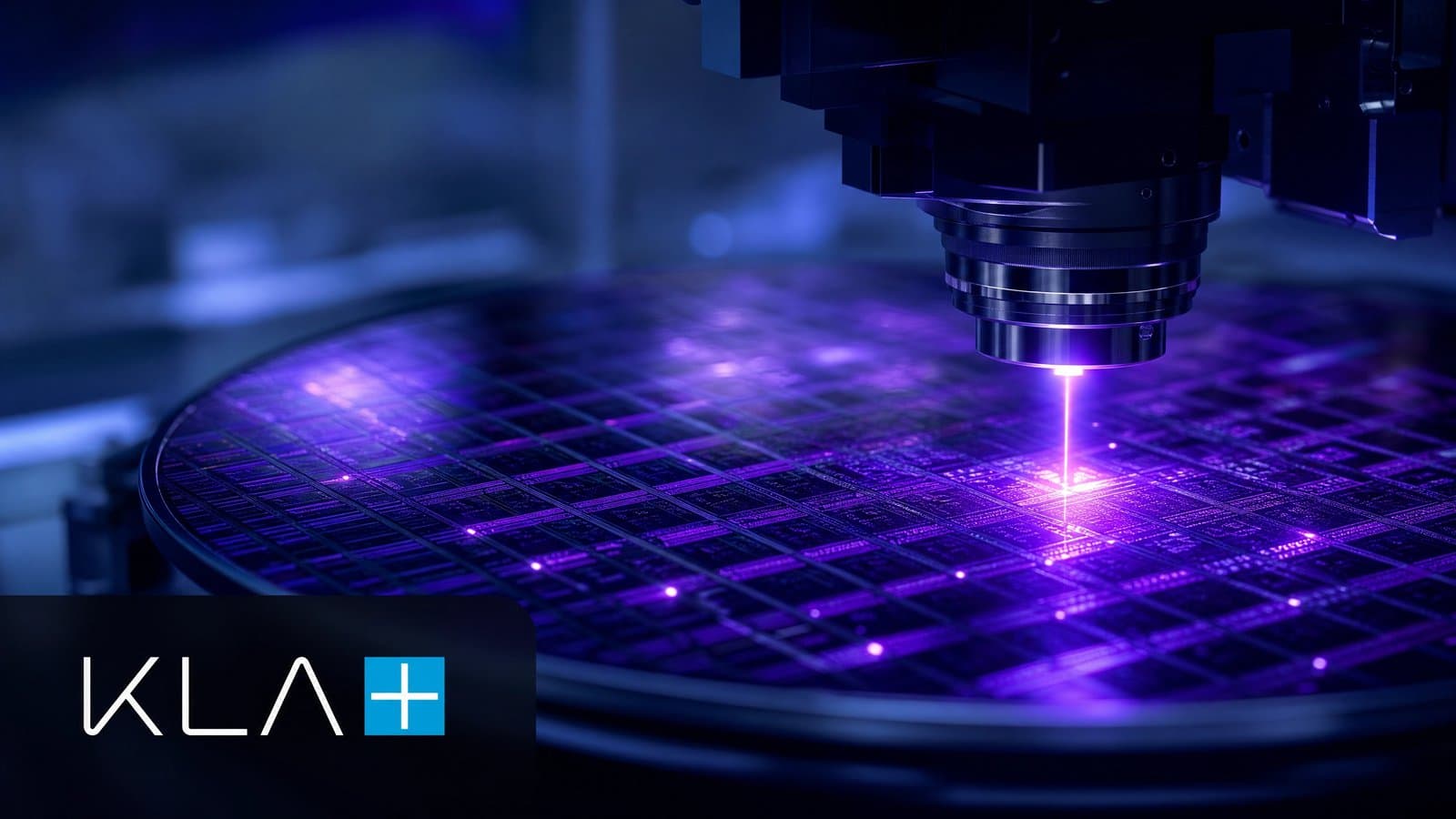
KLA (NASDAQ: KLAC) does not make chips and does not make the machines that print them. It makes the equipment that checks whether everything came out right.
The field is called process control, and it consists of two things: inspection - finding defects on the wafer, and metrology - precise measurement of the layers and structures.
And why that is critical: a modern chip is built from dozens of layers, one on top of another, at dimensions of a few nanometers. A tiny defect in the fifth layer will ruin the chip - but will only be discovered after another thirty layers of work have gone into it. The more complex the process, the more expensive it is to find out late.
And this is where KLA's business model sits: its revenue is derived not only from how many wafers are produced - it is derived from how complex they are. A chip with more layers requires more inspection points. A new architecture requires more measurements. Complexity rises, and with it the amount of equipment required per wafer.
Why AI in particular increases that demand
Artificial-intelligence processors are among the most complex chips made today, and they come with two characteristics that especially increase the need for process control. First, HBM memory: high-bandwidth memory is built from chips stacked on top of one another. Every additional layer is another possible point of failure, and another need for inspection. Second, advanced packaging: a modern AI processor is not one chip - it is an assembly of several components on a shared substrate. That assembly process itself has become a place where defects arise, and it is a field the company explicitly cites as a new growth opportunity.
What Was Reported
This is the fourth quarter of fiscal 2026 - the calendar quarter ended June 30.
| Metric | Current quarter | Prior quarter | Year ago |
|---|---|---|---|
| Revenue | $3.658 billion | $3.415 billion | $3.175 billion |
| GAAP net income | $1.363 billion | $1.201 billion | $1.203 billion |
| GAAP EPS | $1.04 | $0.91 | $0.91 |
| Adjusted net income | $1.386 billion | $1.239 billion | $1.244 billion |
| Adjusted EPS | $1.05 | $0.94 | $0.94 |
Revenue rose about 15% versus the comparable quarter, and EPS about 14% on GAAP and 12% adjusted. The company noted revenue was above the midpoint of the guidance range, and that earnings on both measures were at the top end of it.
For the full fiscal year: revenue of $13.58 billion, GAAP net income of $4.83 billion and GAAP EPS of $3.66.
And cash flow:
| Metric | Quarter | Year |
|---|---|---|
| Operating cash flow | $906.4 million | $4.14 billion |
| Free cash flow | $817.1 million | $3.77 billion |
| Capital returned to investors | $876.3 million | $3.35 billion |
Note the ratio: out of $3.77 billion of annual free cash flow, the company returned $3.35 billion - about 89%. That is the profile of a mature, highly profitable company, not one consuming capital for growth.
Guidance - and This Is the Real Headline
| Metric | Next-quarter guidance |
|---|---|
| Revenue | $4.0 billion (±$200 million) |
| GAAP gross margin | 61.6% (±1.0%) |
| Adjusted gross margin | 62.5% (±1.0%) |
| GAAP EPS | $1.14 (±$0.10) |
| Adjusted EPS | $1.16 (±$0.10) |
And this is the number that sets the tone: moving from $3.66 billion to $4.0 billion - a jump of about 9% in a single quarter. And adjusted EPS is expected to rise from $1.05 to $1.16 - about 10%.
And a gross margin above 62% is a figure worth pausing on: that is a software company's margin, at an industrial equipment maker. It attests to an unusually strong competitive position - customers pay the price because there is no real alternative.
Two Opposite Outlooks on the Same Day
And here is the most interesting point of this evening.
On the same trading day, two companies supplying infrastructure to the AI wave published strong reports - and guided in opposite directions:
| Corning | KLA | |
|---|---|---|
| The reported quarter | Strong - optical communications +32% | Strong - revenue +15% |
| The outlook | Midpoint below consensus | A 9% jump in the quarter |
| The signal | Possible slowdown in wireless-carrier spending | Acceleration in H2 and into 2027 |
And there is not necessarily a contradiction - because they serve different customers. Corning sells optical fiber both to data centers and to wireless carriers, and it is there that it flagged weakness. KLA sells to the chipmakers themselves, and there demand is accelerating.
The cautious conclusion: the wave is not uniform. The layer closest to the chip keeps accelerating; layers further out in the chain are starting to see a mixed picture. That insight is worth more than either outlook on its own.
What Management Said
The company's CEO, Rick Wallace, described the trends driving growth as strengthening, and signaled acceleration in the second half of 2026 continuing into 2027.
The reasons he gave map directly onto the business model: a growing number of leading-edge designs in logic, rising complexity and performance requirements in memory, and a new growth opportunity in advanced packaging.
The Stock Split
On June 11, 2026, after the market close, the company effected a 10-for-1 stock split. All per-share data in the report was retroactively adjusted.
And it is worth clarifying, because this confuses quite a few investors: a stock split changes nothing about the company's value or the value of a holding. Someone who held one share worth $1,000 now holds ten shares worth $100 each. The pie is the same, the slices are smaller. The purpose is usually to make the stock more accessible to smaller investors.
The Bull Thesis
Whoever reads it positively will point to the guidance: a 9% jump in revenue and 10% in earnings in a single quarter, with management signaling acceleration continuing into 2027.
Beyond that: a gross margin above 62% attests to a competitive position that is hard to replicate - KLA is the dominant player in process control, and its customers cannot simply switch to another supplier in the middle of a production cycle.
And the model itself: revenue derived from complexity rather than volume alone means the company benefits from every new technology generation, even if wafer counts do not grow. And free cash flow of $3.77 billion a year, about 89% of which returns to investors, is the profile of a cash machine.
The Bear Thesis
Whoever reads it critically will note first the cyclicality of the industry. Semiconductor production equipment is among the most cyclical fields there is: when manufacturers slow investment, orders stop almost immediately. The current outlook is excellent - but it is an outlook for one quarter.
Second, customer concentration. A small number of chipmakers account for a large share of revenue. One of them deciding to postpone a project has an immediate impact.
Third, regulation and geopolitics. Export restrictions on equipment to certain markets are a permanent risk in this industry, and shifting policy can change the picture regardless of demand.
And fourth, dependence on the AI wave. If the pace of data-center investment slows - an open question that has accompanied this entire earnings season - growth in complexity will slow with it.
The debate in one line
The bulls see guidance jumping 9% in a quarter, a 62% gross margin, a model derived from complexity rather than volume alone, and free cash flow almost entirely returned to investors. The bears see an unusually cyclical industry, high customer concentration, regulatory risk on exports, and total dependence on the AI investment wave continuing. Both sides are reading the same report.
My Angle
A personal opinion of Ilan Abramov - not advice, not a recommendation
What catches me here is the model, not the quarter.
Most companies in the chip chain depend on the question of how many wafers will be produced. KLA depends on the question of how complicated each wafer will be. And that is a material difference, because complexity rises with every generation - including in years when volumes are flat.
And that is, to me, the cleanest way to get exposure to the trend without betting on a winner. KLA does not need to know whether the winning processor will be Nvidia's, AMD's, or someone who does not exist yet. Every advanced chip made, by whoever makes it, gets inspected.
And the second thing I take from this evening is the comparison itself.
On the same day, Corning and KLA both published strong reports - and then guided in opposite directions. One signaled a slowdown, the other acceleration. And that is exactly the sort of thing that is hard to see when you read about one company at a time.
What that tells me: "AI infrastructure" is not one category. There are layers, and each layer has different customers and a different cycle. The layer adjacent to the chip - equipment, inspection, packaging - currently looks stronger than the layers further away. Anyone holding "AI exposure" as a single label is in fact holding several different stories.
And what I will follow: whether the $4 billion guidance materializes. An outlook jumping 9% in a single quarter is a very confident statement. If it holds - management read the cycle correctly. If not - it will be an early sign the wave has started to cool in the layer closest to the chip, and that will be important information well beyond KLA itself.
Summary
KLA closed fiscal 2026 with a quarter of $3.658 billion in revenue (up about 15%), adjusted EPS of $1.05 - both at or above the top end of guidance - and free cash flow of $817 million. For the full year: $13.58 billion of revenue and $3.77 billion of free cash flow, about 89% of which was returned to investors.
And the real headline is the guidance: $4.0 billion for next quarter, a jump of about 9%, with adjusted EPS of $1.16 and a gross margin above 62%.
And beyond the company, this evening provided an important data point: on the same day Corning warned of a slowdown in wireless-carrier spending, KLA signaled acceleration from the chipmakers. The AI investment wave does not move as one block - and it is worth knowing which layer of the chain you are looking at.
Sources: KLA Corporation's official results announcement for the fourth quarter and fiscal year 2026 (July 28, 2026), as filed with the U.S. Securities and Exchange Commission on Form 8-K, including revenue, GAAP and adjusted earnings, operating and free cash flow, capital returns, the stock split, management commentary and guidance for the first quarter of fiscal 2027. Data accurate as of the time of writing. The chart is shown in real time via TradingView. Nothing herein constitutes a forecast, recommendation or advice - see the full disclaimer at the bottom of the page.


