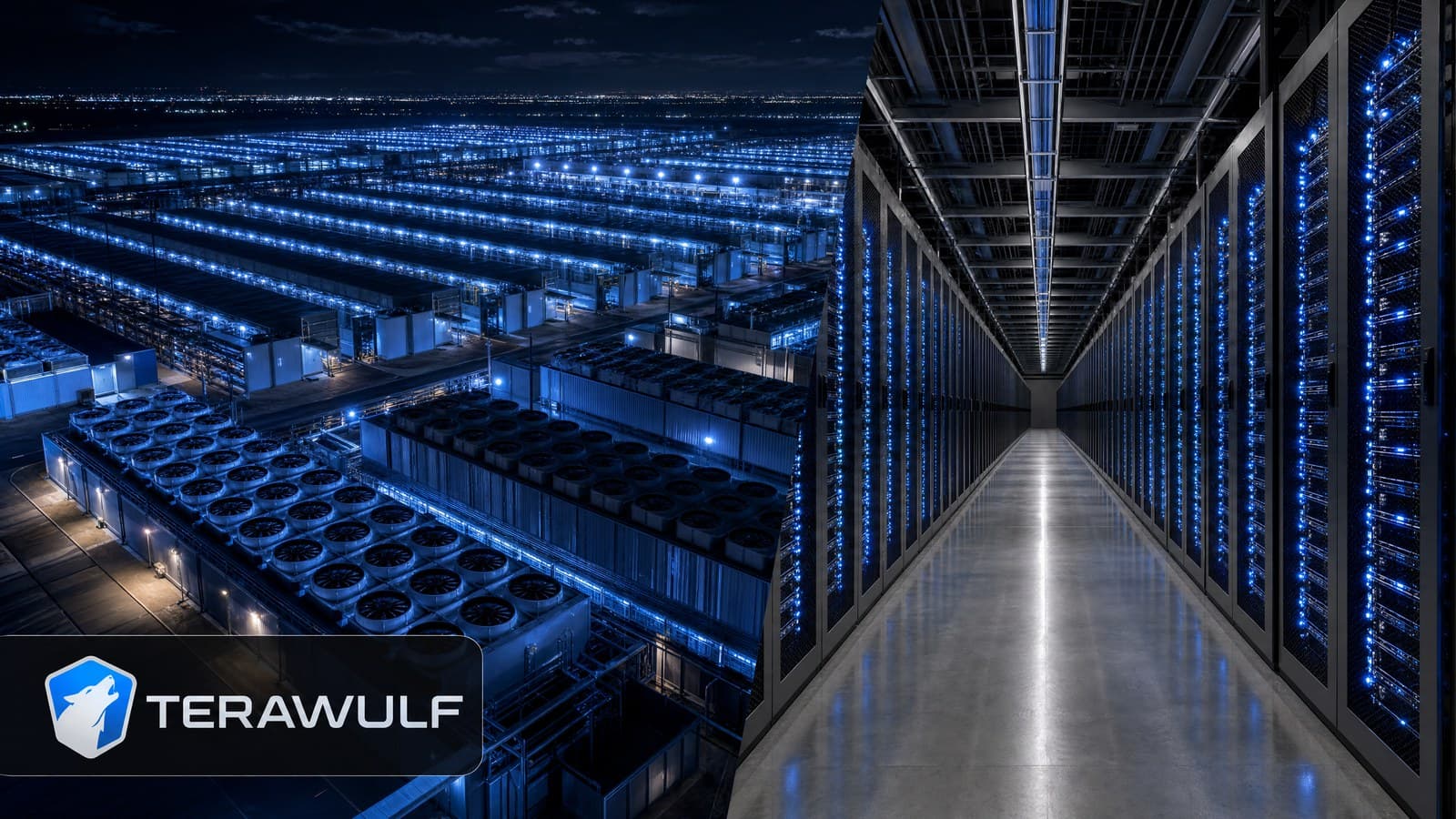
TeraWulf reported its second quarter today - and anyone who read yesterday's piece on Cipher will recognise the exact mirror image here.
What was reported
| Quarter | Year ago | Change | |
|---|---|---|---|
| HPC lease revenue | 31,932 | 0 | new |
| Digital asset revenue | 12,835 | 47,636 | -73% |
| Total revenue | 44,767 | 47,636 | -6% |
| Operating loss | (140,450) | (15,590) | - |
| Net loss attributable | (939,917) | (18,370) | - |
| Loss per share | $(1.94) | $(0.05) | - |
In thousands of dollars except per share
Total revenue fell 6%. And that is precisely not the story.
The mix flipped
71% of revenue already from leasing
High-performance computing lease revenue: $31.9 million, roughly 71% of total revenue.
A year ago that line was zero.
And alongside it, digital asset mining revenue collapsed 73% - from $47.6 million to $12.8 million.
So total revenue fell 6%, but the company swapped one business for another within a year.
And that is the difference from Cipher. Cipher, which reported yesterday, showed a single revenue line literally called "Revenue - bitcoin mining" - zero lease revenue. At TeraWulf the transition already sits in the income statement, not only on the balance sheet.
And the contract that changes the order of magnitude
After quarter end, TeraWulf signed a 20-year data center lease with Anthropic.
| Capacity | approx. 401 MW |
| Site | Justified campus, Hawesville, Kentucky |
| Contracted revenue over the initial term | approx. $19 billion |
| Including both 5-year extension options | up to approx. $33 billion |
| Initial delivery | second half of 2027 |
| Full delivery | early 2028 |
For proportion: $19 billion of contracted revenue, against current annual revenue of under $200 million.
And this tenant is named. Not "an investment-grade hyperscale tenant" - Anthropic, explicitly.
Google's credit support
And a second detail worth noting: delivery of the CB-3 building in early July activated $600 million of Google credit support for Fluidstack's lease obligations.
In other words: Google stands behind part of the tenant's obligations. That strengthens the quality of the contracted revenue, because the risk does not sit on the tenant alone.
And where a $940 million loss came from
Mostly non-cash - but not entirely
Net loss attributable to the company: $939.9 million, against $18.4 million a year ago.
The breakdown:
- Change in fair value of warrants: minus $755.7 million - a non-cash accounting line
- Selling, general and administrative: $112.4 million against $10.0 million a year ago - 11x
- Interest expense: $56.4 million against $4.0 million
- Loss on extinguishment of debt: $7.1 million
- Against which, interest income of $29.0 million on the cash pile
The operating loss itself: $140.5 million.
And here it is worth not rushing to the "it is only accounting" explanation. The warrant revaluation is indeed non-cash, but the 11x jump in administrative expenses is real - and it includes $185.4 million of share-based compensation for the half year. That is dilution, even if it is not cash.
Weighted average shares rose to 485.7 million from 386.9 million - roughly 26% in a year.
The capacity, which is what is actually being sold
What exists today and what is under construction:
- 102 MW of revenue-generating capacity at the Lake Mariner campus - 81 at the end of June, plus CB-3 delivered in early July
- A further 336 MW under construction across CB-4 and CB-5
- Stated cost: $8 to $10 million per MW of critical IT capacity
And beyond that, a platform of sites:
- Muskie, Kentucky - acquired in May, roughly 308 acres, agreements for up to 1 GW with Kentucky Power
- Chesapeake, Maryland - FERC authorised the Morgantown generating station acquisition on 29 July, potential of up to 1 GW
- Lake Hawkeye, New York - potential of roughly 320 MW of critical IT load, not before 2029
And the company sold an asset: its entire 50.1% interest in the Abernathy Joint Venture, for roughly $530 million in cash.
The cash
Roughly $3.0 billion of cash and restricted cash at quarter end.
And net property and equipment rose to $3.60 billion from $1.51 billion at the end of 2025 - 2.4x in six months. Total assets: $8.05 billion.
And what the CEO says, and why it ties the whole week together
Paul Prager, Chairman and CEO of TeraWulf:
"As access to power becomes the defining constraint on AI infrastructure development, we believe our ability to combine energy expertise, infrastructure control and execution at scale will become increasingly valuable."
That is exactly the thesis we have covered since July, phrased by someone living it. And in the same week: Caterpillar attributed its power generation growth to data centers, Tower reported a surge in silicon photonics, and Arista a 60% saving in interconnect power.
Electricity is the bottleneck. Whoever controls it sells it.
My Angle
A personal opinion of Ilan Abramov - not advice, not a recommendation
The comparison between TeraWulf and Cipher is the lesson of this week, and I want to phrase it precisely.
Both companies came from the same place - bitcoin mining - and are entering the same market. But at Cipher lease revenue is still zero, and the tenant is unnamed. At TeraWulf 71% of revenue already comes from leasing, and the anchor tenant is Anthropic, on a 20-year contract.
That does not make one good and the other bad - it means they are at different stages, and the market priced that difference when it took Cipher down 15.65% on its reporting day.
And what I am not willing to wave through: the loss. It is true that $755.7 million of the $940 million is a non-cash warrant revaluation. But administrative expenses jumping 11x, and $185 million of share-based compensation in half a year, are a real cost to the shareholder - it is simply paid in dilution rather than cash. The share count rose 26% in a year. That is not trivial.
And what genuinely impresses me is not the contract itself but the structure behind it: sites with secured power, long contracts with creditworthy tenants, and Google credit support on part of the obligations. This is not a bet on the bitcoin price - it is industrial real estate leasing on a long contract. A completely different business, with a completely different risk.
And what remains to be tested: $19 billion is a contract, not revenue. First delivery in 2027, full delivery in 2028. Until then it is execution capability, not a result.


