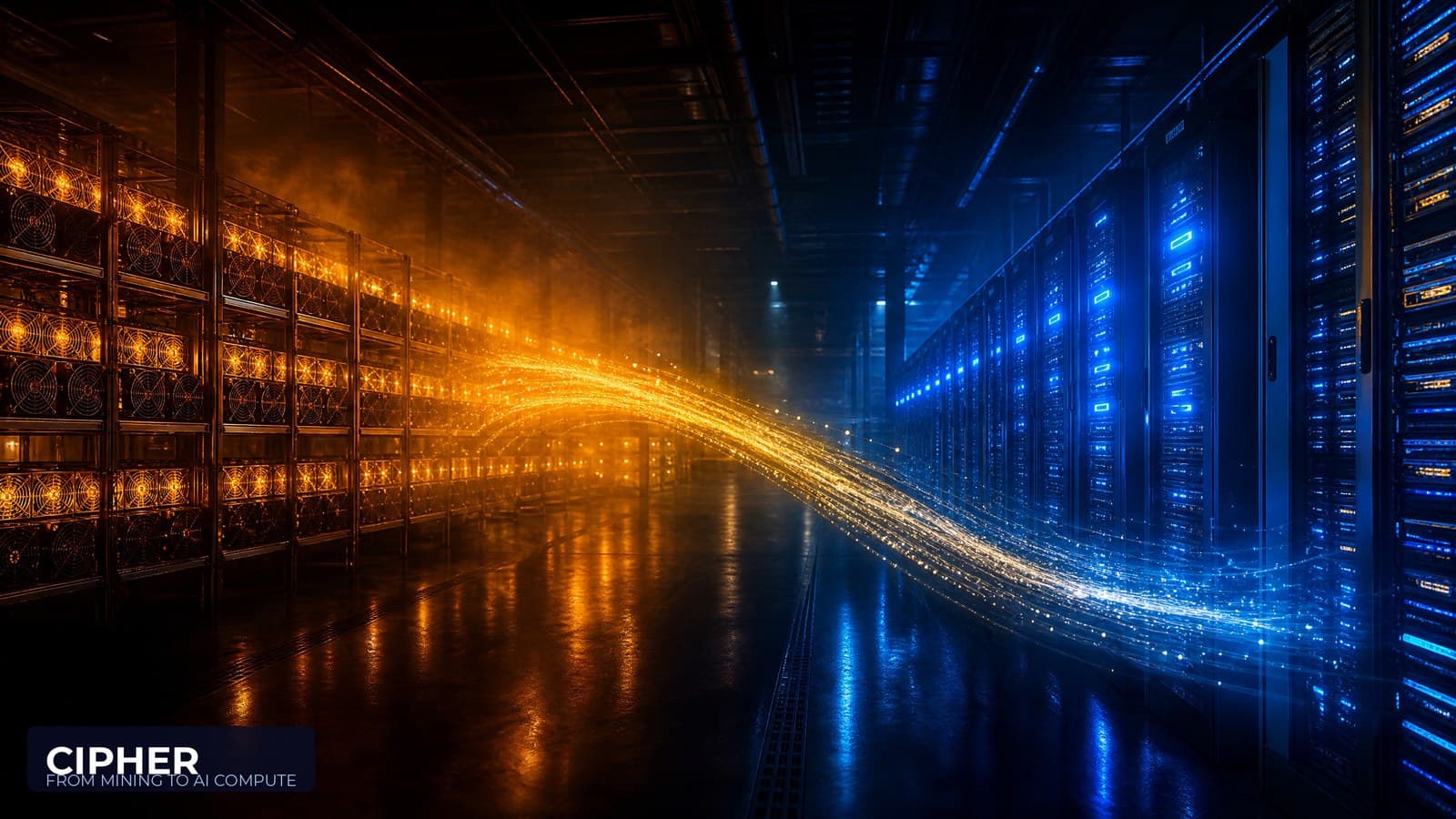
Cipher reported second-quarter results before the open this morning - and anyone reading only the revenue line will completely miss what happened here.
What was reported
| Quarter | Year ago | Change | |
|---|---|---|---|
| Revenue | 24.8 | 43.6 | -43% |
| Operating loss | (78.5) | (45.2) | - |
| Net loss | (267.5) | (45.8) | - |
| Loss per share | $(0.65) | $(0.12) | - |
| Adjusted EBITDA | (30.0) | 32.3 | swing |
In millions of dollars
At first glance this looks like a collapse. Revenue cut 43%, the net loss 5.8x larger, and adjusted EBITDA flipped from positive to negative.
But those numbers describe a business the company has already exited.
The revenue line gives it away
In the income statement, the single revenue line is literally called: "Revenue - bitcoin mining".
That is it. There is no second line. All $24.8 million of the quarter came from the old business - from mining bitcoin, not from leasing data centers.
And why that changes the whole reading
Cipher is not mid-transition. It has finished one.
The company changed its name from Cipher Mining to Cipher Digital, and describes itself in the release as "a leading developer, owner, and operator of industrial-scale data centers". The word mining does not appear in its self-definition.
But the revenue from the new business has not entered the report yet. The first data center began delivering at the beginning of August - after the quarter closed.
So this quarter is the last quarter of the old business, and the first of the new one has not been reported.
What did happen in the quarter
Rent started. Cipher disclosed an amendment to the lease on its Black Pearl campus with its investment-grade hyperscale tenant. Under the amended terms, the company began delivering capacity at the beginning of August, two months ahead of the original schedule - at the tenant's request.
CEO Tyler Page: "We are proud to have delivered our first HPC data center capacity ahead of schedule and announce that rent has commenced at the site."
And that is the interesting detail: the tenant asked to accelerate. The company did not offer - the tenant asked. In a market where compute capacity is the bottleneck, that is a demand signal.
And three more sites in motion:
- Barber Lake - the tenant has commenced beneficial use of the facility, including partial occupancy of the building and deployment of network racks
- Stingray - a bond offering completed in the quarter fully funds the development, and reimbursed the company $56.7 million of previously funded expenditures
- Apollo - an option on a new site of up to 900 MW, within 25 miles of San Antonio, Texas, spanning roughly 288 acres
The balance sheet already tells the new story
And here the gap between the income statement and the balance sheet becomes dramatic.
| 30 Jun 2026 | 31 Dec 2025 | |
|---|---|---|
| Property and equipment, net | 2,132.6 | 633.4 |
| Cash and restricted cash | 4,559.8 | 2,664.6 |
| Bitcoin | 37.8 | 125.4 |
| Miners held for sale | 0 | 94.9 |
| Total assets | 7,501.5 | 4,291.9 |
| Long-term borrowings | 5,446.9 | 2,711.6 |
| Total equity | 562.1 | 805.5 |
In millions of dollars
Property and equipment grew 3.4x in six months. That is what happens when a company builds three data centers at once.
And the bitcoin has nearly vanished: from $125.4 million to $37.8 million. Miners held for sale fell from $94.9 million to zero - meaning they were sold. The company liquidated the old business to fund the new one.
And there is one more small line that says a great deal: deferred revenue of $25.5 million, which did not exist at all at the end of 2025. That is prepaid rent. The first line of the new model - on the balance sheet, before it ever reaches the income statement.
And where a $267 million loss came from
The breakdown, and it matters
Most of the loss is not operating.
- Change in fair value of warrant liability: minus $150.5 million - a non-cash accounting line driven by the share price rising
- Interest expense: $66.7 million, against just $1.1 million a year ago - the cost of $5.45 billion of debt
- Interest income: plus $35.9 million, on the restricted cash pile
- Realized loss on sale of bitcoin: minus $23.5 million
- Compensation and benefits: $42.4 million against $15.7 million, of which $30.5 million is share-based compensation
The operating loss itself was $78.5 million. Everything else comes from below the operating line.
What deserves saying without dressing up
Three points that demand caution
First, there is not yet a single quarter of the new model in the numbers. All that exists is contracts, schedules and statements. The first leasing revenue will appear in the third-quarter report, and not before.
Second, the leverage. Long-term borrowings of $5.45 billion against $562 million of equity. And equity fell over the half year, from $805.5 million - meaning losses are eroding the base while the debt grows. This is a heavily leveraged build.
Third, the tenant is not named. The release describes it as an "investment-grade hyperscale tenant" without saying who. Customer concentration is a risk in its own right when it is not disclosed.
And the connection to the earlier article today
On the very same morning, Caterpillar reported the biggest quarter in its history, writing that power generation sales rose "primarily in data center applications".
The two companies sit on the same chain, at two different points:
Caterpillar sells the excavator and the generator. Cipher is the one buying them, building the structure and leasing it out. At Caterpillar that is booked as record revenue and profit; at Cipher the very same construction is booked as property, as debt, and as negative EBITDA.
It is the same revolution, simply from opposite sides of the invoice.
My Angle
A personal opinion of Ilan Abramov - not advice, not a recommendation
I want to avoid two opposite mistakes here.
The first is to read the headline and conclude the company is collapsing. Revenue cut 43% and a $267 million loss sound like a disaster - but that revenue line is bitcoin mining, a business the company deliberately exited. Measuring a company by the performance of the activity it has just wound down is a misreading.
And the second mistake, the more dangerous one, is to get carried away by the story and ignore the balance sheet. $5.45 billion of debt against $562 million of equity is extreme leverage, and the equity is falling. This build was financed almost entirely with debt.
And what I am waiting for is the next quarter, not because I am trying to guess the result. But because it is the first quarter in which we will see what the rent actually is - how much the company collects against how much it spent. Until that number appears, any valuation here is a valuation of a promise, not of a business.
What can be said with confidence: the tenant asking to bring delivery forward by two months is the most informative detail in the report. A tenant does not rush to start paying rent earlier unless it genuinely needs the capacity.


