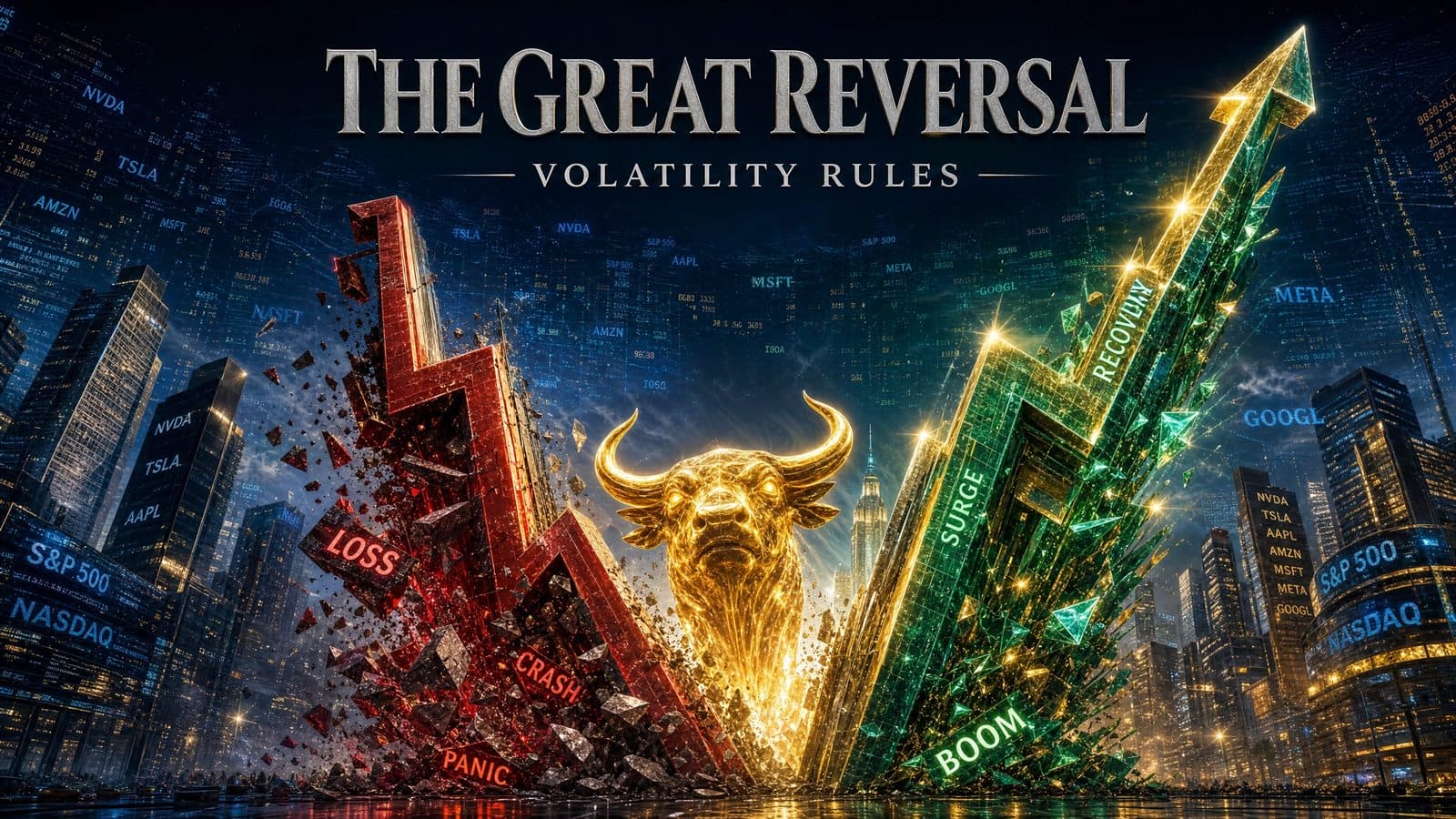
Last week something happened in the markets that looked, on its face, illogical: the big banks' reports beat forecasts, TSMC posted an exceptional quarter and raised guidance, ASML raised too, and the economic data surprised to the upside - and yet AI and growth stocks suffered aggressive declines. Even optimistic statements from the most senior level - including Jensen Huang, who explained in Tokyo that the AI revolution is only at the beginning of a 10-15 year cycle - did not move the needle. And then, this week, that very same market did a U-turn: two days of significant gains, which passed with surprising calm even through a military escalation with Iran. I want to break down what happened here, because in my eyes it is one of the year's best lessons on the difference between sentiment and data.
First, the Precision: What Exactly Fell
It is important to note a detail many missed: the broad index was barely hurt. The S&P 500 stayed near its high throughout the storm. The declines concentrated in a very specific place - AI, chip and growth stocks, exactly where the positions were the most crowded and leveraged.
How specific? Look at the most famous names among retail investors - the ones that led the past year's rally. Per trading data, at the mid-July low some of them traded 30% to 70% below their highs: the famous space stocks took a concentrated blow - Rocket Lab (RKLB) lost nearly 30% in one month, Intuitive Machines (LUNR) more than 40%, and AST SpaceMobile (ASTS) fell in two waves - the whole sector weakened further ever since the SpaceX IPO drew capital toward it. Alongside them, prominent retail names from the AI-infrastructure world - Nebius, CoreWeave, Credo, Coherent and others - moved tens of percent from their highs, some beyond the 50% line. And note the contrast: all this happened while the broad index barely moved. When the index is stable and the famous growth names get cut in half, it is almost never a story about "the economy" - it is a story about positions: exactly in these stocks sat the leverage, the options and the algos.
Four of the most famous - at a glance (live charts):
The Korean Laboratory: This Is What Broken Leverage Looks Like
And whoever wanted to see the mechanics in action got a live - and painful - lesson in South Korea. The Seoul exchange, where the retail investing public is especially leveraged and concentrated in chip stocks, became an amplifier of the declines: the KOSPI plunged about 23% in July - its worst month ever - amid seven emergency trading halts. Margin credit balances reached an all-time high in late June, and then were forcibly closed: per reports, more than 1.2 million leveraged accounts got a margin call, and about 360,000 accounts were forcibly liquidated - automatic selling, with no questions about fair value. The Korean regulator even banned the listing of new leveraged ETFs.
This is exactly the point I wrote about in our week-opening review: when positions are crowded, leverage is high and algorithmic systems respond in seconds - any negative catalyst ignites a chain of forced sales that feed themselves. The leveraged holder's sale knocks the price down, the drop triggers a margin call for the next in line, and so on. At this stage the market is no longer pricing companies - it is digesting positions. That is why the good news did not help: whoever is selling under duress does not read reports.
So What Did Ignite It? My Answer: The Capex Numbers
The negative sentiment had, in my estimation, an identifiable trigger: the forecast Morgan Stanley published, under which the cloud giants' capital expenditures are expected to reach about $1.2 trillion in 2027 and about $1.4 trillion in 2028 - after more than $800 billion already this year, nearly double 2025. These numbers, meant precisely to support the growth thesis, did the opposite for part of the market: they illustrated the size of the bet. The question of "who funds this and when does it pay for itself" - the same question Goldman Sachs framed as a "debt tsunami" - turned from theoretical into tangible. When the answer is not immediate, whoever is leveraged does not wait to find out.
And Then Came the Flip - With the Same Force
On Monday the market opened the week on a positive note, and yesterday (Tuesday) it was already a real rally: the three indices broke a streak of three declining days - the Nasdaq jumped 1.29%, the S&P rose 0.89% and the Dow added nearly 400 points. And most importantly - the leaders were exactly the stocks that had been beaten: Micron jumped 12% and Sandisk 14% in a memory-stock rally, AMD added 8% following its AI deal with Microsoft, and the chips all recovered on the back of strong export data from Taiwan and Korea.
What fed the reversal? A series of concrete catalysts, each of which gave the market what it lacked a week earlier - evidence that the big money still believes:
- Nvidia disclosed a 9.3% stake in Nebius - the AI cloud provider - worth about $5 billion (the result of an earlier investment this year). When the world's largest chip maker buys a stake in its customer, the market reads it as a vote of confidence in the whole chain. The stock jumped.
- IREN, which we elaborated on in our power-scarcity piece, announced new contracts worth a total of $2.8 billion, centered - per the announcement - on a new customer: a leading AI developer whose name was not disclosed (likely a private company, not obligated to report) - evidence that demand for electrified capacity is only expanding.
- AST SpaceMobile completed a raise of over a billion dollars in convertible bonds at a rate of just 1.625% - after the announcement itself first scared the market and knocked the stock down. Completing it on such favorable terms signaled: the capital market is still wide open to growth stories.
And the sharpest proof of the sentiment flip: all this happened against a real escalation with Iran - exchanges of blows over the weekend, American soldiers killed and explicit threats from Washington. The same market that a week ago ignored excellent reports, this week ignored a war. If a controlled experiment was needed to separate sentiment from data - we got it.
The Lesson - and This Evening's Test
I am in no rush to declare "it is all behind us." Sentiment that flips so easily in one direction can flip back just as easily, and the structural question - the financing gap between investments and return - was not solved, only dropped from the headlines. What did change: the excess leverage was forcibly cleaned (mainly in Korea), and the positions are less crowded - so the market is again able to hear news.
The lesson I take from these two weeks is the old, good one, in the words of Benjamin Graham, the father of value investing (as immortalized by his student Warren Buffett): "In the short run the market is a voting machine; in the long run, a weighing machine." In these two weeks we saw the voting machine at the height of its power - in both directions. Whoever sold in panic last week sold at a local bottom; whoever was scared by the Iran headlines yesterday missed a rally. Our job as investors is not to guess tomorrow's mood - but to know what we hold and why, so that others' mood does not become our decisions.
And this evening the real test of the whole thesis arrives: Alphabet and Tesla report after the close. Google's capex guidance is exactly the junction where sentiment and data will meet again - we elaborated on what to look for.
Sources: the index data and reports are based on ongoing international coverage (including CNBC, Reuters and company SEC filings) and on the companies' official announcements, current as of the time of writing. The charts are shown in real time via TradingView.


