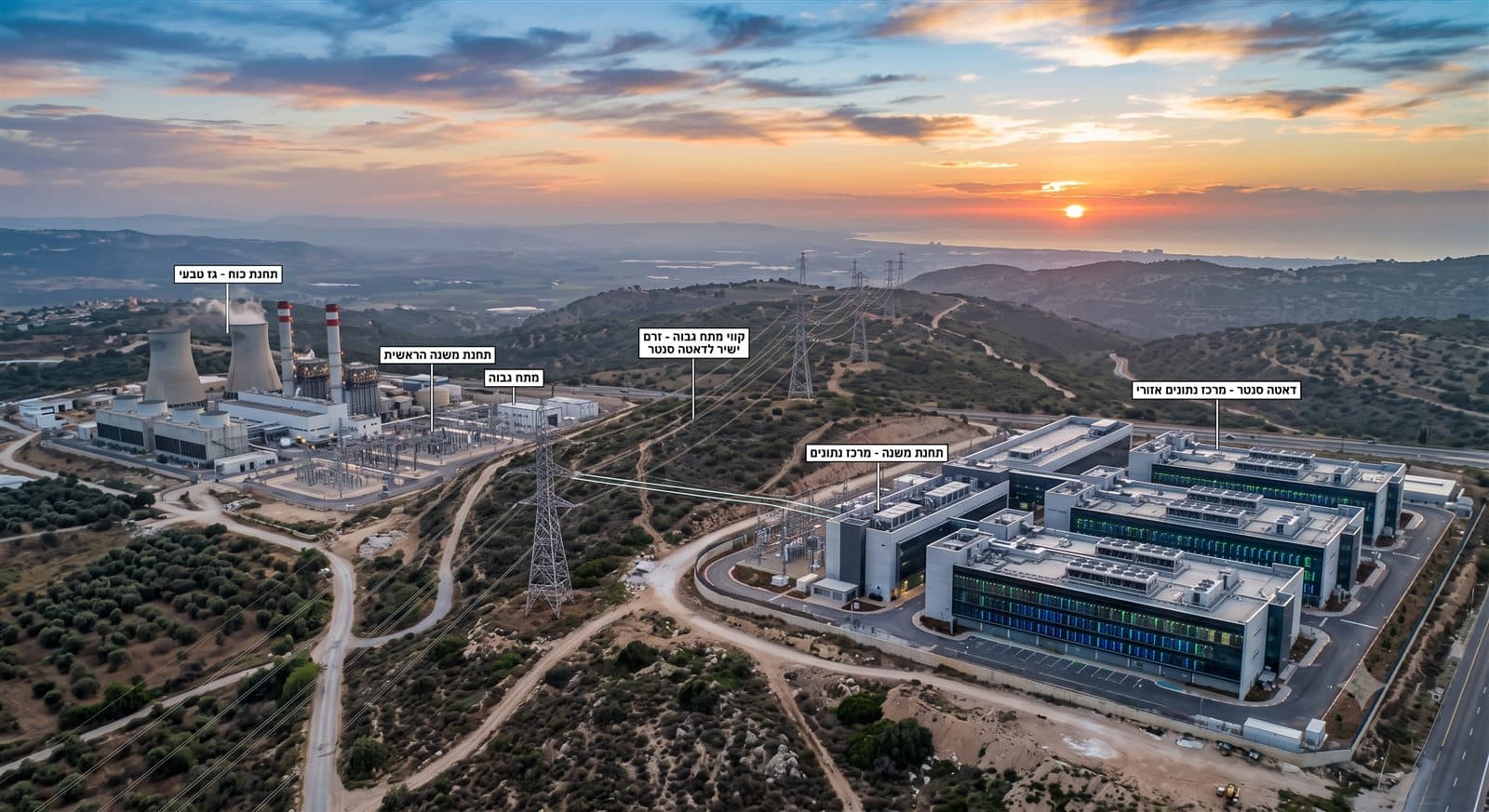
This week the Electricity Authority announced a temporary halt - 140 days - on processing new requests to connect data centers to the grid, after the volume of requests climbed to about 27,000 megawatts, three times the average consumption of the entire economy. We published the full analysis of the decision in a separate piece. But the further you get from the local headline, the more a more important point becomes clear: Israel did not invent the problem - it just reached it early relative to its size. That exact same bottleneck is currently choking the largest energy market in the world, and from it derives one of the more interesting investment theses of the coming years.
The American Reflection: A 2,600-Gigawatt Queue
The numbers in the U.S. are two orders of magnitude larger than the Israeli ones, and the dynamic is remarkably identical. In early 2026, projects for generation and storage with a cumulative volume of about 2,600 gigawatts were waiting in the U.S. grid connection queues - roughly double the installed generation capacity of the entire U.S. The median wait time from filing a request to commercial operation is approaching five years, and in congested areas much longer: in Northern Virginia, the densest data-center concentration in the world, the queue at the local utility stretches to about seven years, and there are projects delayed as much as 12 years.
The result is already felt in prices. In PJM's latest capacity auction - the largest grid operator in the U.S., serving 13 states - a record price of $333 per megawatt-day was set, and the supply procured remained about 6.6 gigawatts short of the reliability requirements for 2027-2028. The reason is clear: about 94% of expected demand growth in this grid through 2030 comes from data centers. Demand is adding 5-7 gigawatts a year; new supply provides only 2-3. Gartner estimates that by 2027, about 40% of AI data centers will run into power-supply constraints. And behind it all hides another, entirely physical bottleneck: large transformers and gas turbines are ordered today with queues of years. The electrical equipment is less than a tenth of the cost of building a data center - but when it is missing, it is a hundred percent of the delay.
This is exactly the pattern we saw in Israel, in miniature: demand that behaves like a technology industry, against supply that behaves like a national project. And when such a gap opens, it does not close in a quarter - it defines the flow of capital for years.
Who Profits? The Roadmap of the Scarcity
When a grid connection becomes the rarest asset in the industry, five groups of potential winners form - each with a different profit mechanism.
1. Those Who Already Hold a Connection: The Bitcoin Miners Who Became the AI's Electrical Real Estate
The ironic story of the cycle: the companies that quietly built enormous power infrastructure for bitcoin mining find themselves sitting on the asset everyone wants - power connected and live, today, with no queue. The cloud giants, who need immediate capacity for their GPUs, simply rent it.
IREN (NASDAQ: IREN) is the standout example. The company, which started as an Australian bitcoin miner, signed in late 2025 a giant contract with Microsoft: supplying AI cloud services on NVIDIA GB300 accelerators worth about $9.7 billion over five years, including a prepayment of about 20%. The deployment is at a 750-megawatt campus in Texas, and the company bought equipment from Dell for about $5.8 billion. The figure that explains its power: more than 4.5 gigawatts of secured grid-connected power, including a new 1.6-gigawatt campus in Oklahoma. In a market where a connection takes seven years, this is the equivalent of owning land in the heart of Manhattan.
And if proof was needed that demand is only expanding - it came just yesterday (7/20): IREN announced the signing of new contracts worth a total of $2.8 billion, including a new customer - a leading AI developer whose name was not disclosed (likely a private company) - and raised its year-end 2026 annualized AI-cloud revenue run-rate target from $3.7 to over $4 billion - about 85% of it already signed. The customer list is no longer a one-customer story: alongside Microsoft and NVIDIA it also includes Perplexity, Figure AI, Together AI and others. And the build pace illustrates the strength of demand: from 3 megawatts of cloud capacity just a year ago, to 480 megawatts being built this year - and a target of 1.2 gigawatts in 2027. The stock responded with a jump of about 20%. This is exactly the point: when supply is locked in the queue, whoever is already connected sets the pace.
Cipher (NASDAQ: CIFR) built the same story with no less impressive signings: a $5.5 billion, 15-year contract with Amazon Web Services to supply 300 megawatts, and AI-hosting deals with Fluidstack backed by Google - which even received stock options and posted guarantees of about $1.7 billion for the commitments. Total contracts: about $8.5 billion, with a site pipeline of 3.2 gigawatts. Note the structure: the tech giants not only rent - they are willing to guarantee and invest equity just to secure access to electricity.
2. Those Who Bypass the Grid Entirely: On-Site Generation
If you cannot connect to the grid - you generate the electricity inside the fence. This is the thesis of Bloom Energy (NYSE: BE), a maker of solid-oxide fuel cells (SOFC) that became one of the big surprises of the year. Its systems are installed on the data-center site itself, run on natural gas, and skip the connection queue entirely. The figure that sold the story to the market: Oracle ordered a first system and received it installed within 55 days - versus years of waiting for the grid - and per reports expanded the agreement to a potential of up to 2.8 gigawatts. Alongside it: a contract of about $2.65 billion with utility AEP, and an investment framework with Brookfield that was reportedly expanded to up to $25 billion for global deployments. When the grid is the bottleneck, whoever sells "electricity without a grid" sells time - and time is currently the most expensive product in the AI industry.
3. The Power Generators: When the Cloud Signs Nuclear for Twenty Years
At the other end of the value chain sit the owners of the power stations themselves - and chief among them the owners of the nuclear reactors, the only asset that provides continuous, carbon-free power available 24/7 at enormous scale. The cloud giants internalized this, and the result is deals at a scale not seen in the industry for decades. Constellation Energy (NASDAQ: CEG), operator of the largest reactor fleet in the U.S., signed with Microsoft a 20-year power purchase agreement under which the shut-down reactor at Three Mile Island (under the name Crane Clean Energy Center) will be brought back into operation - 835 megawatts dedicated entirely to Microsoft's AI, with a return to operation expected as early as 2027, earlier than planned, and backed by a one-billion-dollar federal loan. Talen Energy (NASDAQ: TLN) signed with Amazon a 17-year agreement to supply 1.92 gigawatts from the Susquehanna nuclear plant in Pennsylvania - and Amazon even bought a data-center campus adjacent to the plant. The mechanism is simple: when a tech giant is willing to lock a price for two decades ahead, the plant owner turns from a seller of a volatile commodity into the holder of a long contract with the strongest customer in the world.
4. The Equipment Suppliers: When the Turbine Queue Reaches 2030
And finally, the layer that benefits from the scarcity in every scenario - the equipment makers. The numbers here speak for themselves: GE Vernova forecasts that by the end of 2026 the order backlog and reservations for its gas turbines will reach at least 110 gigawatts, and the CEO estimated that by year-end no production slot would remain free until 2030. In the first quarter of 2026 alone, data-center customers ordered electrical equipment worth $2.4 billion - more than all of last year. At Germany's Siemens Energy the order backlog jumped to a record of about 154 billion euros, and delivery times across the industry stretch to eight years. Whoever holds a production line for turbines, transformers or switching equipment sits today on the second-rarest resource after the connection itself - and pricing power to match. We covered GE Vernova, Eaton and Vertiv extensively in the data-centers piece.
5. The Israeli Angle: Who Will Build the Local Solution
In Israel, the connection halt will eventually end in a new policy - but in every scenario, the economy will need enormous investment in generation, transmission and distribution. The government has already declared data centers a national infrastructure with an expedited planning track for large facilities, and those who will do the work in practice are the infrastructure and electrical contractors. Afcon Holdings (TASE: AFHL) is a clear example: a veteran electro-mechanical contractor specializing in exactly the layers the scarcity exposes - electrical and high-voltage systems, substations, control, communications and industrial cooling - and it is involved in building data-center projects in Israel. Alongside it operate the players we covered in the full analysis - from the private power generators to the global equipment suppliers.
What Could Ruin the Thesis
For the analysis to be fair, we must also present the other side - and first of all the failure point at the heart of the story. A data center without a connection is an empty building. This is a point easy to miss in the excitement: a company can hold land, permits and even finished buildings - but if the authority or the system operator cannot connect them to electricity, it has no product. No matter how many data centers it has on paper. This is exactly what the Electricity Authority's decision illustrated in Israel: the freeze does not hurt those already connected - it turns a future project pipeline, which the market may already have priced, into a question mark. So the critical distinction in this group is not "how many megawatts are planned" but how many megawatts are connected or backed by a connection commitment - and everything else is an option, not an asset.
And from here to the rest of the risks. First, valuation: some of the stocks in this group have already jumped tens and hundreds of percent, and the market prices in years of growth ahead - any delay in execution will hurt. Second, customer concentration: when most of the revenue depends on one or two contracts with a cloud giant, the bargaining power is not symmetric, and what is signed can also be revised. Third, leverage and execution: building gigawatts of infrastructure requires enormous capital, and these companies raise it at a dizzying pace. And fourth, the systemic risk that accompanied us all week: if AI investment slows, the demand that justifies all this building will moderate - and today's rare asset could turn into tomorrow's excess capacity. The scarcity is real, but it is not an insurance certificate for any single stock.
The Bottom Line
The Israeli Electricity Authority's decision and the American 2,600-gigawatt queue are the same story in two languages: the AI era turned electricity from a transparent given into a scarce strategic asset. In such a world, the competitive advantage moves down the value chain - from the algorithm to the socket. Whoever holds a connection, whoever generates on-site, whoever owns the reactor, whoever makes the turbine and whoever builds the infrastructure - all sit today on the right side of the gap between demand and supply. The investor's job, as usual, is to separate the correct thesis from the correctly priced stock - and to remember that a connection in hand is worth more than ten buildings on paper.
Sources: the Electricity Authority's decision (gov.il), official company filings (SEC and announcements from IREN, Cipher, Bloom Energy, Constellation, Talen and GE Vernova), and international energy coverage (including PJM data, Utility Dive and Power Engineering), current as of the time of writing. The charts are shown in real time via TradingView.


