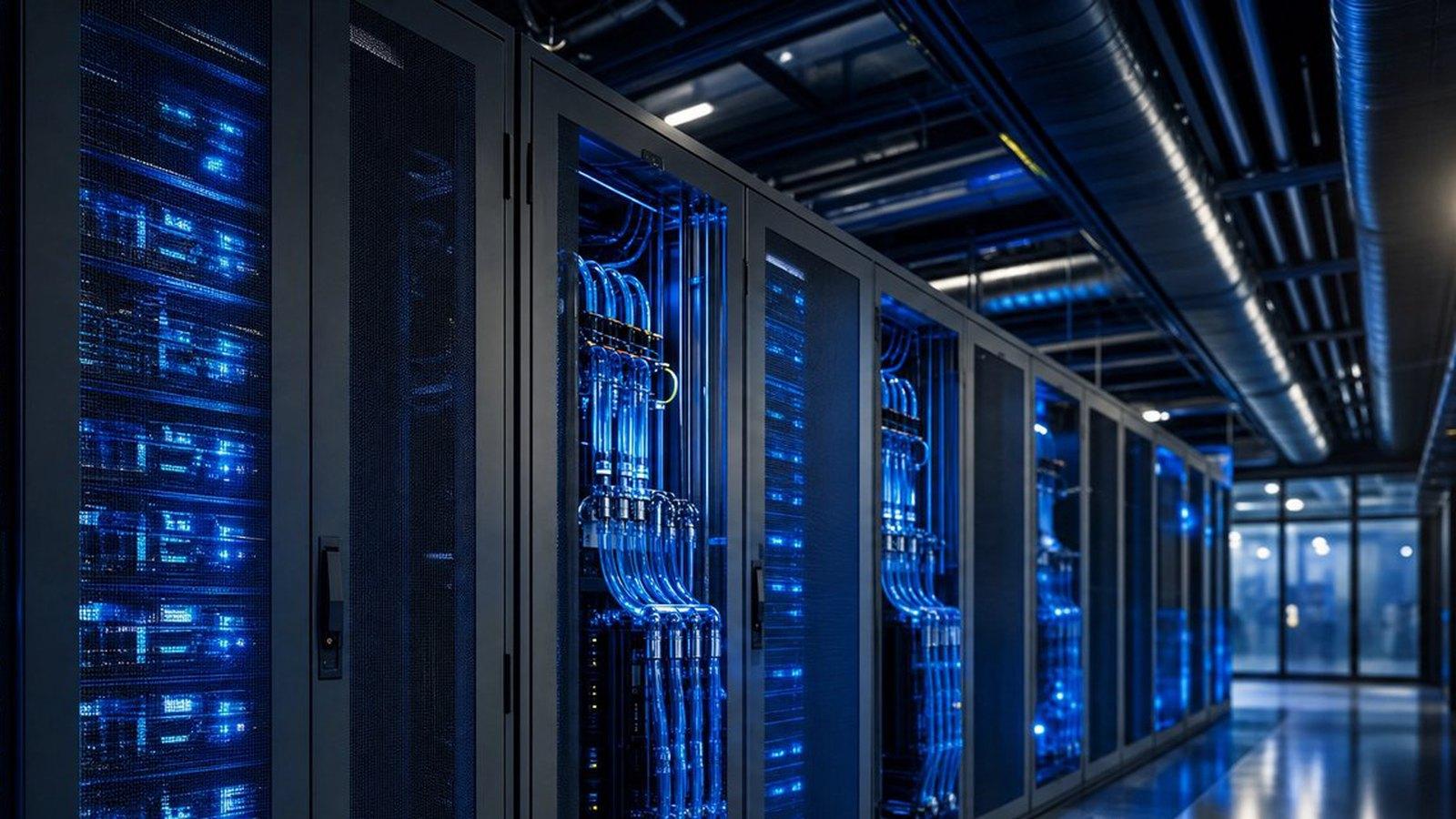
Every watt that enters a server leaves it as heat. So every data center has two physical jobs that are not computing: bring power in and take heat out. According to Lawrence Berkeley National Laboratory, US data centers used about 4.4% of the country's electricity in 2023, and the estimate for 2028 is 6.7% to 12%. Vertiv, one of the makers of this equipment, ended 2025 with a $15 billion backlog - more than double the end of 2024.
Errors or inaccuracies are possible. Spotted something that looks wrong? Write to me and I will correct it.
What happens inside the building
Power arrives from the grid at high voltage and passes several stations on its way to the chip:
- A substation and transformers, which step the voltage down.
- Switchgear and uninterruptible power supplies (UPS), which protect against outages and keep power flowing until the generator starts.
- Busbars and power distribution within the rack rows, which bring power all the way to the server.
Heat leaves the opposite way: fans and air handlers in the room, and heat exchangers, chillers and cooling towers outside. AI servers add a new layer: liquid cooling, where coolant reaches the chip through pipes, via coolant distribution units (CDUs) in the row.
Vertiv describes the shift in its annual report. According to the company, AI workloads have created a mix of air and liquid cooling, and that mix complicates the entire thermal chain, from the chiller to the coolant distribution unit.
How the money flows
There are three kinds of buyer, and who pays depends on who owns the building:
- The cloud giants - Amazon, Microsoft, Alphabet and Meta - build their own centers and buy equipment directly or through contractors.
- Colocation companies, such as Equinix and Digital Realty, build and lease space, power and cooling to tenants.
- AI-focused cloud providers and enterprises that build their own sites.
All the money starts in the same place: the cloud giants' capital budgets.
| Property and equipment purchases | 2025 (annual report) | Latest 2026 outlook |
|---|---|---|
| Amazon | $131.8 billion | about $220 billion |
| Alphabet | $91.4 billion | $195-205 billion |
| Meta | $69.7 billion | $135-145 billion, including finance-lease principal payments |
| Microsoft | $115.9 billion (fiscal year ended June 2026) | about $170 billion for calendar 2026 |
Definitions differ between the companies, so the total serves as an order of magnitude, not an exact comparison. Only part of it goes to power and cooling equipment. Most goes to servers and chips, and some to land and buildings.
Where the bottleneck is
It is no longer only inside the building. Berkeley Lab estimates US data centers will use roughly 325 to 580 TWh in 2028 - 74 to 132 gigawatts at 50% average utilization. For comparison, in 2018 consumption was about 76 TWh, 1.9% of US use.
Three constraints follow:
- The grid connection. A site needs available megawatts, and that is a separate link with its own timelines: generation, transmission lines and transformers. It is covered in the energy chain.
- Equipment production pace. Vertiv's backlog grew from $7.2 billion at the end of 2024 to $15.0 billion at the end of 2025. A backlog growing faster than sales means customers are ordering far ahead.
- The move to liquid. Liquid cooling requires a different design for the rack, the piping and the service. A site designed for air only needs adapting.
What pushes it forward
- Orders, not only forecasts. In Q3 2026 Vertiv reported sales of $4.31 billion, up 61%, and organic orders up more than 100%. Its full-year sales outlook is $14.65 billion at the midpoint, against $10.23 billion in 2025.
- Rising density. Each generation of AI servers puts more power into each rack, so each rack needs more power and cooling equipment.
- The cloud giants' 2026 outlooks are well above their 2025 spending, and Alphabet said on its earnings call that it expects a significant increase in 2027 as well.
What could stop it
- Dependence on one large source: cloud investment. This equipment is bought only when something is built. Budget cuts would arrive here directly.
- The grid. If the grid connection is delayed, the equipment inside the building waits too.
- A wide forecast range. The gap between 325 and 580 TWh in the Berkeley estimate shows how uncertain the pace is. The researchers themselves give a range, not a number.
- Geographic concentration. 62% of Vertiv's 2025 sales were in the Americas, against 56% in 2024. Exposure to one market has risen.
The optimistic reading does not explain what happens to the backlog if construction slows. The cautious reading does not explain why Vertiv's organic orders more than doubled in Q3 2026.
Company map for this link
Factual mentions only. This is not a closed list and not a recommendation.
| Sub-link | Companies | Role |
|---|---|---|
| Power and cooling for the server room | Vertiv, Schneider Electric | UPS, power distribution, air and liquid cooling |
| Electrical equipment | Eaton, Schneider Electric and others | Switchgear, transformers and distribution |
| Colocation operators | Equinix, Digital Realty | Build and lease space, power and cooling |
| The large buyers | Amazon, Microsoft, Alphabet, Meta | Fund construction from capital budgets |
Further reading
- AI capex of the cloud giants: where the money flows in the chain - the master article of the compute and AI chain.
- The three chokepoints of AI infrastructure: power, cooling and light - background on the three physical limits.
Sources
Lawrence Berkeley National Laboratory: 2024 United States Data Center Energy Usage Report (December 2024). Vertiv: 2025 annual report (10-K), Q4 2025 and Q3 2026 results releases. Amazon, Alphabet, Meta: 2025 annual reports and Q3 2026 results releases; Alphabet and Microsoft: October 2026 earnings calls. Microsoft: fiscal 2026 annual report.
Ilan Abramov, the author, or anyone on his behalf may hold securities mentioned in this article, and holdings change from time to time.


