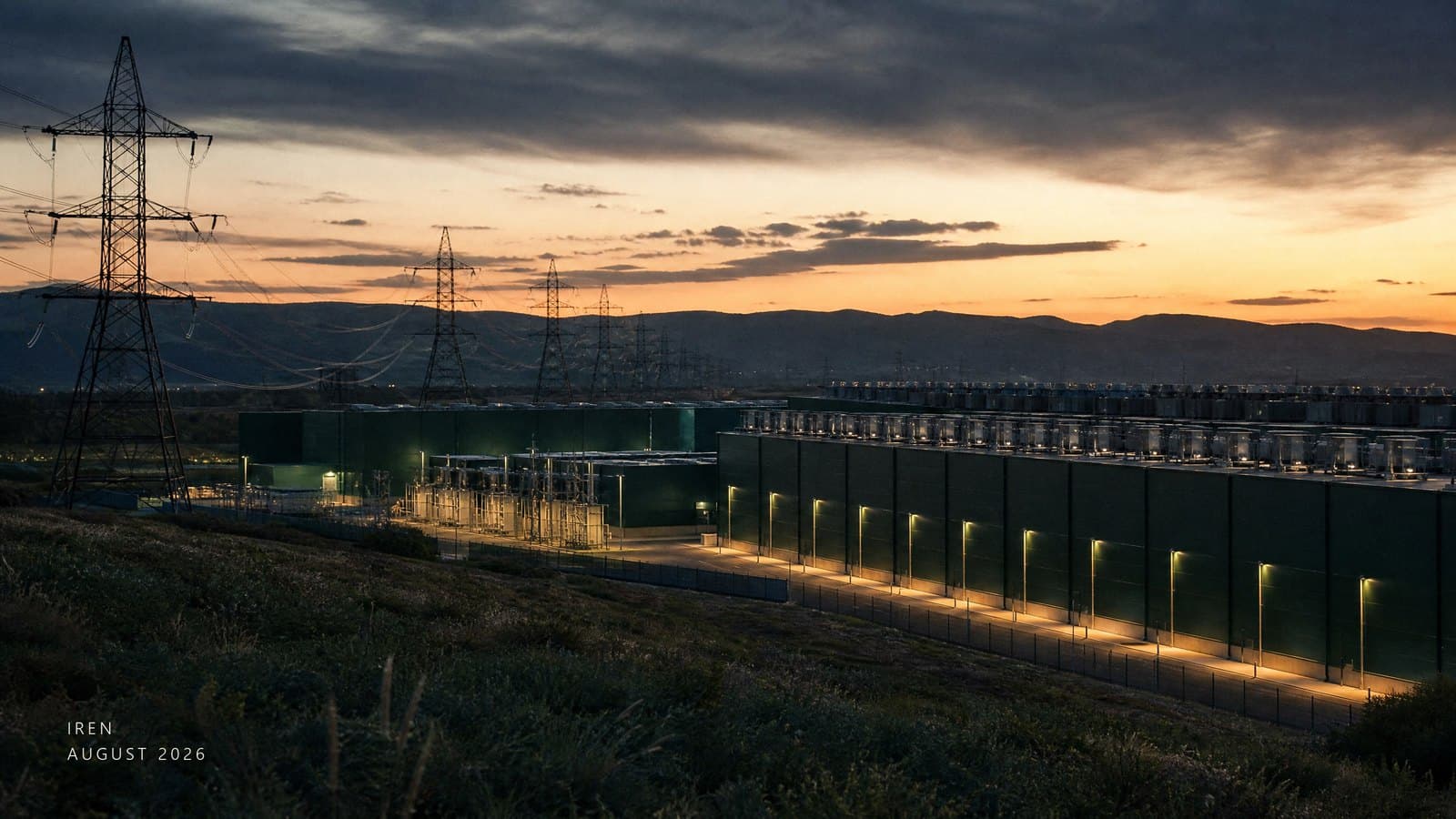
IREN published its results for fiscal 2026, which ended on 30 June. Revenue came to $707 million, and the net loss to $703 million.
But two other numbers in the report tell the story, and neither is on the bottom line.
Errors or inaccuracies are possible. Spotted something that looks wrong? Write to me and I will correct it.
What This Company Does, and Why That Changed
IREN was founded as a Bitcoin miner. It built enormous computing sites where electricity is cheap, filled them with purpose-built machines, and converted electricity into coins.
Today it builds AI data centres and rents out compute.
And that transition makes more sense than it sounds, for one reason: the real asset of a Bitcoin miner was never the machines.
The asset is the land, the grid connection, and the permits. Building a site with hundreds of megawatts of approved capacity takes years, and that is precisely what everyone wanting to build an AI data centre lacks today.
I wrote about this at length in the piece on the Israeli grid - where the conclusion was that electricity, not the chip, is the bottleneck. IREN is the other side of that equation: a company already sitting on the electricity.
And what does change completely is the revenue model. Mining is volatile income against a commodity price, with no customer. AI cloud is a long contract against an identified customer - and that is a different business, with a different risk.
The Year, and the Quarter
| $ millions | FY2026 | FY2025 | Change |
|---|---|---|---|
| AI Cloud revenue | 128.8 | 16.4 | 7.9 times |
| Bitcoin mining revenue | 578.2 | 484.6 | +19.3% |
| Total revenue | 707.0 | 501.0 | +41.1% |
| Net income (loss) | -702.6 | 86.9 | |
| Adjusted EBITDA | 245.7 | 269.7 | -8.9% |
And at the quarterly level, the picture is far sharper.
| $ millions | Q4 | Q3 |
|---|---|---|
| AI Cloud | 70.5 | 33.6 |
| Bitcoin mining | 66.7 | 111.2 |
| Total revenue | 137.2 | 144.8 |
| Net loss | -684.0 | -247.8 |
| Adjusted EBITDA | 19.2 | 59.5 |
The First Figure: The Crossover
In the fourth quarter, for the first time, AI Cloud revenue was larger than Bitcoin mining revenue.
$70.5 million against $66.7 million - that is, AI is already 51.4% of revenue.
And one quarter earlier the ratio was 33.6 against 111.2. In three months, AI Cloud more than doubled and mining fell 40%.
This is the crossover the whole thesis rests on, and it happened.
But in the same quarter, the company's total revenue fell - from $144.8 to $137.2 million.
That is, mining fell faster than AI grew.
And this is the chapter easy to miss in a transition story: between the old business closing and the new one opening there is an interim period in which both are smaller than the sum that came before. Quarterly adjusted EBITDA fell from $59.5 to $19.2 million - a drop of 68%.
And management explains that with employee costs and platform investment "ahead of" the revenue ramp - that is, expenses pulled forward of the income. That is a reasonable explanation. It also means next quarter has to prove it.
And the annual net loss - $702.6 million - is mostly non-cash: of it, $638.8 million are impairments, mainly decommissioning mining hardware at sites being converted to AI. That is money already spent in the past and written off today - and it is the real cost of the transition, written in a single line.
The Second Figure, and the More Important One: 6.0% Against 9.0%
IREN reported two separate GPU financings this year, at two different interest rates:
| Size | Rate | Why | |
|---|---|---|---|
| Financing for the Microsoft contract | $3.6 billion | 6.0% | Investment grade |
| Financing for other customers | $2.4 billion | 9.0% | Non-investment grade |
The second is a tranche within a wider $2.8 billion package raised for non-investment-grade customer deployments, and this tranche - $2.4 billion - is led by Blue Owl and PIMCO, at a fixed rate, for the Mackenzie expansion.
And that gap - 300 basis points - is the most important thing in the entire report.
Because exactly the same chips, at exactly the same company, in exactly the same credit market, are financed at two prices. The only difference is who the customer sitting at the other end of the contract is.
In other words the market is not pricing the GPU. It is pricing the customer.
And in numbers: 300 basis points on $2.4 billion is about $72 million a year - an additional cost arising not from the asset but from the identity of the tenant.
And why does that matter beyond IREN itself?
Because it is the most direct measurement I have seen of the question I keep returning to since the US debt piece and the three vectors piece: who actually bears the risk of building AI infrastructure.
The answer this report gives is that the market has already separated the two. Whoever rents to an investment-grade hyperscaler gets infrastructure terms. Whoever rents to a young AI lab gets risk terms - and the difference falls on them, not on the customer.
And the Scale Raised, Which Is Hard to Grasp
| In fiscal 2026 | |
|---|---|
| Ordinary share issuance | $4,742.8 million |
| Convertible note issuance | $6,299.6 million |
| Total direct raise | about $11.0 billion |
| Of which paid on induced note conversion | -$1,623.5 million |
| Financing facility | $938.0 million |
| Net cash from financing activities | $9,680.1 million |
| Invested in investing activities | -$4,723.0 million |
A company with $707 million of annual revenue raised about $11 billion - 15.6 times its annual turnover.
And that shows up in the balance sheet:
| $ millions | 30.6.2026 | 30.6.2025 |
|---|---|---|
| Cash | 5,895.6 | 564.5 |
| Restricted cash | 1,670.3 | - |
| Total assets | 15,790.0 | 2,940.3 |
| Total liabilities | 11,604.4 | 1,122.8 |
| Shareholders' equity | 4,185.6 | 1,817.5 |
Total assets grew 5.4 times. Total liabilities grew 10.3 times.
Leverage stands at 3.77 to one, and liabilities make up 73.5% of the balance sheet - against 38.2% a year earlier.
What the Company Promises Going Forward
| Contracted ARR for 2026 capacity | $4 billion |
| ARR operating today | $1 billion |
| 2026 capacity | Per the company, largely sold out |
| Latest contract pricing | Over $20 million of revenue per megawatt on three-year contracts |
| Active discussions | Around $25 million per megawatt |
| Customer prepayments | 45%-55% of GPU capital expenditure |
| Site pipeline | Over 5 gigawatts |
| Cumulative delivery target | 0.3 gigawatts in 2026, 0.8 in 2027 |
And note the gap between the first two lines: $4 billion contracted against $1 billion operating.
That is not a contradiction - the contracts were signed on capacity not yet delivered. But it does mean the large number depends on execution: on construction, on electricity, on installation, and on meeting schedules. Contracted ARR is a promise. Operating ARR is revenue.
And what is impressive is that the first delivery has already happened: Horizon 1 was delivered to Microsoft - the first of four 50-megawatt liquid-cooled facilities at the Childress site. And that moves the risk from "can they build" to "at what pace".
What I Will Check Next Quarter
| Total revenue | Whether it returns to growth, after the fourth-quarter fall |
| Adjusted EBITDA | $19.2m in the quarter - whether the pulled-forward costs begin to pay back |
| Operating versus contracted ARR | $1 billion against $4 - the conversion rate is the number |
| The rate on the next financing | 6% or 9% - that reveals who the customer is |
| Price per megawatt | $20 million today, discussions at $25 |
| The rate of decline in mining | It is still almost half of revenue |
| Leverage | 3.77 to one, and rising |
הזווית שלי
דעה אישית של אילן אברמוב - לא ייעוץ ולא המלצה
IREN is one of the most interesting companies I have read this month, and also one of the riskiest - and both come from the same place.
What is interesting is that it solves the right problem. In a world where electricity is the constraint, whoever already holds grid-connected sites holds an asset that cannot be bought with money in the short term - only with time.
What is risky is how it is financed. $11 billion raised in one year against revenue of $707 million. Equity grew 2.3 times; liabilities grew 10.3 times. This is a company that built itself on an open capital market, and an open capital market is the first thing that closes when something goes wrong.
And what I try to hold onto reading a report like this is not the growth but the matching of durations. A data centre is a 15-to-20-year asset. A rental contract is three years. Financing runs for a third period. And every gap between those three durations is the real risk - not the Bitcoin price and not the pace of GPU demand.
And what this report gave me beyond IREN itself is the gap between 6.0% and 9.0%. This is the first time I have seen the credit market explicitly price the difference between "Microsoft is paying" and "an AI lab is paying" - and not in an analyst's remark, but in two signed contracts at the same company in the same year.
Anyone wanting to know whether the AI bubble is inflating or stabilising does not need to track multiples. They need to track that gap. If it widens, the market is pricing rising risk in the end customers. If it closes, it is accepting them as ordinary customers.
(It is important to stress: this is my personal opinion only, and nothing herein constitutes a recommendation to take any action.)


