Live update: the article updates throughout the day as the companies publish their results.
This is the daily format of earnings season: on every trading day we concentrate here the significant reports - what was published, and what the numbers really say. This week is the heaviest of the season, and we covered its full road map - including Wednesday's rate decision and the four giants reporting within 48 hours - in the weekly review.
Baker Hughes: Orders Jumped 49%, and the Energy Division Doubled
The morning's central report came from Baker Hughes (NASDAQ: BKR), the energy services and technology giant. The headline lines were mixed: revenue fell 2% to $6.7 billion, and GAAP EPS fell 3% to $0.68. But adjusted EPS rose 2% to $0.64, and adjusted EBITDA reached $1.231 billion - above the high end of the company's guidance.
And the figure that decides: the orders. Total orders in the quarter came to $10.5 billion, a jump of 49%, and the total backlog (RPO) reached $40.1 billion - growth of $4 billion in a single quarter. Free cash flow jumped to $1.109 billion, versus just $239 million a year ago.
The internal split is the real story:
| Segment | Orders | Revenue | EBITDA |
|---|---|---|---|
| Oilfield services (OFSE) | $3.41B (-3%) | $3.45B (-5%) | $605M (-11%) |
| Energy technology (IET) | $7.09B (+101%) | $3.29B (flat) | $678M (+16%) |
The energy-technology division - the one that manufactures gas turbines, compression equipment and energy infrastructure - doubled its orders, and its backlog reached a record $37.1 billion. The company raised the segment's annual order guidance, and expanded its 2026-2028 horizon outlook to more than $45 billion.
The CEO left no room for interpretation about the source of the demand: "another strong quarter, reflecting the breadth of the portfolio and continued momentum in data center markets, gas infrastructure and upstream."
The meaning: this is a second confirmation, from an independent company, of the thesis we have been tracking all summer. Last week we saw GE Vernova jump its gas-turbine backlog from 100 to 116 gigawatts, and NextEra add 3.6 gigawatts to its backlog. Now a company perceived as an "oil company" reports that orders on its energy-infrastructure side have doubled, and attributes it explicitly to data centers.
And no less important - the internal split. That same company shows the traditional oil side contracting (operating profit -11%) while the energy-infrastructure side surges. This is exactly the split we saw Friday at Schlumberger, where the international business was hurt while North America jumped. The world is not leaving energy - it is moving money within it, from the drill to the grid.
AstraZeneca: Beat Expectations and Raised the Dividend
The British-Swedish pharma giant AstraZeneca (NYSE: AZN) published its half-year results: revenue of $30.7 billion for the half, up 6% in constant currency, with core operating profit and core EPS both rising 11%.
In the quarter itself: revenue of $15.4 billion (+6%), and core EPS of $2.63 - a jump of 21%, above the analyst estimate of about $2.48. The company raised its dividend, reported 30 regulatory approvals, and reaffirmed both its annual guidance and its revenue target of $80 billion by 2030.
Beneath the numbers: growth came from oncology and rare diseases, which offset weakness in the drug Farxiga and headwinds in the Chinese market.
The meaning: a solid report from a sector that is not part of our central theses, but one that provides an indication of global pharma's health - and the bottom-line beat alongside a dividend increase is a combination that signals management confidence.
Who Else Reported This Morning
Noble Corp (NE) - Revenue Above Estimate, but Earnings Missed
The offshore drilling company reported revenue of $719.7 million - above the estimate of about $694.7 million, but down 15.2% year-over-year. Adjusted EPS was just one cent, versus an estimate of $0.18, and adjusted EBITDA stood at $212.3 million (a 29.5% margin), slightly below estimate.
The central reason for the gap: a hit of about $43 million from the operational suspension of both of the company's rigs in Brazil. Per the company, the rest of the operation was strong.
The meaning: the report completes the picture of the drilling and production side - the same side we saw contracting at Baker Hughes and at Schlumberger. Here too, revenue is falling year-over-year.
Coca-Cola FEMSA (KOF) - The Emerging-Market Consumer Holds Up
Note the distinction: this is not the American beverage giant The Coca-Cola Company (KO), which reported on Tuesday. This is Coca-Cola FEMSA - the independent bottling and distribution company that produces and distributes Coca-Cola products in Latin America, and trades separately. It reported volume up 3.5% and revenue of Ps. 76,318 million, up 4.7% (6.6% on a currency-neutral basis). Operating income rose 9.1%, and net income attributable to shareholders jumped 16.9%.
Profitability improved on both lines: the gross margin expanded 180 basis points to 47.1%, and the operating margin 60 basis points to 14.0%. Geographically, the company posted record volumes in Brazil, Colombia and Guatemala, while Mexico continued to contend with an excise-tax increase and softer consumer demand.
The meaning: a good barometer for the emerging-market consumer - rising volumes alongside expanding margins indicate the company is managing to raise prices without losing customers.
The Regional Banks - Credit Remains Calm
Bank of Hawaii (BOH) reported diluted EPS of $1.47, above the estimate ($1.46), and up 38.7% versus $1.06 in the comparable quarter a year ago. Net income totaled $63.8 million, up 11.1% from the prior quarter, and return on equity rose to 15.47% versus 13.90% in the prior quarter.
Alongside it, Bank of Hope, HBT and Bank of Marin also reported. These continue the series of reports from which we learned last week that provisions for credit losses remain low.
Tonight: Five Links in the Same Chain
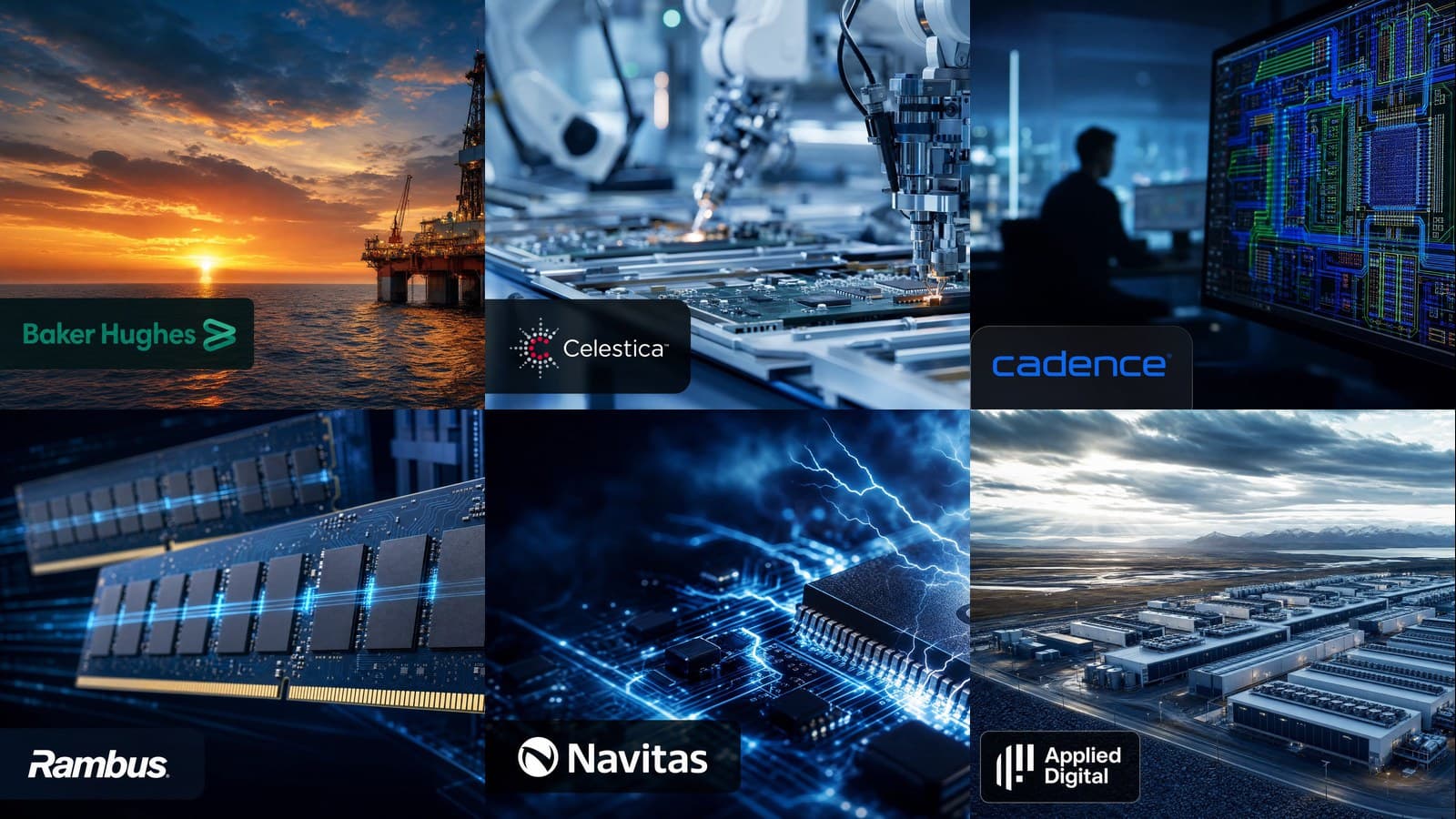
After the close comes the heavy part of the day, and the five main reporters together cover the entire AI infrastructure chain - from the software that designs the chip to the physical building it sits in.
Cadence (CDNS) - the design. One of the two companies that dominate the chip-design software market; every advanced chip in the world is designed with its tools or with Synopsys's. The estimate: revenue of about $1.58 billion (+23.6%) and adjusted EPS of about $2.05 (+24.2%). Management's own guidance points to a non-GAAP operating margin of 44.5%-45.5% - among the highest in the entire industry. The company beat consensus in each of the last four quarters. The conference call is at 5:00 PM New York time.
Rambus (RMBS) - the memory. It makes memory-interface chips and licenses intellectual property, led by its HBM4E controller - the component that feeds data to AI accelerators. Management guidance: revenue of $192-198 million and adjusted EPS of $0.65-0.73. This is the other side of the memory-shortage story we saw in IBM's report.
Navitas (NVTS) - the power. Gallium-nitride and silicon-carbide power chips, which enable more efficient power conversion. In the first quarter the company launched a 20-kilowatt GaN platform converting 800 volts to 6 volts for AI data centers.
The flag to remember about Navitas
Here there is a sharp gap between the narrative and the numbers, and both deserve to be presented. The story is AI and data centers; the estimate points to revenue of only about $10 million, down about 31% year-over-year, and a loss of about 4 cents per share. This is a small, early-stage company that the market prices on future potential rather than current performance. The figures worth checking in the report: the pace of design wins in data centers, the cash burn rate and the cash balance.
Celestica (CLS) - the assembly. The Canadian contract manufacturer that assembles servers, network switches and cooling solutions for the large cloud providers. The estimate: revenue of about $4.35 billion and EPS of about $2.29. This report is especially interesting in its timing: it is an early thermometer for the hyperscalers' order pace, two days before Microsoft and Meta report themselves.
Applied Digital (APLD) - the building. It builds and operates AI data centers. It reports on its fiscal fourth quarter, which ended at the end of May, with an estimate of about $82 million in revenue - growth of over 115% - alongside a loss. Per the coverage, the company carries a high valuation and rising debt, meaning the same "building phase" pattern we identified at Alphabet and Tesla.
Reporting alongside them tonight are also Nucor (steel - the old-economy thesis continues), Amkor (chip packaging, another link in the chain) and F5 (network infrastructure).
The Morning's Bottom Line
The morning delivered two solid reports from two entirely different worlds, and the most significant confirmation: orders on Baker Hughes's energy-infrastructure side doubled, and the CEO attributed it to data centers. After GE Vernova and NextEra, this is the third company within a week to report unprecedented demand for equipment that generates and moves electricity.
Tonight will test the other side of that equation - not who generates the electricity, but who consumes it and who builds what sits at the end. The five companies reporting after the close together cover the chain end to end, and in a week when Microsoft, Meta, Apple and Amazon report themselves - they are the early indication.
Sources: Baker Hughes's official results announcement for the second quarter of 2026 (July 26, 2026) including revenue, profit, orders, backlog, segment breakdown, guidance and the CEO quote; AstraZeneca's half-year 2026 results announcement and its coverage; management guidance from Cadence, Rambus, Navitas and Applied Digital from their official announcements, and analyst consensus as covered by Zacks, Yahoo Finance and TradingView. Data accurate as of the time of writing and updated during the day. The charts are shown in real time via TradingView. Nothing herein constitutes a forecast, recommendation or advice - see the full disclaimer at the bottom of the page.


