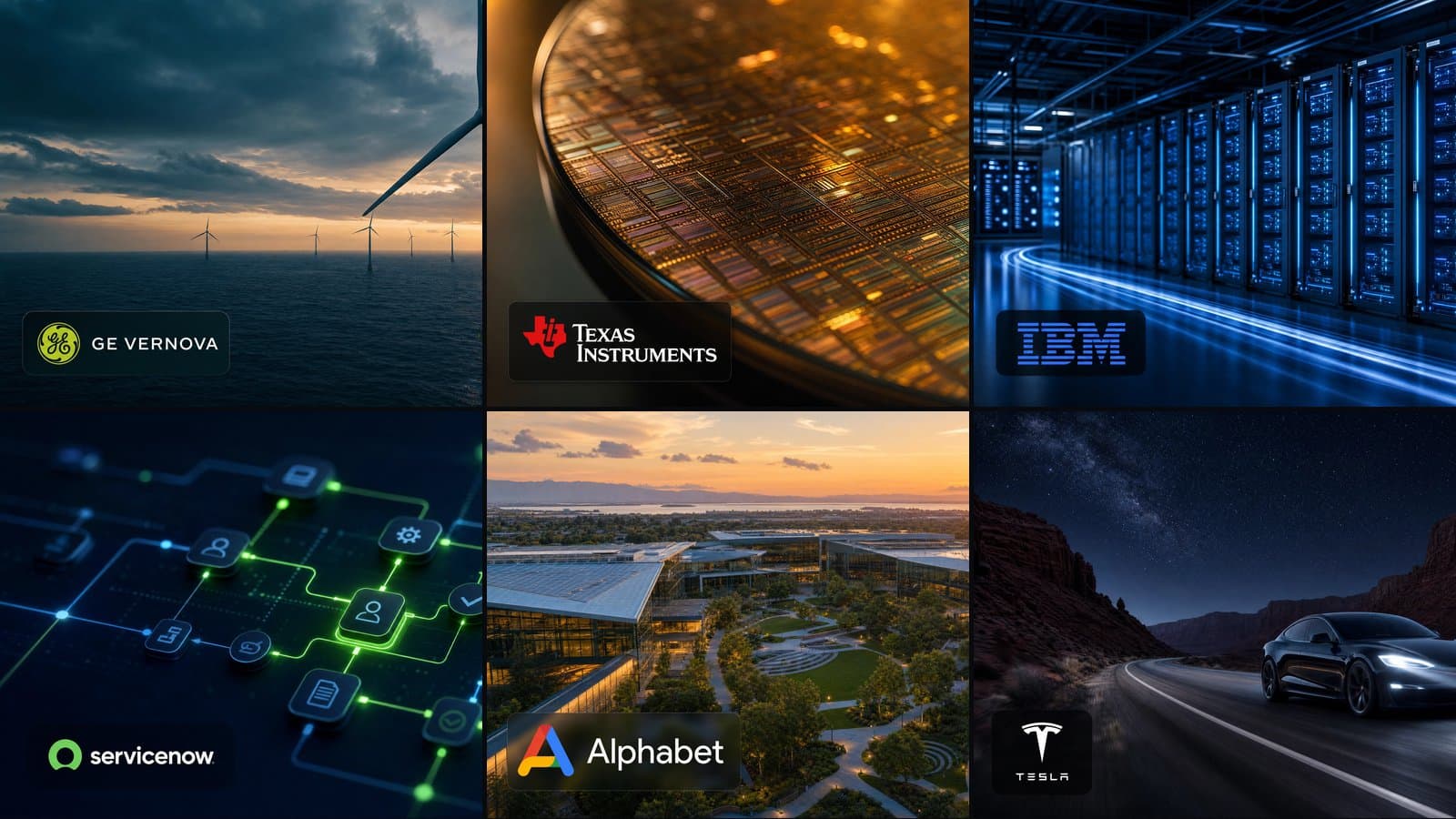
This is the daily format of earnings season: on every trading day we concentrate here the significant reports - the morning reports, followed by the evening reporters - what was published, and what the numbers really say. Today was the heaviest of the season: eight reporters, three before the open and five after the close.
What Was Already Published This Morning
AT&T: Fiber Accelerates, and Buybacks Are Doubled
The communications giant from Dallas, the classic value-and-dividend stock, opened the day with an earnings beat: adjusted EPS of $0.65 versus $0.54 in the comparable quarter, on revenue of $31.6 billion (up 2.3%). Its critical figure - the one that services the heavy debt and the dividend - is free cash flow, and it rose to $4.7 billion from $4.4 billion a year ago.
But the real story is operational: the company added 432 thousand net postpaid phone subscribers, 367 thousand fiber subscribers and 279 thousand in fixed wireless - more than a million additions in a single quarter, with low churn of 0.86%. The fiber infrastructure reached 38.6 million households, on the way to a target of over 40 million by year-end. CEO John Stankey announced an acceleration of buybacks to about $10 billion this year, and reaffirmed the multi-year guidance.
The meaning: after years in which AT&T was seen as a company trying to climb out of the debts of failed media deals, this is a picture of a company back to growing in its core. When a CEO increases buybacks mid-year, he signals that he sees cash-flow certainty - another brick in the week's "strong old economy" thesis.
GE Vernova: Our Thesis, Written in Balance-Sheet Language
And here is the report that touched us most. In the power scarcity piece we wrote that by the end of the year no free manufacturing slot for gas turbines would remain until 2030. This morning that number tightened: the backlog of gas turbines and slot reservations jumped from 100 to 116 gigawatts in a single quarter, and the target was raised to at least 125 by the end of 2026.
The rest of the figures in the same spirit: orders of $24.2 billion, an organic jump of 88%, a total backlog of $176 billion, and revenue of $11.1 billion (up 22%). Data-center orders in the electrification division passed $5 billion since the start of the year - more than double all of 2025 combined. Free cash flow reached $5.1 billion in a single quarter, more than all of 2025, and management nearly doubled the annual cash-flow forecast to $11.5-12.5 billion.
And in fairness, two things the headlines missed: the wind division lost $275 million in the quarter - more than double a year ago - and the impressive half-year profit of $5.4 billion includes a one-time accounting gain of about $4 billion from the acquisition of the transformer company Prolec. The real quarterly profit: $649 million.
The meaning: the bottleneck we described is not closing - it is tightening. And when both volume and price rise at the same time, that is the signature of a supplier in a shortage market.
Philip Morris: A Historic Revenue Record - with an Accounting Asterisk
The tobacco giant in its smoke-free transformation crossed a symbolic threshold for the first time: revenue of over $11 billion in a quarter, up 10.4%. Adjusted profit rose 15.2% to $2.20 per share. But whoever looks at the reported line will see a 7.7% decline to $1.80 - and the entire gap stems from a non-cash write-down of the investment in the Canadian subsidiary RBH. Again the same lesson of the week: check what entered the bottom line before getting excited about it.
Inside the numbers: the smoke-free business is already about 42% of revenue, IQOS volumes rose 7.6%, and ZYN products sold 2.9 billion pouches (up 1.8%) - relatively flat growth in the U.S., which management intends to attack with the launch of ZYN ULTRA and a new flavor line. In June the FDA granted reduced-risk-product marketing authorization to 20 ZYN variants - the first of its kind for nicotine pouches.
The meaning: the global consumer still absorbs price increases, and the shift to high-margin products keeps working - even if the American market is struggling.
The Morning's Bottom Line
Three companies from entirely different worlds - communications, energy equipment and tobacco - and all telling the same story: the real economy is functioning well. AT&T adds subscribers and increases buybacks, GE Vernova sells equipment two-three years ahead, and Philip Morris raises prices without losing volume. Two days after we wrote here about the "strong old economy," the thesis only strengthens.
And this backdrop matters especially today, because this evening comes the moment the whole week has been preparing for. A market that enters the heavy reports with a stable real economy absorbs surprises better.
The Reports Published After the Market Close

Five companies reported within less than an hour, and each of them gets a full breakdown from us in a separate piece. Here is the essence:
Alphabet: The Cloud Jumped 82% - and Free Cash Flow Turned Negative
The big report of the week delivered both sides at once. Revenue rose 24% to $119.8 billion, and the star was Google Cloud, which accelerated to 82% growth ($24.8 billion) - a sharp jump from a pace of about 63% in the prior quarter. More importantly, the cloud's operating profit more than tripled to $8.8 billion, meaning margins of about 36% versus about 21% a year ago. The fear of AI eroding search also did not materialize: search actually accelerated to 17%.
But two figures change the picture. EPS ostensibly jumped 294% to $9.11 - and of that, $6.26 came from an unrealized gain on securities, not from operations. And second: capital expenditures doubled to $44.9 billion in the quarter, against operating cash flow of $39.1 billion - meaning negative free cash flow of about $5.9 billion. In the background: an equity raise of $49.6 billion in June, $20.3 billion in bonds, and zero buybacks versus $13.2 billion a year ago. The meaning: the demand is real and the cloud's profitability proven - but Alphabet entered a phase where it invests more than it generates. The full breakdown.
Texas Instruments: Free Cash Flow Jumped 271%
Revenue of $5.46 billion (up 23%) and EPS of $2.14 (up 52%) - both above market estimates. Operating profit jumped 48%, and gross margins crossed 61%. The guidance for next quarter, $5.65-6.15 billion, is also above the estimate.
The dramatic figure: **free cash flow over the last 12 months jumped to $6.53 billion versus $1.76 billion
- a rise of 271%** - after quarterly capital expenditure plunged to just $514 million. This is the result of a six-year factory-building cycle reaching its end. It is worth noting that the company's cash-flow definition includes CHIPS Act incentives ($549 million in the quarter), and that buybacks were cut 61%. The meaning: growth was led by industrial, automotive and data centers - an independent indication of the real economy outside the accelerator world. The full breakdown.
IBM: Operating EPS Rose 5% - and the Annual Guidance Was Cut
The second act after the preliminary announcement. Revenue stood at $17.2 billion (1% growth), and EPS split into two pictures: at the GAAP level it fell 2% to $2.27, and in operating terms it rose 5% to $2.93.
The breakdown reveals the gap: in software ($7.8 billion, +5%) Red Hat grew 11% and the data segment 19%, while transaction processing fell 8%; consulting ($5.3 billion) stood in place; and in infrastructure ($3.8 billion, -7%) IBM Z sales plunged 42% - while distributed infrastructure jumped 37%, with a Power-and-storage order backlog approaching $500 million. The new and significant figure: the annual guidance was cut to growth of 4%-5% in constant currency, versus over 5% previously. The free-cash-flow forecast, by contrast, remained in place. The meaning: the new engines are working, the legacy is retreating faster than expected - and the pace of transition between them is the story. The full breakdown.
ServiceNow: AI Crossed a Billion Dollars in Contracts
The company beat the top end of guidance on every metric: subscription revenue of $3.88 billion, growth of 24.5%, a non-GAAP operating margin of 29%, and a total obligations backlog of $29 billion. And the figure that matters beyond the company itself: AI revenue crossed a billion dollars in annual contract value - one of the few concrete monetization metrics that exist in the market, and AI-agent deployments grew ninefold in nine months.
On the other hand, the forward pace is more moderate: the guidance for next quarter implies growth of 20.5% in subscription revenue and 19.5% in cRPO, versus the 24.5% and 21% reported this quarter. The annual guidance raise was modest - about a quarter of a percent. The meaning: on the demand side, enterprise AI generates measurable revenue; on the pace side, the slowdown is consistent. The full breakdown.
Tesla: Record Revenue - and Operating Profit Plunged 57%
The last report of the evening delivered the sharpest contrast. Record revenue of $28.2 billion (up 26%), 480,126 deliveries - a second-quarter record - and trailing-twelve-month revenue crossed $100 billion for the first time. Energy storage returned to growth with 13.5 gigawatt-hours (up 41%), services jumped 50% with record profitability, and active FSD subscriptions reached 1.48 million, up 56%.
And on the other hand: operating profit plunged 57% to just $398 million, and the operating margin fell to 1.4% versus 4.1% a year ago. Operating expenses grew 47%, and capital expenditures jumped 142% to $5.79 billion - so free cash flow turned negative, minus $1.09 billion. The money went to building: Cybercab production began in Texas, Optimus entered Fremont after the dismantling of the Model S and X lines, and Megafactory Texas is nearing completion. The meaning: exactly like Alphabet this evening - strong growth, doubled investment, and free cash flow that flipped. The full breakdown.
The Evening's Bottom Line
Five reporters, and one recurring pattern: this is not the harvesting phase - this is the building phase. Alphabet and Tesla, the two big companies of the evening, both showed strong revenue growth alongside doubled capital expenditures and free cash flow that turned negative in the same quarter. Texas Instruments shows the other side of the same coin - an investment cycle that ended and cash that was freed. ServiceNow proves that enterprise AI already generates measurable revenue, but at a slowing pace. And IBM reminds that not everyone is on the right side of the capital flow.
Whoever looked this evening for a verdict between the sentiment and the data - got something more complex: the data confirmed the demand is real, and in the same breath revealed how much it costs.
Sources: the companies' official SEC filings (8-K forms filed July 22, 2026) and the results announcements of AT&T, GE Vernova and Philip Morris - accurate as of the time of writing. The charts are shown in real time via TradingView. Nothing herein constitutes a forecast, recommendation or advice.


