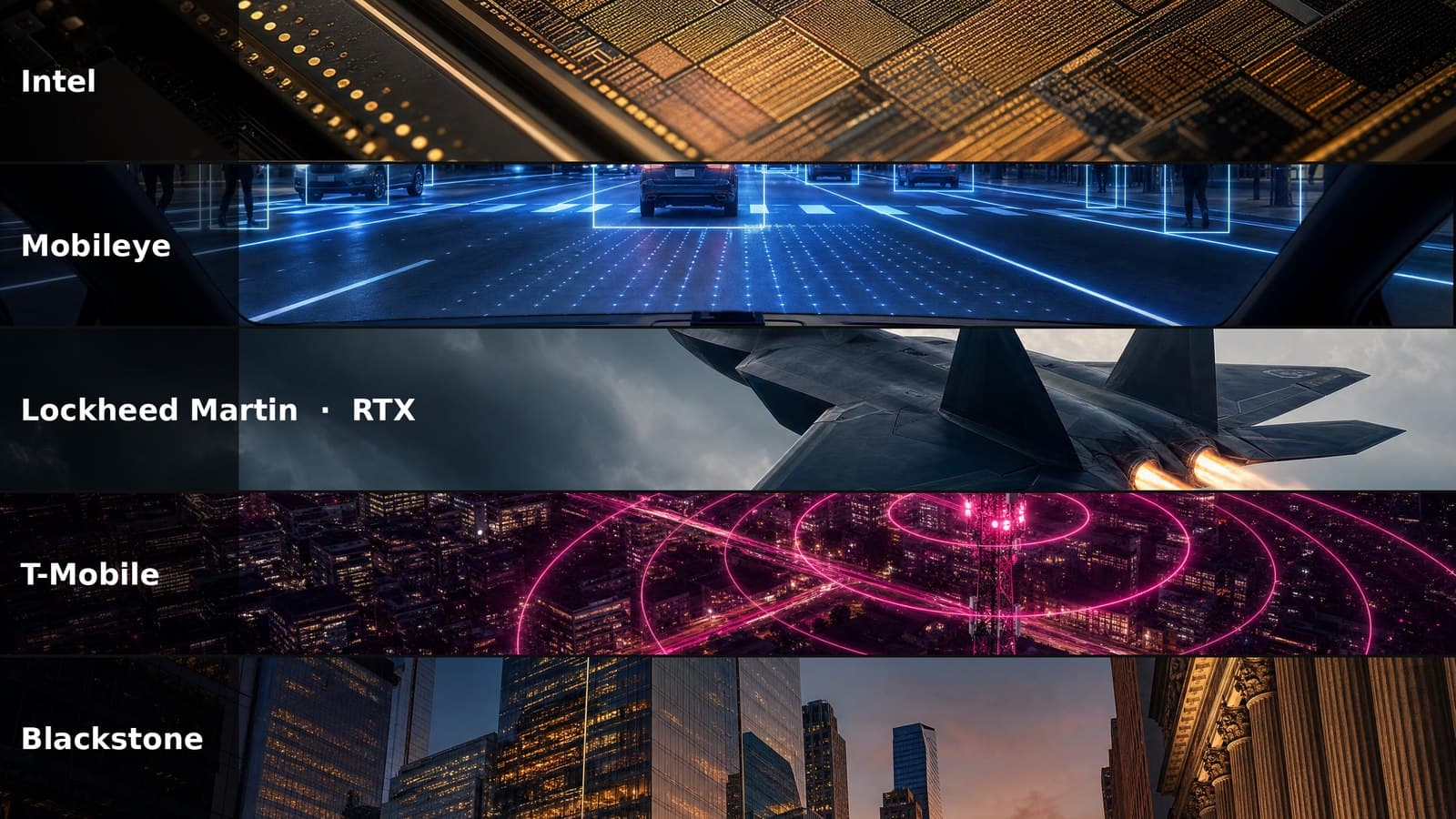
Live update: the article updates throughout the day as the companies publish their results.
This is the daily format of earnings season: on every trading day we concentrate here the significant reports - what was published, and what the numbers really say. The Tel Aviv exchange is closed today (the Tisha B'Av fast), so the local investor is disconnected from the trends in real time.
The Reports Already Published
Nokia: Sacrificing the Short Term to Seize the AI's Optical Infrastructure
Finland's Nokia (NYSE: NOK) posted a quarter with two faces - and that is exactly what makes it interesting. On one hand, the reported result was an operating loss of 50 million euros (a negative margin of 1.0%), and free cash flow was negative. On the other hand, comparable revenue rose 9% in constant currency to 4.82 billion euros, comparable operating profit jumped 18% to 434 million euros, and the comparable operating margin rose to 9.0%.
The gap between the two is the whole story: the reported loss is not weakness - it is the result of an aggressive acceleration in the business. Nokia is pouring capital into a repositioning, and that is recorded today as an expense, but builds tomorrow. And the figure that explains why: sales to AI and cloud customers more than doubled (a jump of 105%), and the network-infrastructure division grew 12%, led by optical networks and IP.
CEO Justin Hotard phrased the thesis in one sentence: "demand remains strong, while supply continues to be the industry's central constraint - which leads our customers to order for the longer term." In other words: Nokia is moving from the identity of a veteran mobile-equipment maker to a new positioning - the optical-infrastructure supplier to the technology giants building AI data centers.
And here is the part I find most impressive - building an entire ecosystem of optical components, not just selling an existing product: the company signed to acquire NXP's manufacturing campus in Chandler, Arizona, which will be converted to indium-phosphide (InP) semiconductor manufacturing - the technology at the heart of high-speed optical components; it acquired full ownership of its China operation and is consolidating it into the global operating model; and it announced a tenfold expansion of testing and packaging capacity in Pennsylvania. This is not a company selling fiber - this is a company building the production chain of the optical infrastructure.
The meaning: this is exactly the pattern we have been tracking in recent weeks, from power scarcity to Texas Instruments: the AI wave does not enrich only the accelerator makers, but the entire physical-infrastructure chain - and this time, whoever lays the fiber and builds the components that connect the data centers. Nokia maintained its annual comparable operating-profit guidance (2.1-2.6 billion euros). The reported figures look weak; whoever reads in depth sees a company choosing to sacrifice profit today to seize a position in the next decade.
Mobileye: Shashua Retires After 27 Years
The big news of the day: the founder and CEO, Prof. Amnon Shashua, announces he will step down from managing Mobileye (NASDAQ: MBLY) after 27 years, with a successor to be appointed. The board is opening a search for a new CEO, Shashua will remain a director and has been offered the role of board chairman - and the announcement stresses the decision does not stem from a dispute. In parallel, the report: revenue of $508 million (stable), an operating loss that narrowed 59%, adjusted EPS of $0.19 (above estimate), and guidance that was raised - mainly thanks to a new Israeli R&D grant. The meaning: Shashua leaves exactly at the moment the company is betting on robotaxis and robotics - the bet he himself led. The full breakdown.
Lockheed Martin: A Record Backlog of $230 Billion and a Guidance Raise
The big defense name opened strong: sales of $20.1 billion (up 11%) and EPS of $7.94 - above the estimate (about 7.22-7.28). Free cash flow jumped to $2.9 billion (versus minus $150 million a year ago, a quarter loaded with program losses). The headline: a record order backlog of $230 billion, including a multi-year contract of $35 billion for THAAD interceptor production, and $65 billion of new orders in the quarter. The company raised guidance: sales growth of about 8%, a 28% jump in segment operating profit, and free cash flow of over $7 billion. The meaning: strong confirmation of the defense super-cycle thesis - RTX reports later, and we will complete the sector reading.
RTX: A Backlog of $289 Billion, and Two Engines - Defense and Civil Aviation
The second defense giant completed the picture: sales of $24.7 billion (up 14%), adjusted EPS of $1.89 (up 21%, above estimate), and free cash flow of $2.9 billion. The backlog reached $289 billion (up 22%), and RTX too raised guidance. Unlike the pure-play Lockheed, RTX combines defense with civil aviation - and the Collins division posted a 26% jump in commercial original equipment, meaning commercial aviation is recovering too. The meaning: both defense names beat and raised guidance on the same morning - perfect sector confirmation of the defense super-cycle. The full sector reading.
T-Mobile: EPS Beats the Estimate, but Account Adds Moderate
Against yesterday's AT&T, T-Mobile (NASDAQ: TMUS) posted adjusted EPS of $2.99
- above the estimate (2.61) - and service revenue of $19.0 billion (up 9%), postpaid service revenue +13%. Core adjusted EBITDA rose 12% to $9.5 billion, and adjusted free cash flow to $4.8 billion. But the qualifying point: net postpaid account adds fell 13% to 277 thousand, and churn rose slightly to 0.99%. The comparison with AT&T is interesting: both are operationally strong, but while AT&T pushed additions through fiber, T-Mobile shows a slowdown in the add pace - even as ARPA and profitability keep rising. The full breakdown.
Blackstone: Record AUM, and a Declared Bet on AI
The alternative-assets giant closed the morning with record assets under management of $1,346 billion (about $1.35 trillion), inflows of $68.3 billion in the quarter, and distributable earnings of $2.0 billion. But the figure that matters most to us is the quote from CEO Stephen Schwarzman: "our decision to lean into the AI mega-trend is driving exceptional investment performance", and that the company has become a "trusted partner at scale" to the AI innovators. The meaning: Blackstone is the engine that finances the physical infrastructure of the AI era - and dry powder of $228 billion says the capital is available and flowing. This is the link that closes the puzzle: electricity demand, chips, fiber - and the capital behind them all. The full breakdown.
Intel: Revenue +25% and a Return to Operating Profit - but an $11 Billion Bottom-Line Loss
The heavy report of the day, after the close. Intel (NASDAQ: INTC) posted revenue of $16.1 billion, a jump of 25% ("the strongest growth in 15 years"), driven by the data-center and AI segment which jumped 59%. The company returned to an operating profit of $1.8 billion after an operating loss a year ago, and cash from operations was $7.0 billion. But the scary headline: a net loss of $11 billion. The secret is in the asterisk - almost the entire loss ($12.5 billion) is a non-cash accounting charge on "shares in trust" Intel owes the U.S. government, created precisely because the stock rose. On an adjusted basis: a profit of $0.42 per share. The meaning: a report that illustrates why one reads beyond the headline - and we have an additional angle: Intel is Mobileye's controlling shareholder. The full breakdown.
Sources: the companies' official filings and results announcements, accurate as of the time of writing. The charts are shown in real time via TradingView. Nothing herein constitutes a forecast, recommendation or advice - see the full disclaimer at the bottom of the page.


