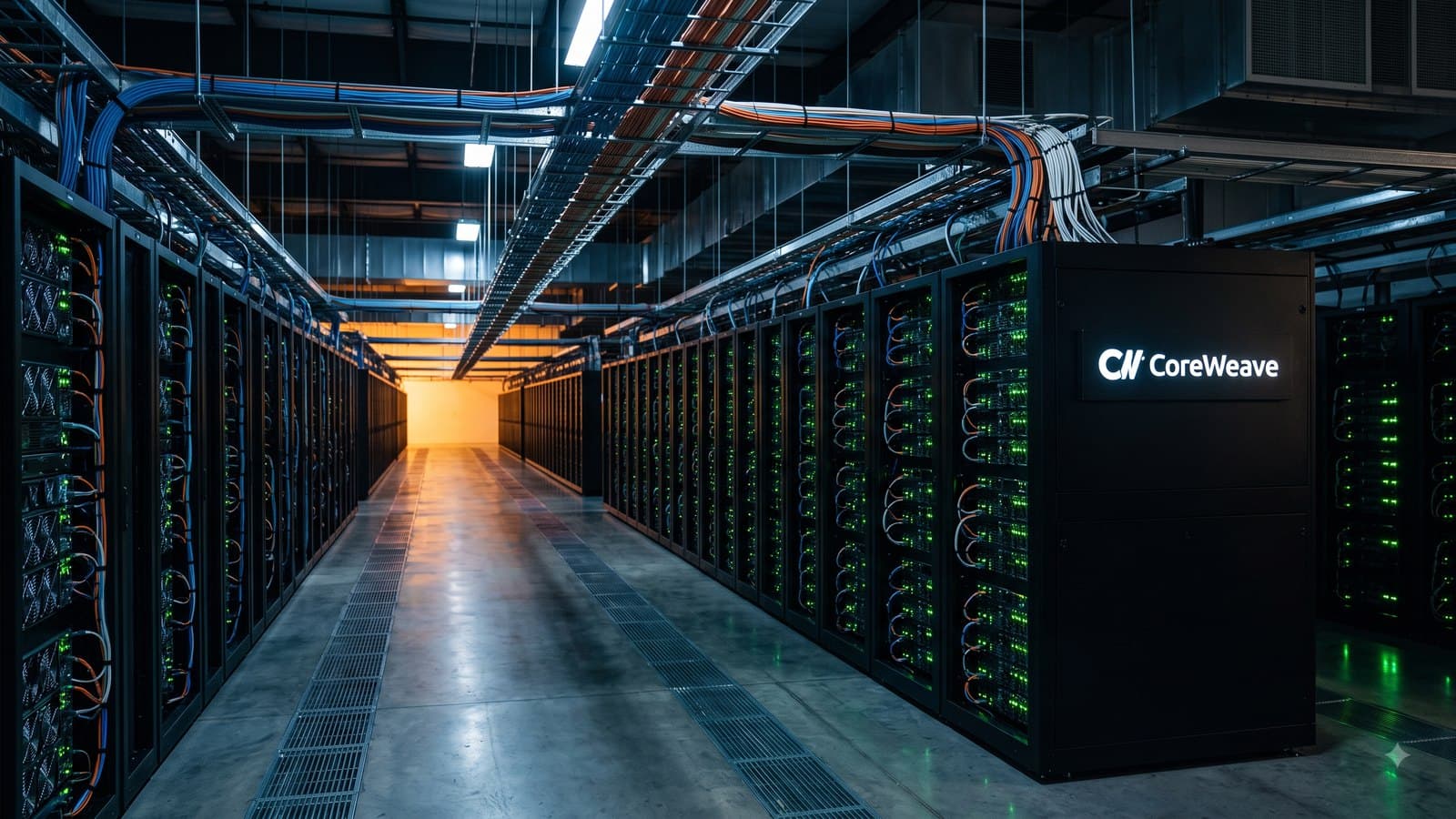
CoreWeave reported its second quarter on 11 August 2026, after the market closed. We are writing about it now.
Errors or inaccuracies are possible. Spotted something that looks wrong? Write to me and I will correct it.
Why This Report in Particular
Yesterday NVIDIA announced a mechanism to mobilise more than $500 billion, designed to let its customers finance compute without loading their own balance sheets.
CoreWeave is the archetypal customer for that mechanism. It is a dedicated GPU cloud: it buys processors, builds data centres around them, and rents the capacity to AI labs and enterprises.
Which makes this report the first opportunity to see what the numbers look like for a company built entirely on that debt. And that makes it the most important report of the week for the AI infrastructure thesis.
The Quarter
| $ millions | The quarter | A year ago |
|---|---|---|
| Revenue | 2,575 | 1,212 |
| Operating expenses | 2,624 | 1,193 |
| Operating income (loss) | loss of 49 | income of 19 |
| Operating margin | minus 2% | 2% |
| Interest expense, net | 640 | 267 |
| Net loss | 626 | 290 |
| Net loss margin | minus 24% | minus 24% |
| Loss per share, basic and diluted | $1.14 | $0.60 |
And on an adjusted basis:
| $ millions | The quarter | A year ago |
|---|---|---|
| Adjusted EBITDA | 1,510 | 753 |
| Adjusted EBITDA margin | 59% | 62% |
| Adjusted operating income | 128 | 200 |
| Adjusted operating margin | 5% | 16% |
| Adjusted net loss | 567 | 130 |
The Number That Explains the Whole Report
Revenue of $2,575 million. Net interest expense of $640 million.
So roughly a quarter of every dollar of revenue goes to interest - before touching depreciation, electricity or salaries.
Which is why the report looks the way it does: adjusted EBITDA is $1,510 million, an impressive 59% margin. And the net loss is $626 million.
The gap between them - roughly $2.1 billion - is depreciation and interest. That is, the cost of the infrastructure itself.
And why that happens: an AI data centre is an asset bought up front for billions and paid for over years. The company earns well on ongoing operations, and loses on financing the metal that the operations run on.
The Asterisk I Found in the Release
CEO Michael Intrator opens the release by saying the company reached an inflection point, and that its scale "began to translate into expanding operating leverage".
In the adjusted figures, that line is not supported:
Adjusted operating income fell from $200 million to $128 million, and the margin collapsed from 16% to 5% - while revenue more than doubled.
Adjusted EBITDA margin also fell, from 62% to 59%.
The plausible explanation is depreciation: the gap between EBITDA and operating income is precisely depreciation, and the company added roughly 500 MW of active power in the quarter. New equipment on that scale generates enormous depreciation before it generates full revenue.
So the explanation makes sense, and the claim of expanding operating leverage still runs ahead of the numbers.
The Backlog, and This Part Is Hard to Argue With
Contracted revenue backlog stood at roughly $104 billion as of 30 June 2026.
And the footnote matters just as much: that figure excludes more than $25 billion of net new customer commitments added in early Q3.
For scale: revenue in the quarter was $2.6 billion. The backlog alone is worth roughly 40 quarters at the current run rate - about ten years of work already signed.
And who the customers are: the quarter added Bentley Systems, Caterpillar, Grammarly, Isomorphic Labs and Sunday Robotics; and expanded relationships with Cognition, Databricks, Hudson River Trading, Periodic Labs, Rescale and Runway ML.
And what is interesting in that list is not the AI labs - it is Caterpillar. A heavy industrial customer that is not a technology company suggests demand is spreading beyond the core.
The Power
And this is the metric I regard as most important in a company like this, because it is the real bottleneck:
| Active power | 1.5 GW - up by nearly 500 MW in the quarter |
| Total contracted power | roughly 3.7 GW |
So in a single quarter the company energised capacity on the scale of a mid-sized power station, and it holds contracts on two and a half times that.
And for comparison from this week: Riot signed a 20-year lease for 191 MW worth $9.1 billion. CoreWeave operates 1,500 MW and holds contracts on 3,700.
How It Is Financed, and Here the Circle Closes
In a single quarter CoreWeave raised:
- A $3.1 billion term loan - which the company describes as the first ever publicly syndicated delayed draw facility backed by HPC infrastructure
- More than $10 billion in unsecured debt and convertible bonds, including an inaugural Eurobond issuance
- $1 billion strategic investment from Jane Street
Note the wording on that first loan: "backed by HPC infrastructure".
That is precisely NVIDIA's thesis from yesterday, in practice. Processors as collateral for a syndicated loan, rather than as equipment written off as an expense. CoreWeave is not waiting for the $500 billion mechanism - it is already doing this.
And what the release also shows: it costs $640 million of interest per quarter.
Also in the Quarter
Technology: the company says it completed the industry's first bring-up and validation of the NVIDIA Vera Rubin NVL72 system. And it launched capabilities letting customers run AI workloads across clouds - including CoreWeave Interconnect, private fibre linking directly to other hyperscale platforms, beginning with Google Cloud.
And on performance: new MLPerf records in training and inference on NVIDIA's Grace Blackwell platform, with the lowest cost per token for inference in the test runs.
And on indices: the company was selected for inclusion in the Nasdaq-100.
And guidance: the company said it would provide forward-looking guidance on the conference call, not in the written release. So the release itself contains no numerical outlook.
The Market Reaction
The report was published after the close, so no regular session reflecting it has taken place yet. The market's response will be visible in Wednesday's session.
הזווית שלי
דעה אישית של אילן אברמוב - לא ייעוץ ולא המלצה
This is the report I was most waiting for this week, and it delivered exactly what I hoped for - just not what I expected.
What I hoped to see is what a business built entirely on infrastructure financing looks like from the inside. And I got one number that explains everything: $640 million of interest in a quarter, on revenue of $2,575 million.
A quarter of the revenue goes to lenders.
And that is not a sign of failure - it is a description of the model. CoreWeave earns a 59% adjusted EBITDA margin, which is exceptional on any scale. It simply pays all of it, and then some, on the metal and the debt beneath it.
And what that says about the wider thesis is the genuinely interesting part.
Yesterday I wrote that NVIDIA is trying to turn processors into an asset you can borrow against, and that the only question that matters is the assumption about the collateral. And here, one day later, comes the company that has already done it - with "the first ever publicly syndicated delayed draw facility backed by HPC infrastructure".
So the mechanism works. The question is at what price. And $640 million a quarter, up 140% in a year, is the price.
And what I am flagging is the gap between the statement and the number. The CEO opens with "expanding operating leverage", and adjusted operating income fell from $200 million to $128 million, with the margin going from 16% to 5%. The explanation - depreciation on 500 new megawatts
- is entirely reasonable. But expanding operating leverage should look different in the report, not only in the quote.
And what is hard to argue with is the backlog: $104 billion, plus $25 billion added after the balance sheet date. That is not a sales pipeline - those are contracts. And at the current run rate that is ten years of work.
So the question I am left with is not whether demand exists. It does. The question is whether revenue growth outruns interest growth. This quarter revenue rose 112% and interest rose 140%. Interest is running faster.
And that is exactly what I will read first next quarter: not the backlog, and not the EBITDA. The ratio between those two.


