In four trading days, Bloom Energy's stock changed direction four times. It fell, rose, fell and rose - each time by between 3% and 11% - and ended the window above where it started.
All of that movement turned on a single document: a force majeure notice Oracle sent on September 24.
There may be errors or inaccuracies. Found something that looks wrong? Write to me and I will fix it.
The stock, day by day
| Day | Bloom Energy | Oracle | Nasdaq 100 (ETF) |
|---|---|---|---|
| 9/24 - Oracle's notice | -3.10% | -3.47% | -0.01% |
| 9/25 | +8.27% | -1.75% | +0.46% |
| 9/28 | -8.95% | -3.28% | -1.07% |
| 9/29 | +10.80% | +3.91% | +0.19% |
| Net, 9/23 to 9/29 | +5.8% | -4.7% | -0.4% |
Closing prices from Yahoo Finance trading data. Bloom's closing price on September 29: $291.25.
Two things stand out. First: the broad market barely moved, so the swings belong to the stock itself. Second: on September 28 and 29 Oracle and Bloom moved in the same direction, but on September 25 Bloom jumped while Oracle fell.
Since the window: on September 30 the stock fell 4.9% to $276.98, and on October 1 it closed at $277.64.
And volume doubled: about 8.2 million shares on September 23, against 15.6 to 23.7 million on each of the four days that followed.
What Project Jupiter is
Jupiter is an AI data center campus in Doña Ana County, New Mexico. Oracle is the tenant, and a Blue Owl Capital entity is the developer. Power for the campus is meant to come from a microgrid of Bloom Energy fuel cells, with about 2.4 gigawatts of capacity - not from the grid.
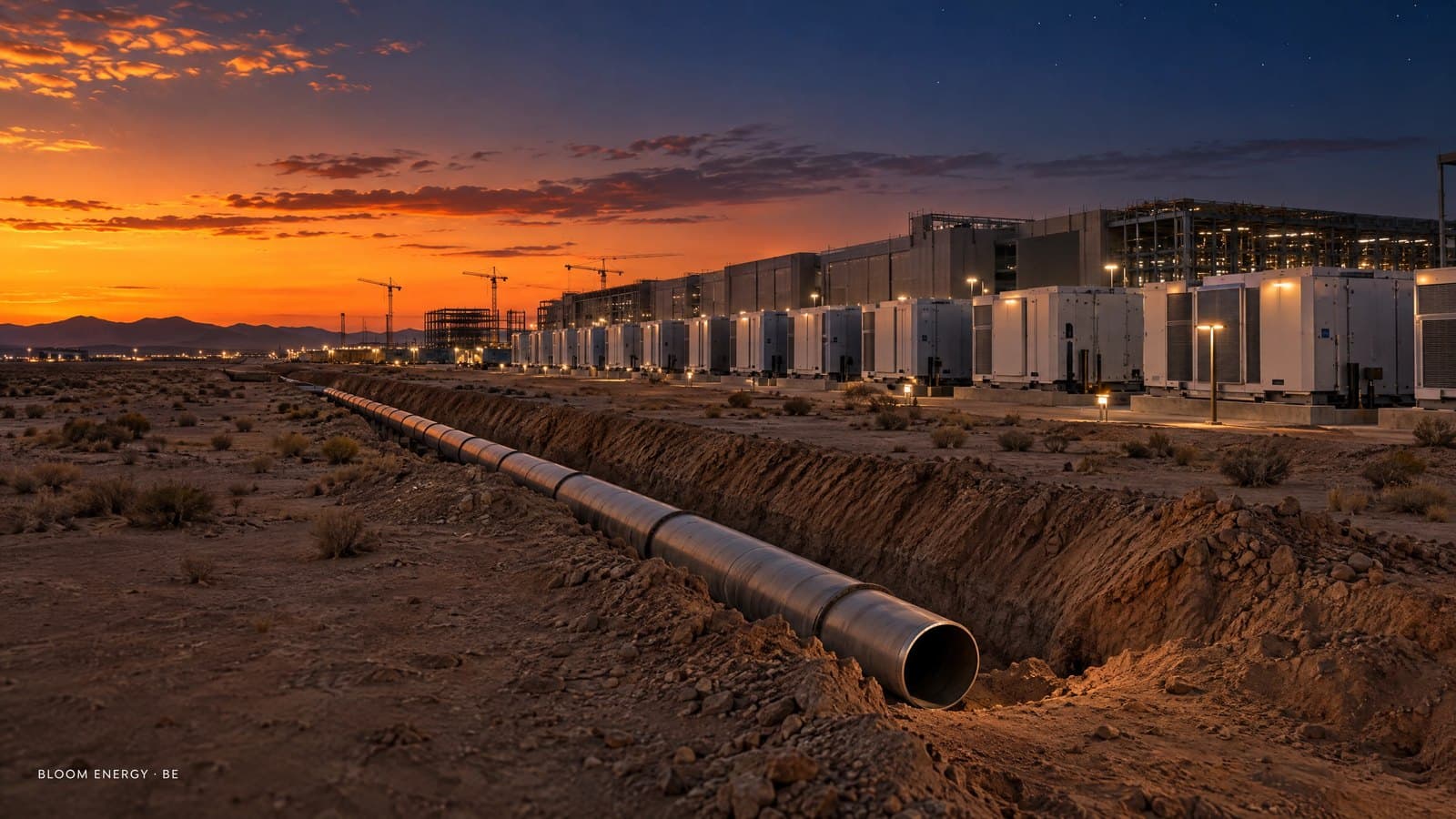
And here is the heart of the story: Bloom's fuel cells run on natural gas. Without a working gas pipeline, they have no fuel.
The pipeline - and the delay that was known in August
The pipeline meant to feed the campus is a segment of about 17.8 miles being built by Transwestern Pipeline, a subsidiary of Energy Transfer. According to filings reported in mid-August, its in-service date has moved to February 2027.
The reason is permits. New Mexico's State Land Office denied the right-of-way applications for the pipeline across state land in March, and on July 14 the land commissioner also denied the request for reconsideration. In parallel, a case ran in the state Supreme Court, which paused the permit proceedings on August 23 and lifted the pause on September 17.
So the pipeline's delay was not news on September 24. What was new is that Oracle responded to it with a contractual step.
What Oracle's notice says, and what it does not
A force majeure notice is a contractual tool: a party tells its counterparty that an event outside its control may prevent it from meeting an obligation, and so preserves the protections the contract gives it. According to reports, Oracle's notice was meant to preserve its right to defer rent payments if the campus does not come online in 2028, as planned.
And Oracle itself stressed what the notice is not. According to the company's statement, Jupiter remains on its planned schedule, and such notices "do not, by themselves, establish a project delay" or change delivery expectations.
Bloom Energy responded the same day, during trading hours, in a post on X: the company wrote that it had spoken with Oracle, that Oracle is committed to the project and to the contract for 2.4 gigawatts of fuel cells, and that it expects to execute the project on Oracle's timeline. The stock closed that day down 3.1%, and jumped 8.3% the next.
Neither company filed a current report with the SEC on the event.
And what happened on Monday
The 9% drop on September 28 came with no new announcement from Bloom or from Oracle. According to reports that day, the decline was attributed to renewed concerns around Jupiter, together with pressure on growth stocks - the day the 10-year Treasury yield rose to 5.24%. Oracle fell 3.3% the same day.
The 10.8% jump the next day also came with no new company announcement. According to reports, it was attributed to brokerage notes reiterating their views, and to a correction of the drop itself.
How much it matters to Bloom
A decisive number is missing here: Bloom Energy has not disclosed the dollar value of the Jupiter contract, so it is not possible to calculate what share of its expected revenue depends on it.
What is known: in its second-quarter report the company posted revenue of $1.065 billion and raised its 2026 outlook to a range of $3.9 billion to $4.2 billion. (We broke the report down here.) And this is one project, however large, at a company that sells fuel cells to several data center customers.
The next date worth marking: New Mexico's Environment Department is due to decide on the construction permit for the microgrid itself by November 23. That is the second gate, alongside the pipeline: the air permit for the fuel cells has not been issued. According to reports from July, the research firm SemiAnalysis moved its base case for first power at Jupiter from 2027 to 2029.
הזווית שלי
דעה אישית של אילן אברמוב - לא ייעוץ ולא המלצה
What interests me here is the gap between the pace of information and the pace of the stock.
The material information - that the pipeline is delayed to February 2027 - has been public since mid-August. Oracle's notice did not change it; it only made it contractual. And yet the stock moved about 31 cumulative percentage points in both directions within four days, with no new disclosure from the company itself after the first day.
That says something about where Bloom is: a stock that rose 41% in one month, where every piece of information about a large customer gets heavy weight, even when it is not new. In that environment, the volatility itself is part of the story.
And the real question is not the notice but the two gates - the pipeline and the air permit. If both open on time, there is enough time before 2028. If either slips again, the contractual protection Oracle preserved this week becomes relevant. And that, unlike this week's swings, will be settled in documents, not on a chart.
(To be clear: this is my personal opinion only, and nothing here is a recommendation to take any action.)
Ilan Abramov, the author, or anyone on his behalf may hold some of the securities or funds mentioned in this article.


