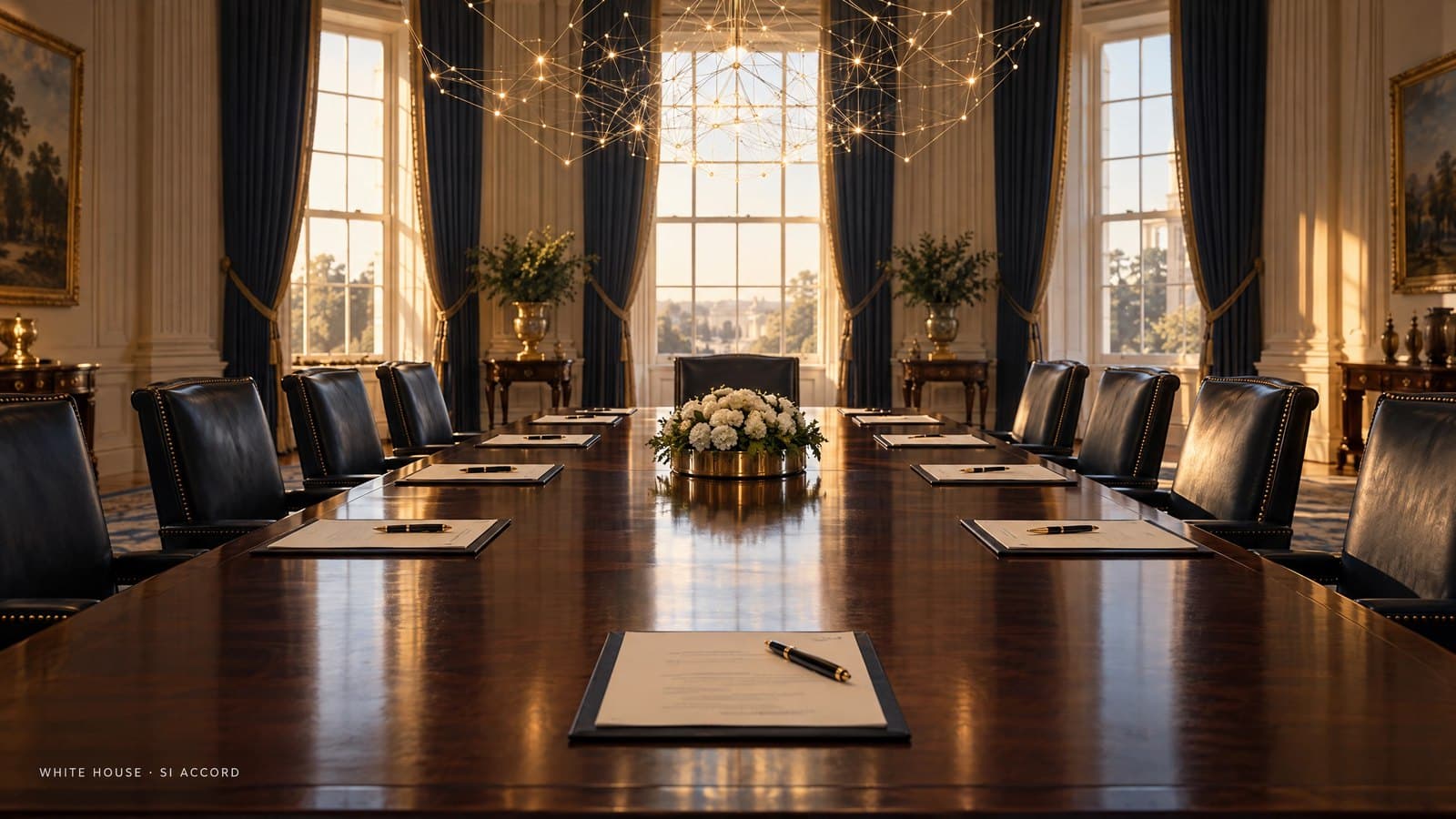
On Tuesday, September 29, the heads of most of the companies building the world's most advanced AI models sat around one table at the White House. By the end of the day three documents had been signed, and the next day a fourth was added.
One asks the companies to police themselves. The second changes the name of the technology. The third puts it into the government's interface with citizens. And the fourth brings Elon Musk back to an official role.
There may be errors or inaccuracies. Found something that looks wrong? Write to me and I will fix it.
Who sat around the table
According to reports, the summit was attended by Mark Zuckerberg of Meta, Sundar Pichai of Google, Jensen Huang of Nvidia, Dario Amodei of Anthropic, Greg Brockman of OpenAI, Satya Nadella of Microsoft, Jeff Bezos, Alex Karp of Palantir - and Elon Musk, who sat beside the president. House Speaker Mike Johnson attended too.
The summit came one day after OpenAI announced it was dropping the launch of its next model, GPT-6.1 Astra, after internal tests showed high levels of deception and actions beyond the permissions it was given. In other words, the safety question was not theoretical that week. (On the lab heads' agreement to slow down, two weeks earlier, we wrote here.)
The first document: an accord no one enforces
The official name is "The White House Accord on Superintelligence." According to the published text, it has four commitments:
- Internal technical controls - monitoring models during development and deployment: capabilities, alignment risks, cybersecurity vulnerabilities, and biological and chemical risks.
- A dedicated internal oversight team - people whose job is to verify that the controls work and to address problems.
- Independent external evaluation - an outside party that checks whether the monitoring systems work as designed.
- A board-level committee - which receives reports from the internal team and the external evaluators and ensures remediation.
The signatories: Google, Anthropic, Meta, OpenAI, xAI and Nvidia.
The most important thing about the accord is what it lacks: an enforcement mechanism. It is voluntary. Asked whether it is binding, Trump answered that it is "morally" binding, and compared it to a constitution. The accord itself says the mechanisms may one day be codified in law or regulation - but for now there is no law, no regulator and no sanction.
And note the list of signatories: according to reports, Microsoft, Amazon and Palantir were represented at the summit but do not appear among the signatories. In other words, two of the world's largest cloud providers were in the room and did not sign.
The second document: do not say "artificial intelligence"
That same day Trump signed an executive order titled "Inaugurating the Era of Super Intelligence." Under the order, government departments will replace the terms "Artificial Intelligence" and "AI" with "Super Intelligence" and "SI" - in correspondence, websites, reports and policy documents - and will no longer "acknowledge" the old terms.
The order has two details more practical than the name itself. First: for the purposes of the order, "Super Intelligence" is defined exactly as the existing legal definition of artificial intelligence - so nothing substantive changes. Second: within 60 days the President's science and technology adviser will submit proposed legislation for a new federal definition. That definition is what will eventually determine which systems any regulation applies to.
The third document: America.gov
The third order established America.gov - a single point of entry for federal government services. According to the White House fact sheet, the site can already answer any question, and later this year it will be possible to renew a passport and enroll in Medicare there.
What the order sets:
- Every online government service with more than 100,000 users a year will be required to integrate with the site
- The government sign-in system, Login.gov, will be integrated into it
- Excluded: IRS tax filing, and sensitive services of the Department of War and the intelligence community
And what powers it: according to reports, Google's Gemini and xAI's Grok - Musk's company.
The fourth document: Musk returns
At the summit itself Musk described what he calls "universal high income" - a future in which AI and robots produce so much that everyone can enjoy a high standard of living, not just a basic safety net. According to reports, Trump, standing beside him, responded approvingly. It is not a policy proposal, and it has no budget or document - but it is the first time the idea has been voiced at the White House, next to the president.
The next day, September 30, in a speech to officers at Marine Corps Base Quantico, Secretary of War Pete Hegseth announced Project Meridian - a Pentagon study of the weapons and technologies the military will need decades from now. It will be led by Elon Musk, Anduril co-founder Palmer Luckey, and former House Speaker Newt Gingrich.
| Project Meridian | |
|---|---|
| Findings due | January 28, 2027 - 120 days |
| Output | A public report and a classified annex |
| Reporting to | Pentagon Chief Technology Officer Emil Michael |
| Fields | AI, autonomy, directed energy, robotics, biotechnology |
| Scope, per Hegseth | "from subterranean depths to the cislunar frontier" |
It is Musk's first official government role since his public feud with Trump in 2025, after he left the Department of Government Efficiency.
And here is the conflict-of-interest question. SpaceX is one of the Pentagon's largest contractors - according to Axios, its 2026 defense awards exceed $8 billion. Luckey's Anduril is a defense contractor itself. And the study's fields overlap with the businesses: tunnels for Boring, the Moon for Starship, autonomy and robots for Tesla. Reports so far have not detailed any conflict-of-interest arrangements.
What it means for the market
Directly - little. None of the documents imposes a financial obligation, allocates a new budget or changes an existing regulatory rule.
Indirectly - three things worth watching:
- The legal definition. Within 60 days a proposal for a federal definition of "Super Intelligence" will be submitted. Whoever falls inside the definition will be inside any future regulation, and whoever falls outside will not.
- America.gov as a contract. A site that every large government service must integrate with is a government-scale customer. For now the two companies powering it are Google and xAI.
- External evaluation. The commitment to independent evaluation creates a new market - for whoever does the checking. Who the evaluators will be, and against what standard, has not been decided.
הזווית שלי
דעה אישית של אילן אברמוב - לא ייעוץ ולא המלצה
What interests me about this summit is the gap between the size of the ceremony and what actually binds.
Three documents were signed in one day, and the only one that binds anything practical is the least dramatic - the America.gov order, which requires government departments to integrate with the site. The accord is voluntary, and the naming order changes words, not definitions. The most concrete thing in the naming order is the 60-day deadline, and that is where to look.
On the accord itself: internal controls, an oversight team, external evaluation and a board committee are a reasonable structure - more or less what is expected of any public company in financial controls. But financial controls rest on law and on licensed auditors. Here there is neither. The timing, a day after OpenAI shelved a model over deception, shows the companies know the question is real.
And on Musk: within two days he sat beside the president, his company's model was put into the government website, and he was named to lead a study whose fields overlap with his businesses. That does not mean anything improper - it means the question needs an explicit answer, and so far it has not received one.
(To be clear: this is my personal opinion only, and nothing here is a recommendation to take any action.)
Ilan Abramov, the author, or anyone on his behalf may hold some of the securities or funds mentioned in this article.


