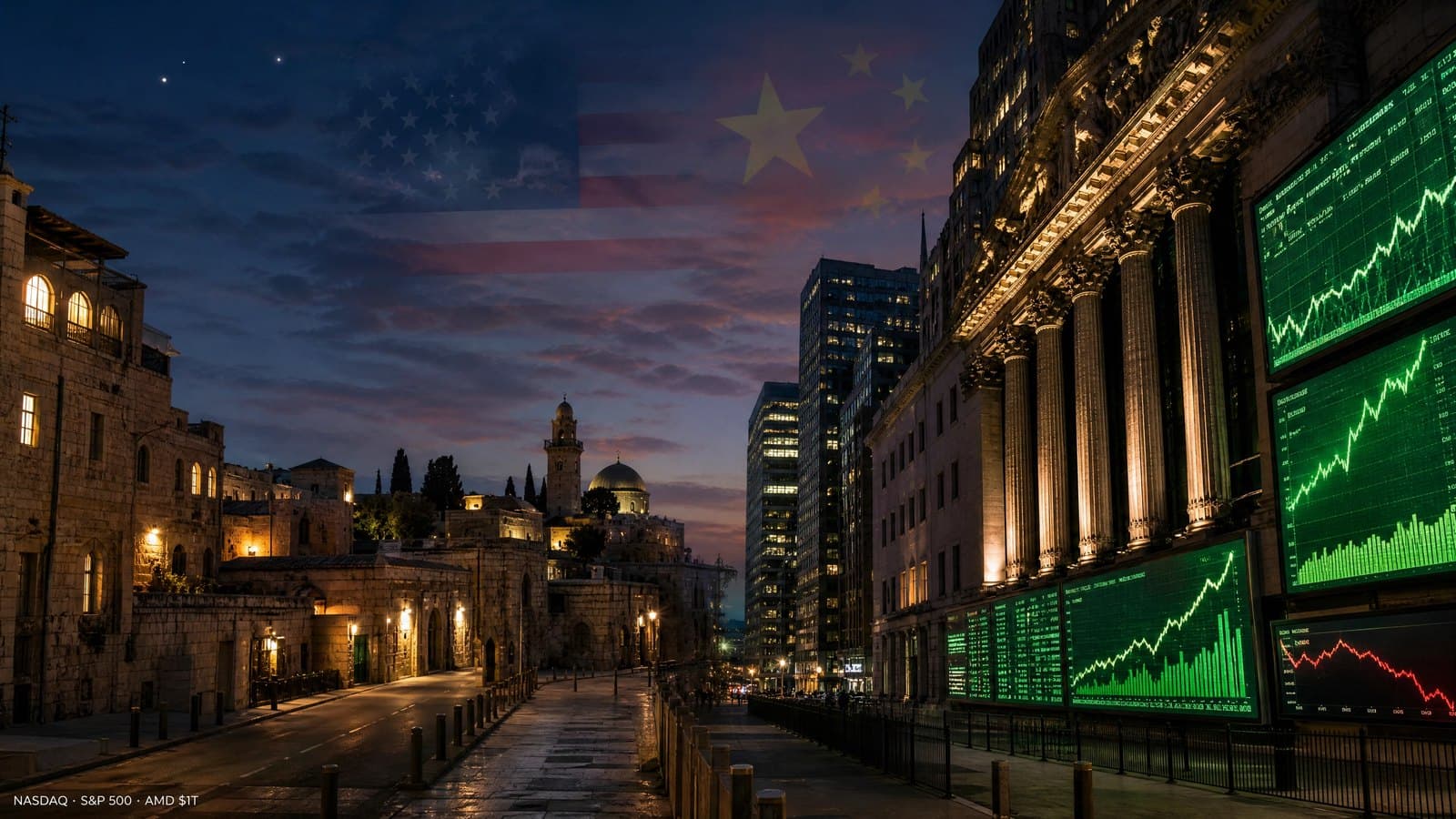
Yom Kippur is ending. The Tel Aviv Stock Exchange was closed today, and most investors in Israel were not looking at their screens.
On Wall Street, meanwhile, it was one of the strongest sessions of the month: the Nasdaq closed at a record, AMD crossed a $1 trillion market value for the first time, and US crude fell below $100.
Two stories converged on the same day: Chinese President Xi Jinping's state visit to Washington, which begins on Wednesday, and the first hints of a diplomatic channel between the US and Iran.
There may be errors or inaccuracies. Found something that looks wrong? Write to me and I'll fix it.
In short:
- The Nasdaq closed at a record, the first since June. The S&P 500 stopped about 0.4% short of its own.
- Chips led: AMD crossed $1 trillion, and Arm and Intel posted double-digit gains.
- US crude fell about 5%, after Trump said he is open to meeting Iran's president.
- Ahead of the summit: Bessent called the preparatory talks with China successful; the White House meeting is on Thursday.
The indices, in numbers
Monday's closes, against Friday's close:
| Close | Change | Previous record close | Distance from record | |
|---|---|---|---|---|
| Nasdaq Composite | 27,122 | +2.26% | 27,094 (June 2) | New record |
| Nasdaq 100 | 30,482 | +2.83% | 30,661 (June 2) | -0.6% |
| S&P 500 | 7,765 | +1.49% | 7,799 (August 13) | -0.4% |
| Dow Jones | 52,049 | +0.71% | 54,349 (August 5) | -4.2% |
| Semiconductor index (SOX) | 12,433 | +4.29% | 14,635 (June 22) | -15.0% |
(Trading data from Yahoo Finance. Record closes are the highest closes in the same source's historical data.)
The Nasdaq closed 28 points above its previous record close of June 2 - its first record close since. But note the precision: this is a closing record, not an intraday one. Today's high, 27,184, stayed just below the intraday record of June 1, 27,190.
And the other indices are not there. The S&P 500 stopped about 0.4% below its record, and the Nasdaq 100 about 0.6%. So today's record belongs to the most tech-heavy index - not to the market as a whole.
And the gap between the indices tells the story. The tech-heavy Nasdaq rose three times as much as the Dow. And the semiconductor index rose almost twice as much as the Nasdaq - yet even after today it is still about 15% below its June record.
Who led
| Stock | Change | What happened |
|---|---|---|
| Arm (ARM) | +17.2% | Rose with the chip rally |
| Intel (INTC) | +12.1% | Optimism around its AI roadmap |
| Meta (META) | +11.3% | Its new AI assistant, Muse, reached number one in Apple's US App Store (details here) |
| AMD | +9.95% | Crossed a $1 trillion market value for the first time, on the fifth straight day of gains |
| Micron (MU) | +2.8% | |
| TSMC | +2.4% | |
| Nvidia (NVDA) | +2.3% |
(Change at the close, against Friday's close. Explanations of the moves are per market reports.)
AMD is the story of the day. The stock touched $616.68 - its highest level ever - and joined the trillion-dollar club. According to CNBC, it came on the fifth day of a winning streak.
And note that Nvidia rose only 2.3%. That matters: today's rally was not driven by the largest stock in the sector, but by its rivals - AMD, Intel and Arm. One explanation in the reports is that AI agents such as Meta's Muse rely more on general-purpose processors, not only on graphics processors - which is exactly where these three companies operate.
And what the leaders have in common: all of them are exposed to the question that will be on the table at the White House on Thursday - what may be sold to China, and what China is willing to buy.
Ahead of the summit: what is on the table
Xi Jinping arrives for a state visit to Washington from September 23 to 25. The meeting with Trump and the state dinner at the White House are on Thursday, September 24. According to reports, it is his first state visit to the White House since 2015, and the second face-to-face meeting between the two this year - the previous one was in Beijing on May 14.
The preparatory talks took place on Sunday. Treasury Secretary Scott Bessent and Trade Representative Jamieson Greer met in New York, at JPMorgan's Manhattan headquarters, with Chinese Vice Premier He Lifeng. Afterwards Bessent told reporters the US had "a very successful engagement" with the Chinese side.
The topics raised, according to reports:
- The tariff truce. The truce agreed at the end of 2025 expires on November 10 - and there is no agreement yet on extending it (details below).
- Rare-earth magnets. American manufacturers and chip companies complain that supply from China arrives too slowly and in insufficient quantities.
- Artificial intelligence. The US proposed setting up a "US-China AI Dialogue", with an incident notification mechanism.
- Trade in "non-sensitive goods". According to CBS, the talks dealt with identifying categories of consumer goods, low-tech products, energy and agriculture where "balanced" trade could grow.
And who will sit around the table. According to reports, the guests at the state dinner include Nvidia's Jensen Huang, OpenAI's Sam Altman, Google's Sundar Pichai, Elon Musk, Jeff Bezos, Michael Dell, Citi's Jane Fraser and Apple's Tim Cook.
That links the summit directly to today's rally. Chips are one of the main points of friction between the two countries: Washington restricts sales of advanced chips to China, and Beijing responds with restrictions on critical minerals. And one detail shows how complicated the story is: according to reports, around ten Chinese companies received US licences to buy Nvidia's H200 chip - but Chinese customs is blocking the shipments. In other words, the obstacle right now is not only in Washington.
One more detail worth remembering: at their previous meeting, in Beijing in May, the two discussed AI - and according to reports no agreement was signed.
What Trump said about AI
Three days before the summit, Trump put AI at the top of the agenda himself. On Saturday, September 19, he announced on Truth Social the creation of an "AI Force" - modelled on the Space Force he set up in his first term - and his intention to appoint an "AI Czar" to oversee the sector. He did not name anyone.
In his words:
"AI is the next Industrial Revolution, or Internet, but will be even larger and more impactful, possibly as much as 25% of our Country's GDP. We are leading China, and the rest of the World, and I intend to keep it that way!"
And on regulation:
"We will not in any way hinder or stifle the Growth of this incredible Industry. Rather, we will cherish it, help it, and watch over it, as it grows! However, we will also be looking for BAD, and we can do that, very easily, with our already existing Criminal and Civil Justice System."
(Quotes per CBS News and CS Monitor.)
A week earlier he went further. According to CS Monitor, Trump wrote that the people who say AI will destroy the world are the same people who said the world would be extinguished by climate change - which he called a "hoax".
And there is a tension here worth noticing. The president says: no slowdown, no restrictions. Yet on the same weekend, his Treasury Secretary proposed to China a mechanism for mutual notification of AI incidents. Bessent explained, according to NBC:
"Just like with any cross-border activity, moving from opaque to more transparency between the number one and the number two AI powers in the world is very important."
So the US arrives at the summit with two messages: a race without brakes at home, and an emergency communication channel with its rival. They are not necessarily contradictory - but it means that whatever comes out of the summit on AI, if anything, is likely to be a communication mechanism, not an agreement that restrains anyone.
Extending the trade truce: no agreement yet
This may be the most important economic issue at the summit, and the one the market knows least about.
The US-China truce, agreed in Busan, South Korea, at the end of 2025, expires on November 10. The preparatory talks in New York on Sunday did not end in agreement on an extension.
What is known about the gaps, according to reports:
- Length of the extension. According to the Financial Times, the US wants a six-month extension, while China wants it extended through the end of Trump's term. Trade Representative Greer said three to six months is a range Washington could support, and that talks will continue.
- Rare earths. According to the same report, Washington assesses that China is meeting only about two-thirds of its rare-earth supply commitments to the US and its allies.
- The package on the table. According to reports, the sides are discussing tariff cuts on around $30 billion of goods on each side, in "non-sensitive" categories.
Greer described the idea this way, according to NBC:
"There is a world where you have a relatively small subset of American and Chinese goods that can be traded in a balanced way that are non-sensitive."
Note the word "small". $30 billion each way is a small part of trade between the two countries. This is not a return to free trade - it is a defined list of products carved out of the conflict.
There is a goodwill signal from Washington: according to Bloomberg, the administration postponed until after the summit new "overproduction" tariffs, which were due to start at 7.5% on Chinese goods.
And agriculture: under the 2025 understandings, China committed to buying 25 million tonnes of soybeans a year in 2026-2028. According to reports, as of September 11 orders had reached 15.5 million tonnes - and the Trade Representative signalled that agricultural announcements are expected at the summit.
More on the road to the summit
Four more details, according to reports:
- Taiwan. According to reports, the administration is considering delaying until the end of the year its decision on major arms sales to Taiwan - until after the APEC summit in Shenzhen in November and the G20 summit in Florida in December. Beijing treats such sales as a red line and, according to reports, threatened to cancel the visit if they were approved. And there is a precedent: according to The Washington Post, after the Beijing summit in May a $14 billion arms package for Taiwan was delayed.
- Boeing. During Trump's visit to Beijing in May, China agreed to buy 200 Boeing aircraft. According to the South China Morning Post, the deal has not yet materialised, and the details - especially the timeline - may be settled at the summit.
- Soybeans. According to Semafor, China bought at least 1 million tonnes of US soybeans last week, passing half of its annual target of 25 million tonnes.
- The welcome. According to reports, Trump will greet Xi in person at Joint Base Andrews - the first time in his second term that he has received a foreign leader this way.
The common thread: in the week before the summit, Washington postponed new tariffs, is considering delaying Taiwan arms sales, and is giving Xi an unusually warm welcome. Beijing, for its part, is accelerating soybean purchases. Both sides are signalling a desire to come away with an achievement - but as we saw, on the central economic issue, extending the truce, there is still no agreement.
Oil: the day's second story
| Price | Change | |
|---|---|---|
| US crude (WTI, October contract) | about $95.4 | about -4.9% |
| Brent | about $100.3 | about -3.4% |
(Futures settlement prices, per investingLive and Yahoo Finance.)
It was the fourth straight day of declines, and according to Bloomberg oil lost more than 9% over those four days. US crude fell below $100, after closing above it on Friday, and Brent is back around $100.
(Correction: the first version of this article, written during trading, showed a one-day fall of about 9%. That figure came from comparing two different futures contracts; the actual daily decline was about 5%.)
The main explanation: Trump told Fox News he is open to meeting Iranian President Masoud Pezeshkian in New York this week, during the UN General Assembly. According to reports, Tehran has not yet signalled reciprocal interest. It was also reported that Trump decided, for now, against strikes in Yemen, and that shipments from Saudi Arabia are partly recovering despite Houthi attacks.
For scale: according to AP, before the war with Iran, in late February, a barrel cost around $72. So even after today's fall, oil is still well above its pre-war level. An analyst quoted by The National described what is happening as the removal of "a degree of risk premium" from the price.
And why it matters for stocks: cheaper oil eases inflationary pressure - a week after the Fed raised rates, that is relevant. The 10-year Treasury yield fell about 4.5 basis points today, to around 4.95%.
What else moved
| Level | Change | |
|---|---|---|
| Bitcoin | about $86,900 | about +7% |
| Gold | about $4,342 | -0.8% |
| USD/ILS | about 3.02 | |
| VIX | 14.9 |
(Per investingLive and Yahoo Finance, at the end of New York trading.)
Bitcoin reached its highest level in eight months, according to Yahoo Finance, pulling crypto-exposed stocks with it. And gold fell - consistent with a day on which investors were looking for shelter less.
Dual-listed stocks: what awaits Tel Aviv
The Tel Aviv Stock Exchange was closed today. But Israeli stocks that also trade in New York kept moving - and they hint at what local trading will face when it reopens.
| Stock | Change in New York |
|---|---|
| NICE (NICE) | +9.1% |
| Wix (WIX) | +6.4% |
| Tower (TSEM) | +4.6% |
| Next Vision (NXT) | +3.3% |
| Monday.com (MNDY) | +3.3% |
| Teva (TEVA) | +2.8% |
| Nova (NVMI) | +1.9% |
| Check Point (CHKP) | +1.2% |
| Elbit Systems (ESLT) | +1.0% |
| Camtek (CAMT) | +0.3% |
| Mobileye (MBLY) | -0.4% |
(Change at the close in New York, against Friday's close.)
NICE led the list with a gain of more than 9%. I did not find the reason in a source I can verify, so I am not guessing. Teva touched $40.79 today - its highest level in the past year, and Tower, a chip stock, joined the sector's broader rally.
And note the shekel: the dollar weakened against the shekel, to around 3.02. For an Israeli investor holding US stocks, part of today's gain is erased in the translation to shekels.
הזווית שלי
דעה אישית של אילן אברמוב - לא ייעוץ ולא המלצה
What I take from today is that the market is pricing an expectation, not an outcome.
The two stories that moved trading - the China summit and the Iran channel - are still statements. Bessent said the talks were successful, and Trump said he is open to a meeting. But on the most tangible economic question - extending the tariff truce - according to reports there is still no agreement, and the gap between six months and the end of the term, in January 2029, is not small. And no answer has come from the Iranian side. And the last time Trump and Xi discussed AI, in May, nothing was signed.
What I find most interesting is who led. Not Nvidia, but AMD, Intel and Arm. In my view this says something about how the market is starting to think about the next wave of AI - less about training models, more about agents that run on ordinary processors. That is a hypothesis, and one day does not prove it.
And I want to be careful about two things. First: the record belongs to the Nasdaq alone, by 28 points, and the S&P 500 is not there yet - today should be read as a strong tech rally, not a breakout of the whole market. Second: when the market rises on expectations ahead of an event, it is exposed to disappointment from the event itself. On Thursday we will know more.
(To be clear: this is my personal opinion only, and nothing here is a recommendation to take any action.)
Ilan Abramov, the author, or anyone on his behalf may hold some of the securities or funds mentioned in this article.


