Supermicro reported its fourth quarter and full fiscal year 2026 on 11 August 2026, after the market closed.
Errors or inaccuracies are possible. Spotted something that looks wrong? Write to me and I will correct it.
A Note That Has To Come First
Supermicro's fiscal year ends in June. The report published covers the fourth quarter and the whole of fiscal year 2026, ended 30 June 2026 - the same slice of time every other company this week calls "the second quarter of 2026".
And when the company talks about "fiscal year 2027", it means the year that has just begun.
What Supermicro Does
Supermicro assembles servers. It buys processors from NVIDIA, AMD and Intel, builds the complete system around them - board, memory, storage, power supplies and cooling - and delivers a rack ready to run.
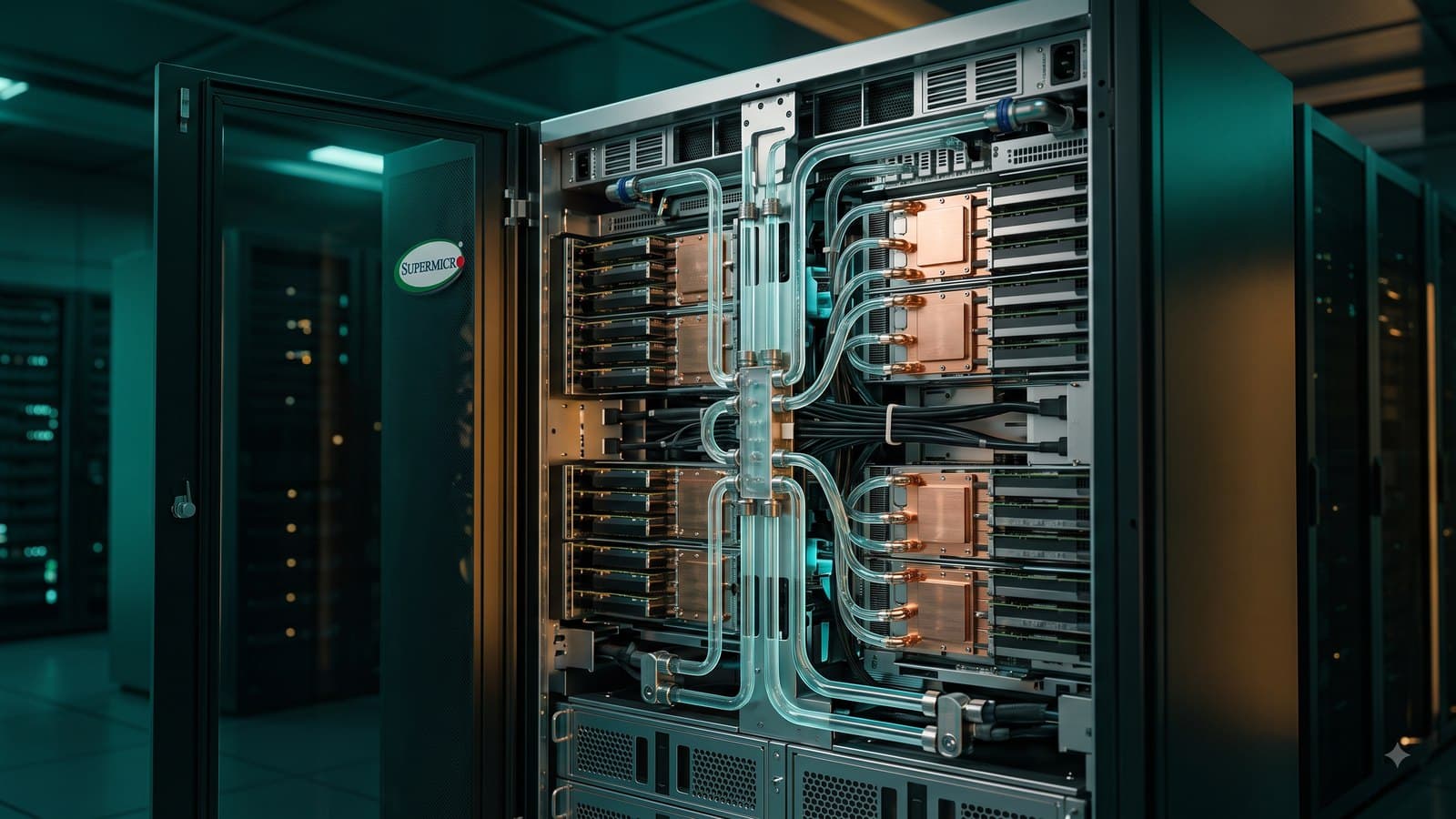
And the specialisation that made it relevant in the AI era is liquid cooling. A rack of AI processors draws power at a level air cooling can no longer handle, and whoever can safely move liquid between the chips enables far higher density.
Which is also the company's historic problem: thin margins. Assembly is a volume business rather than a pricing one, and Supermicro traded for years on a single-digit gross margin. And that is exactly what changed this quarter.
The Quarter
| The quarter | Last quarter | A year ago | |
|---|---|---|---|
| Revenue | $11.1 billion | $10.2 billion | $5.8 billion |
| Gross margin | 17.5% | 9.9% | 9.5% |
| Non-GAAP gross margin | 17.6% | 9.6% | |
| Net income | $1,178 million | $483 million | $195 million |
| Diluted EPS | $1.62 | $0.72 | $0.31 |
| Non-GAAP diluted EPS | $1.70 | $0.41 | |
| Operating cash flow | $747 million | ||
| Capex and investments | $25 million |
Revenue nearly doubled in a year. Net income grew sixfold.
But the line that changes the thesis is gross margin: 17.5%, against 9.5% a year ago.
Close to a doubling, in an industry where margins move in fractions of a percent.
And it did not happen gradually. Last quarter the margin was 9.9% - still single digit. The entire jump happened in one quarter.
The company's explanation, from CEO Charles Liang, names two factors: a richer customer mix with a growing weight of enterprise customers, and broader adoption of the DCBBS architecture - modular building-block solutions for data centres.
And why it matters so much: the difference between a server assembler and a solutions provider is precisely the difference between 9.5% and 17.5%. Whoever sells metal competes on price; whoever sells architecture sells something harder to replace.
The Full Year, and Here You Have To Look Carefully
| Fiscal year | 2026 | 2025 |
|---|---|---|
| Revenue | $39.1 billion | $22.0 billion |
| Gross margin | 10.8% | 11.1% |
| Net income | $2.2 billion | $1.0 billion |
| Diluted EPS | $3.26 | $1.68 |
| Non-GAAP diluted EPS | $3.63 | $2.06 |
Annual revenue rose 78%. And the annual gross margin actually slipped, from 11.1% to 10.8%.
And this is the point not to miss: if the fourth-quarter margin was 17.5% and the annual margin is 10.8%, then the first three quarters were materially lower. The jump is a one-quarter event, not a year-long trend.
That does not invalidate it - but it does mean the only question that matters is whether it holds.
The Outlook, and It Is Large
For the first quarter of fiscal 2027, ending September 2026:
- Revenue of $14.5 to $15.5 billion - against $11.1 billion in the reported quarter
- GAAP diluted EPS of $0.89 to $0.98
- Non-GAAP diluted EPS of $1.01 to $1.10
And for the whole of fiscal 2027: revenue of $65 to $72 billion.
Against $39.1 billion in the year just ended, that is growth of 66% to 84%.
And what sits behind it, per the company: more than $60 billion in new orders generated during the year, several hundred new enterprise customers, and record backlog entering fiscal 2027.
The Balance Sheet, and Here There Is an Asterisk
As of 30 June 2026: cash and equivalents of $7.5 billion, against bank debt and convertible notes of $8.7 billion.
So the company sits in net debt of roughly $1.2 billion.
And that is entirely logical in this business, and worth explaining why: a server assembler has to buy processors before it sells the rack. As revenue grows, the working capital funding it grows with it - particularly when processor prices are what they are.
But if the outlook materialises and revenue reaches $65 to $72 billion, the working capital required grows accordingly. And operating cash flow of $747 million a quarter, impressive as it is, does not on its own cover an increase of that magnitude.
This is not a danger - it is a question about funding.
The Market Reaction
The report was published after the close in New York, so no regular session reflecting it has taken place yet. The market's response will be visible in Wednesday's session.
הזווית שלי
דעה אישית של אילן אברמוב - לא ייעוץ ולא המלצה
This is the report that surprised me most this evening, and the reason is not the revenue.
That revenue would double surprised nobody. Supermicro sits exactly where the money is flowing, and every rack of AI processors sold in the world passes through somebody who assembles it. The growth was expected.
What was not expected is that it would earn on it.
Gross margin was the central bear argument against this stock for years, and it was a good argument: assembly is a commodity business, the processor is most of the cost, and NVIDIA charges what NVIDIA charges. In that world, the server assembler is a subcontractor on nine percent.
A jump from 9.5% to 17.5% in a single quarter says something structural changed - and if the company's explanation is right, meaning enterprise mix and a shift to modular architecture, then this is not an accounting surprise but a change in pricing power.
And now the caution, of which I have two.
The first is that the annual margin fell. 10.8% against 11.1% a year ago. Meaning this quarter is an outlier within the year it belongs to, and one quarter is not a trend. If the margin returns to ten percent next quarter, this whole story was an event.
The second is working capital. Guidance of $65 to $72 billion is close to double the year just ended, and every dollar of revenue in this business requires financing components up front. The company is already in net debt of $1.2 billion. That growth will need money, and where it comes from was not answered in the release.
And what interests me particularly is how this connects to NVIDIA's financing announcement from yesterday. NVIDIA has just announced a mechanism designed to let customers finance AI infrastructure without loading their own balance sheets. Supermicro is a link in exactly that chain - and the more the end customer's financing is solved, the larger its orders grow. $60 billion of new orders in a single year starts to look less coincidental in that light.


