On Tuesday, South Korea's KOSPI plunged 10.84%, the exchange's circuit breaker fired, and markets around the world reacted - a story we detailed in a separate piece.
And on that very same day, one of the largest companies in that index published the best quarter in its history.
What Was Reported
SK hynix reports in Korean won. The dollar conversions are based on a rate of about 1,447 won to the dollar as of the time of writing, and are for illustration only.
| Metric | Q2 2026 | Q2 2025 | Change |
|---|---|---|---|
| Revenue | 79.32 trillion won (about $54.8 billion) | 22.23 trillion | +257% |
| Operating profit | 60.54 trillion won (about $41.8 billion) | 9.21 trillion | +557% |
| Operating margin | 76% | - | record |
| Net income | 93.92 trillion won (about $64.9 billion) | 7.00 trillion | +1,242% |
And versus the prior quarter: revenue rose 51%, operating profit 61%, and the operating margin expanded by 4 percentage points.
The first half of 2026 crossed 100 trillion won in revenue for the first time.
A 76% Operating Margin - and Why That Is So Exceptional
This is the number worth pausing on, because it contradicts everything we knew about this industry for thirty years.
Memory was always the classic commodity business. DRAM is a standard product: one manufacturer's chip substitutes for another's. And when a product is interchangeable, competition is on price alone. The result was brutal cycles - periods of high profitability, then a wave of investment, then oversupply, then collapsing prices and heavy losses.
And a 76% margin is not a commodity producer's margin. It is a monopoly's margin.
What changed the equation: HBM
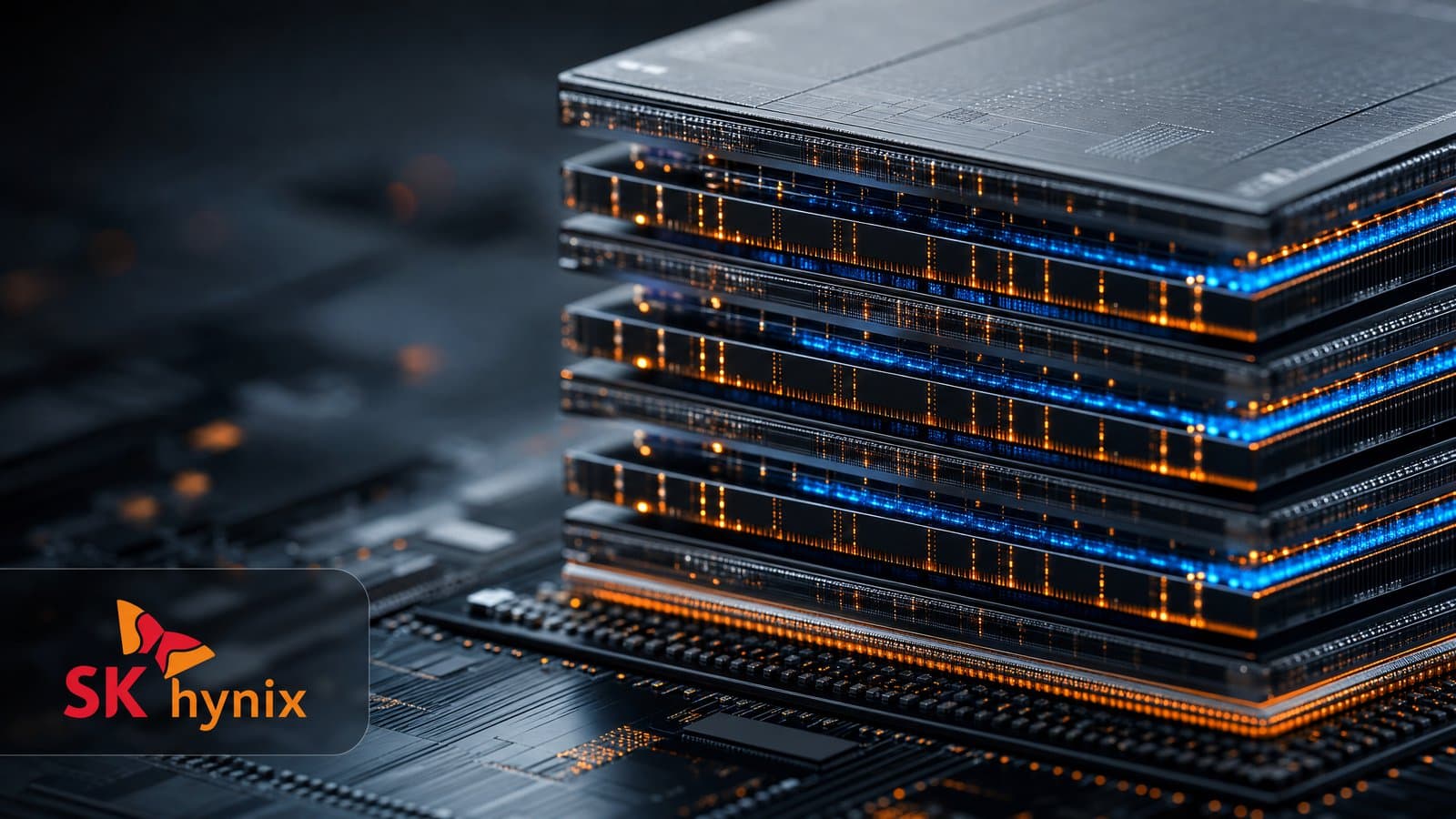
High-bandwidth memory is not ordinary DRAM. It is built from layers of memory chips stacked on top of one another and connected vertically, with the whole unit packaged together with the graphics processor. And that changes three things at once. First, manufacturing is far harder: stacking layers demands high precision, and every additional layer increases the chance of a defect - production yield became a real barrier to entry. Second, the product is customized: HBM is not sold off the shelf; it is designed together with the processor maker and qualified for a specific model, and a product that has been through qualification cannot be swapped immediately. And third, very few manufacturers can supply it in the quantity and quality required. The result: a product that was a commodity became a product with pricing power. And that is exactly what shows up in the margin line.
HBM4 - and the Generational Transition
This quarter marked a milestone: HBM4 entered mass production, and the company notes it achieved the operating speeds customers required, alongside competitive power efficiency and cost. A production ramp is planned for the second half of the year.
And why that matters: in this industry, whoever reaches the new generation first sets the price. A customer designing a new AI processor selects its memory supplier at the design stage - a year or more before production. That choice locks in.
This is precisely the point we covered in the context of Rambus: the transition to a new technology generation is the moment that determines who profits in the years that follow.
The Figure That May Matter More Than the Numbers
The company signed long-term agreements with about 10 key customers, and is negotiating additional multi-year contracts.
And that is a structural change in the industry. Historically, memory was sold at market prices that shifted month to month. A long-term contract turns volatile revenue into predictable revenue - and reduces the severity of the cycle that has characterized the industry.
This is perhaps the most important figure in the report for the long-term picture, even if it is less dramatic than 557% profit growth.
A Point Requiring Caution: Net Income Exceeds Operating Profit
93.92 trillion won of net income, against 60.54 trillion of operating profit.
This is an unusual situation. Normally net income is lower than operating profit - after financing and tax. Net income higher than operating profit means substantial non-operating income - for example gains on holdings in other companies, revaluation gains, or currency effects.
The summary announcement does not detail the composition, which appears in the full financial statements.
And the practical meaning for an investor: when assessing the company's recurring earnings power, operating profit is the relevant measure - because it describes the business itself. Non-operating income of this magnitude does not necessarily repeat.
The Balance Sheet
| Metric | End of Q2 |
|---|---|
| Cash and equivalents | 88 trillion won (about $60.8 billion) |
| Total debt | 18.6 trillion won |
| Net cash position | 69.4 trillion won (about $48 billion) |
Cash grew by 33.6 trillion won in a single quarter, and debt fell by 0.7 trillion.
And why that is significant in this industry in particular: memory manufacturing is among the most capital-intensive businesses in the world - a new fab costs tens of billions of dollars. A company in a cyclical industry entering a peak with $48 billion of net cash is in an entirely different position from a leveraged one. It can invest on the way down, not only on the way up.
And investments are indeed planned: accelerating production at the M15X facility, opening the first-phase cleanroom at Yongin in early 2027, and longer term the P&T7 packaging facility, NAND production at M17 and development of a new semiconductor cluster - all subject to demand and investment efficiency.
And the Paradox: This Report and the Collapse on the Same Day
And here is the real lesson.
SK hynix is among the largest companies in the KOSPI index. And on the day the index plunged 10.84% in a leverage collapse, this company reported a 76% operating margin.
That looks contradictory. It is not.
Two things happening at once
The leverage collapse in Seoul stemmed from leveraged investors forced to sell - margin calls, forced liquidations, a snowball effect. That is selling unrelated to the value of the businesses. Whoever is forced to sell, sells what they hold - including shares of excellent companies. And SK hynix's report describes what happened in the business itself: how many chips were sold, at what price, and at what margin. Both are true, and there is no direct connection between them on any given day. A share price can fall because of who is selling; a report describes what was sold to customers.
The Bull Thesis
Whoever reads it positively will point to a combination that is hard to find: 257% revenue growth, a 76% operating margin, and a balance sheet with $48 billion of net cash.
Beyond that: HBM4 in mass production positions the company in the next generation, and long-term agreements with about 10 customers reduce the industry's historical volatility.
And the structural positioning: a small number of manufacturers can supply HBM at the quality and volume required. This is a barrier to entry built on production yield, not on patents - and it is very hard to replicate quickly.
The Bear Thesis
Whoever reads it critically will note first the cyclicality. Memory is the most cyclical industry of all, and a 76% margin is by definition a cycle peak - not an equilibrium point. When margins like that appear in an industry, they attract investment - and investment produces oversupply.
Second, dependence on the AI wave. Demand for HBM comes almost entirely from data-center construction. If the pace slows, the effect on memory prices will be immediate.
Third, the unusual net income. Net income higher than operating profit is not a basis for future comparison, and it is worth examining what remains without it.
And fourth, competition is coming. Other manufacturers are investing heavily in HBM capability, and a technology gap in this industry is measured in quarters - not years.
The debate in one line
The bulls see 257% growth, a 76% operating margin, HBM4 in mass production, long-term agreements with 10 customers and $48 billion of net cash. The bears see a cyclical industry at a pronounced cycle peak, total dependence on the pace of data-center construction, net income that is not comparable, and competition building in the background. Both sides are reading the same report.
My Angle
A personal opinion of Ilan Abramov - not advice, not a recommendation
This report proves a point I hold, and one worth repeating: hardware can be extremely profitable - the question is market structure, not product type.
It is conventional to think software and licensing are the profitable businesses, and that physical manufacturing is condemned to thin margins. A 76% operating margin at a memory maker contradicts that completely. And it is not because the product changed - it is because the number of suppliers able to make it at the required level is small.
This is the same insight we saw this week at Seagate, whose gross margin jumped from 37% to 52% in an industry with three players. The same demand arriving at an industry with ten players produces competition; in an industry with three - it produces margin.
And the second thing I take is the timing.
This report was published on the day the local index plunged 10.84%. It is hard to find a better illustration that a share price and a financial report measure two different things. Whoever sold that morning did not sell because SK hynix earns less - they sold because they had to post collateral.
And what I will follow: the margin, not the revenue. 76% is a number that has never been sustained over time in this industry - not once. The question is not whether it comes down, but to where. If it settles at a level materially above prior cycles, that is evidence the long-term agreements and the HBM barrier genuinely changed the industry's structure. If it returns to historical levels - it was a cycle, not a change.
Summary
SK hynix published the strongest quarter in its history: revenue of 79.32 trillion won (about $54.8 billion), a 257% surge; operating profit of 60.54 trillion won (about $41.8 billion), a 557% surge; and a 76% operating margin - an all-time high. The balance sheet shows a net cash position of 69.4 trillion won.
And the points beyond the numbers: HBM4 entered mass production, long-term agreements were signed with about 10 key customers, and net income - 93.92 trillion won - exceeds operating profit, which requires checking the composition in the full statements.
And beyond the company, this is one of the sharpest lessons of the week: this report was published on precisely the day the Seoul exchange collapsed 10.84%. Forced selling lowers prices; it does not change how many chips were sold, or at what margin. The question for the investor is not whether the quarter was good
- it was exceptional - but how much of it is a new structure, and how much is a cycle peak.
Sources: SK hynix's official results announcement for the second quarter of 2026, as published in the company's official newsroom, including revenue, operating and net profit, the operating margin, the quarterly and annual comparisons, cash and debt balances, HBM4 production status, the long-term agreements and investment plans. The exchange rate used for conversion is about 1,447 won to the dollar as of July 29, 2026, and the conversions are for illustration of scale only. Data accurate as of the time of writing. The chart is shown in real time via TradingView. Nothing herein constitutes a forecast, recommendation or advice - see the full disclaimer at the bottom of the page.


