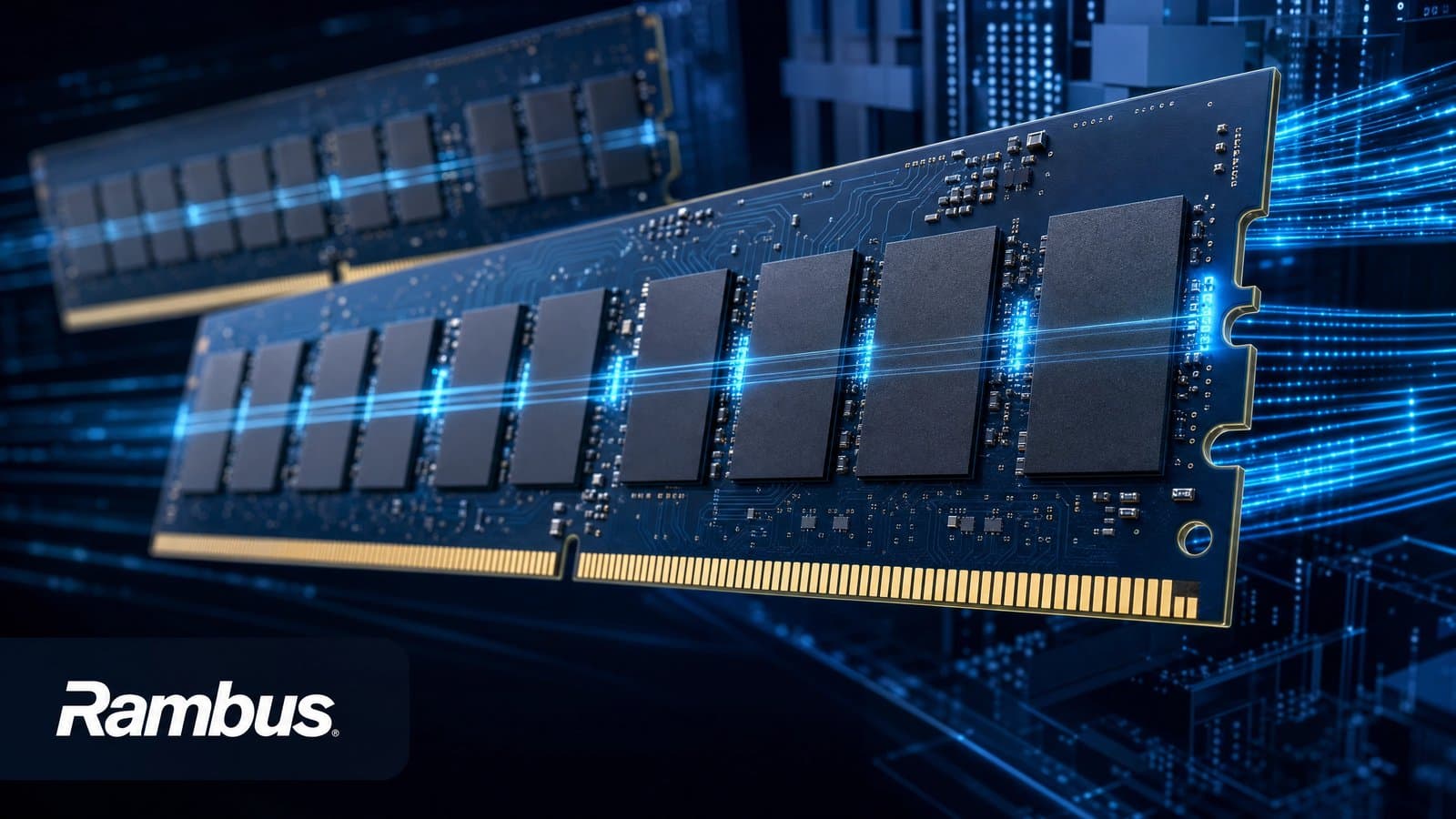
In every discussion of AI accelerators the focus is the chip itself. But an accelerator without fast enough memory is an engine without fuel - and the link connecting them is a business in its own right. Rambus (NASDAQ: RMBS) sits exactly there, and last night it reported a quarter in which it beat its own guidance on every line - and also raised the bar for next quarter.
About the Company: Two Businesses, One High Margin
Rambus operates in two complementary tracks.
The first: memory interface chips. These are physical components that sit between the processor and the memory and manage the traffic between them - amplifying the signal, timing access and allowing modules to work at high speeds without errors. The faster the memory (for example in the DDR5 standard), the more critical this role becomes.
The second: intellectual property. Rambus develops circuit designs and licenses them to other companies, which integrate them into their own chips and pay royalties. This is a business with an especially high margin, because once development is complete, each additional license carries almost no cost.
And the product at the center of attention today is the HBM4E controller. To explain: HBM stands for High Bandwidth Memory. This is memory built in layers and attached physically to the AI accelerator, in order to stream data to it at a rate an ordinary memory component cannot supply. The controller is the component that manages that communication. In other words, Rambus sells the link that feeds data to the accelerators - and the faster the accelerators, the greater the need for it.
This is the other side of the memory-shortage story we saw in IBM's report, where customers shifted budgets from software and consulting to servers and memory. Rambus sits on the receiving side of that same shift.
What Was Reported: Above Guidance on Every Line
Revenue. $207.4 million, up 20% year-over-year. The important figure here is not just the growth, but that it is above management's own guidance, which stood at $192-198 million.
Earnings. Adjusted EPS came to $0.77 - again above the range the company guided to ($0.65-0.73). GAAP EPS stood at $0.61.
The breakdown - two engines:
| Revenue source | Amount | Note |
|---|---|---|
| Products (chips) | $99.2 million | +22% year-over-year, +13% sequentially |
| Royalties | $84.2 million | Especially high margin |
| Contract and other | $24.0 million | - |
Profitability. The adjusted operating margin stood at 45% (adjusted operating income of $93.7 million), and on a GAAP basis at 35% ($72.7 million). Operating cash flow totaled $61.2 million.
The balance sheet. Cash, cash equivalents and marketable securities stood at $824.9 million - a significant cushion relative to the company's size.
The Guidance - and This Is the Interesting Part
For the third quarter the company guides to numbers higher than those it just reported:
- Revenue: $210-216 million
- Product revenue: $110-116 million (versus $99.2 million in the quarter just past)
- Royalties: $69-75 million
- Contract and other: $25-31 million
- Adjusted EPS: $0.75-0.82
Note the detail: product revenue is expected to jump about 15% in a single quarter, while royalties actually moderate. That tells a story about mix: the physical chip engine is accelerating faster than the licensing engine.
The Bull Thesis
Whoever reads it positively will point out that the company beat its own guidance and immediately raised it - a combination indicating demand accelerating in real time, not a one-off quarter. A 45% operating margin at a company this size is rare, and stems from the unique combination of hardware sales and IP royalties.
Beyond that: Rambus is positioned directly at the AI bottleneck. As accelerators get faster, memory becomes the constraint - and that is precisely its field. The HBM4E controller positions it in the next generation of the technology, and the guidance for a jump in product revenue hints the wave is still ahead of it. And the balance sheet, with over $800 million liquid, lets it fund development without raising capital.
The Bear Thesis
Whoever reads it critically will recall first the cyclicality of the memory market. This is one of the most cyclical markets in the world, with a history of sharp boom-and-bust cycles. Current demand is strong, but the memory industry has also known periods of oversupply that erase margins.
Second, dependence on a handful of customers. The world's large memory manufacturers are few, and the same is true of accelerator makers. A change in one customer's design decision can have a material effect.
Third, royalties are not fixed. Licensing revenue depends on agreements renewed periodically, and sometimes on legal proceedings. The guidance for next quarter already shows moderation in that line.
And fourth, the valuation. A stock that has benefited from AI momentum enters every report with high expectations; even a beat may be met with indifference if the market has already priced it in.
The debate in one line
The bulls see a company that beat its own guidance on every line, immediately raised it, and holds a 45% margin thanks to the combination of hardware and intellectual property - right at the AI bottleneck. The bears see a memory market cyclical by definition, dependence on a handful of customers, royalties already moderating in the guidance, and a stock priced on momentum. Both sides are reading the same report.
My Angle
A personal opinion of Ilan Abramov - not advice, not a recommendation
The figure I take from this report is not the beat - but the mix in the guidance.
Product revenue is expected to jump from $99 million to a range of $110-116 million within a single quarter, while royalties moderate. That means the growth comes from selling physical chips, not from licensing - meaning from actual demand, from customers ordering hardware to build systems now.
And that connects to everything we saw today. Baker Hughes reported energy orders that doubled; Cadence a record design backlog; Rambus a jump in memory-component orders. Three entirely different links in the same chain, and all reporting the same thing: the demand is arriving now, not in the future.
And what I am watching going forward is the transition to HBM4.
Every generation of high-bandwidth memory steps up the number of channels, the speed and the density of the connection between memory and accelerator - and each such jump makes the controller a more complex and demanding component. In other words, as the technology advances, the component Rambus specializes in becomes more critical, not less. A company that reaches the new generation with a ready product gains an advantage that persists across that generation's entire life cycle, because a design decision once made stays in the chip for years.
That is why I look at the expected jump in product revenue - from $99 million to a range of $110-116 million - not just as a number, but as a signal. Growth in chip sales means customers are already ordering hardware for the next generation, not merely signing licenses for the future. For a supplier sitting at a technological bottleneck, that is the most meaningful indication there is.
Summary
Rambus delivered a clean quarter: revenue of $207.4 million and adjusted EPS of $0.77, both above the guidance it itself gave, with a 45% adjusted operating margin and a balance sheet of over $800 million in cash and marketable securities. And the guidance for next quarter is higher, with product revenue expected to jump about 15%.
The question for the investor is not whether the demand exists - the report answers that clearly. The question is how much of that strength is already reflected in the price, and what happens when the memory cycle, cyclical by nature, turns. Until then, Rambus sits exactly in the right place: between the accelerator and the memory, at the stage where that is precisely the bottleneck.
Sources: Rambus Inc.'s official results announcement for the second quarter of 2026 (July 27, 2026), including revenue and its breakdown, GAAP and adjusted earnings, the operating margins, operating cash flow, the balance sheet and the third-quarter guidance; prior management guidance as published in the company's SEC filings. Data accurate as of the time of writing. The chart is shown in real time via TradingView. Nothing herein constitutes a forecast, recommendation or advice - see the full disclaimer at the bottom of the page.


