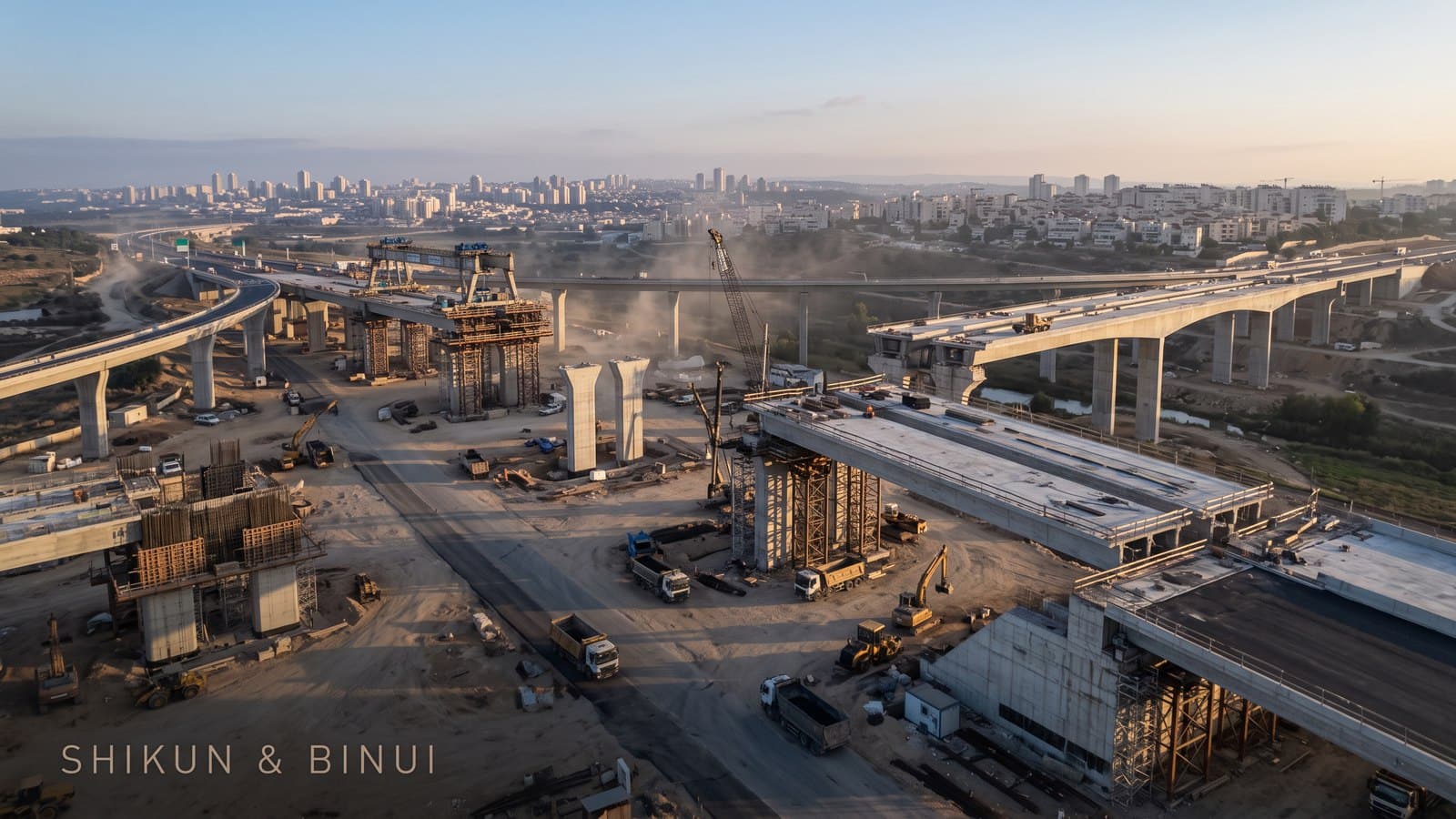
Shikun & Binui published its second-quarter report. This report moves from loss to profit in a single line, and it is worth understanding how.
Errors or inaccuracies are possible. Spotted something that looks wrong? Write to me and I will correct it.
The Quarter
| NIS millions | The quarter | Share of revenue |
|---|---|---|
| Revenue | 2,292 | |
| Gross profit | 150 | 6.5% |
| Operating profit | 84 | 3.7% |
| Pre-tax loss | -38 | |
| Net profit | 229 | 10.0% |
| Attributable to shareholders | 241 | |
| Non-controlling interests | -12 | |
| Basic earnings per share | NIS 0.42 | |
| Balance sheet total | 26,868 | |
| Shareholders' equity | 7,336 |
Three Lines, Each of Which Reverses the Direction
This is a report in which every step between lines changes the picture, so it is worth walking through it slowly.
The first: the gross margin
NIS 150 million of gross profit on NIS 2,292 million of revenue - 6.5%.
In infrastructure and construction contracting this is a familiar range. The price is set in a tender, years before execution, and the costs materialise over the life of the project. A low single-digit margin is the structure, not a surprise.
And because it is low, everything that happens after it matters far more.
The second: financing swallowed the entire operating profit
From NIS 84 million of operating profit, the quarter reached the pre-tax line as a loss of NIS 38 million.
NIS 122 million was taken out there - 145% of operating profit.
And this is the ratio worth taking from this report.
When more than 100% of operating profit is removed below the operating line, it means the activity itself does not cover the cost of the structure behind it.
And the explanation is in the balance sheet: NIS 26.9 billion of assets against equity of NIS 7.3 billion. An infrastructure company holds concessions, projects under construction and income-producing assets - all funded with long-term debt.
For comparison, from this same week: Afcon, also in infrastructure, lost only 16.5% of its operating profit below the same line. Same sector, an entirely different financing structure.
And the third: the tax line reversed the sign
A pre-tax loss of NIS 38 million. Net profit of NIS 229 million.
That is, the tax line contributed about NIS 267 million.
And that is too large a number to pass over without explanation.
A tax benefit is not money arriving in the till. It is an accounting entry, and usually one of two: the recognition of a deferred tax asset for losses that can be offset in future, or the reversal of a provision made in the past and no longer required.
In both cases this is a management assessment about the future, not a cash event.
And the structured quarterly filing does not detail the tax reconciliation, so I do not assert its source here. What can be said with certainty: this quarter's net profit does not describe the activity. The activity ends at the pre-tax line, and it is a loss.
So the figure that describes the quarter is -38 million, not +229.
And the Minority Says Something Too
Net profit is NIS 229 million, and the amount attributable to shareholders is NIS 241 million - larger than it.
The meaning: non-controlling interests absorbed a loss of about NIS 12 million.
In a branched group this is entirely possible: some of the subsidiaries that are not wholly owned ended the quarter at a loss, while the wholly owned companies contributed profit.
And this is the phenomenon we saw twice more this week - at Alony-Hetz and at Medipower. It is not rare, and it changes which line is relevant to the shareholder.
The Balance Sheet
| Balance sheet total | NIS 26,868 million |
| Shareholders' equity | NIS 7,336 million |
| Leverage ratio | 3.7 to one |
NIS 26.9 billion - among the largest balance sheets on the Tel Aviv exchange outside the financial sector.
And at an infrastructure company that is expected: a toll road under concession, a desalination plant or an energy project are assets built over years and yielding over decades, and they are funded accordingly.
הזווית שלי
דעה אישית של אילן אברמוב - לא ייעוץ ולא המלצה
This report is an almost perfect demonstration of why I do not read accounts from the bottom line upwards.
Anyone looking only at "net profit of NIS 229 million" sees an excellent quarter. Anyone reading top to bottom sees something entirely different: a gross margin of 6.5%, financing that swallowed 145% of operating profit, and a loss of NIS 38 million before tax entered the picture.
The same report, two opposite conclusions - and the direction you read it in is what decides.
And what troubles me here is not the tax but the ratio above it. A tax benefit may or may not recur; financing that takes more than the entire operating profit is a structural condition, and it will not change in a quarter.
So the two figures I will follow are operating profit against financing expenses, not net profit. Today that ratio is 84 against 122. For the quarter to end in real profit, the first has to grow or the second has to shrink.
And what I would look for in the full accounts is the order backlog and the profit split by segment - infrastructure, property and concessions behave entirely differently, and the structured filing presents them as one line.
(It is important to stress: this is my personal opinion only, and nothing herein constitutes a recommendation to take any action.)


