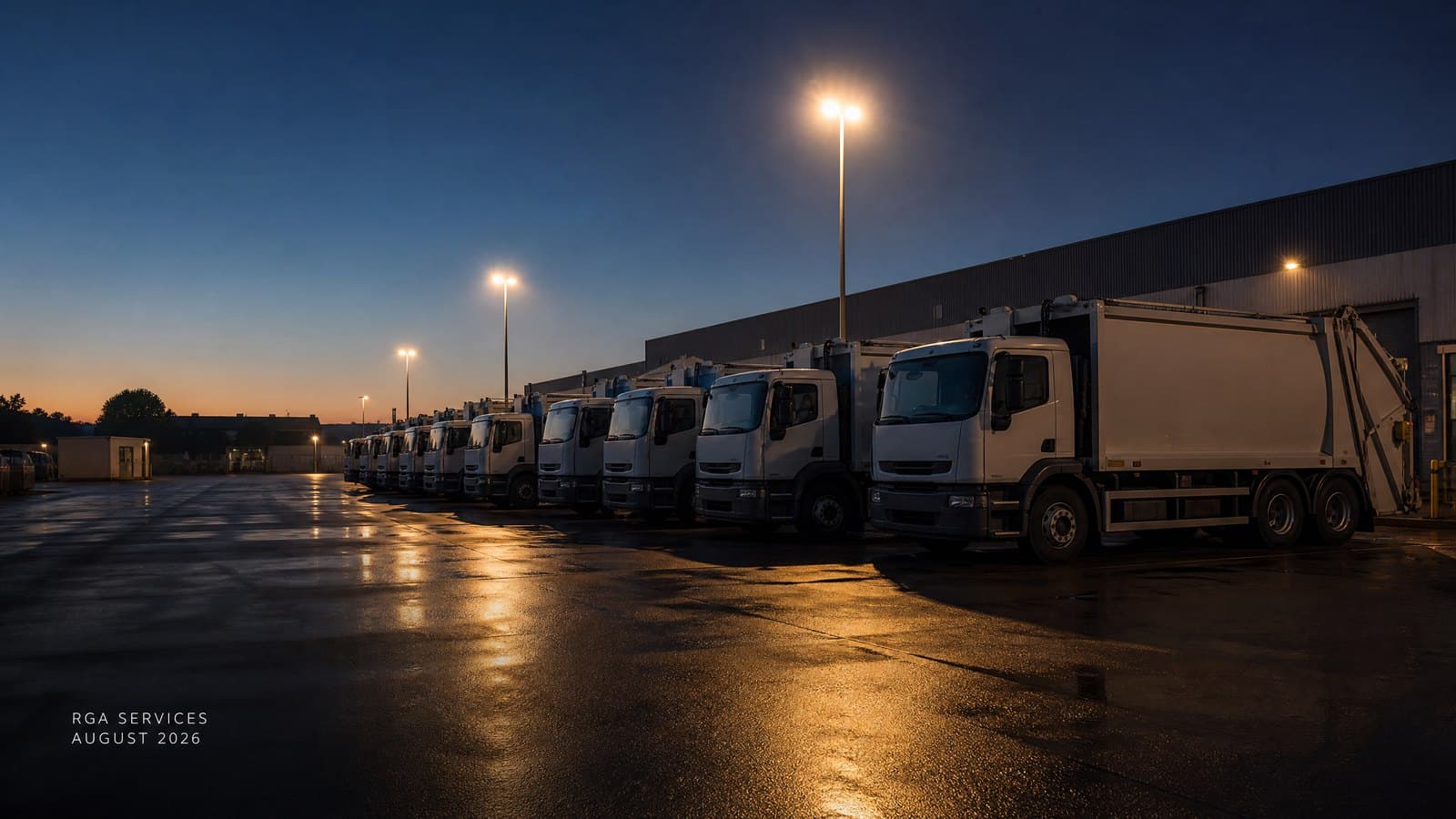
RGA published its second-quarter report. This is a business nobody talks about much, and its numbers teach something about the economics of services.
Errors or inaccuracies are possible. Spotted something that looks wrong? Write to me and I will correct it.
What This Company Does
In the words of the filing itself, the activity areas are "waste collection and removal, and the cleaning of open spaces and institutions".
And the customers are local authorities and government bodies.
And that defines the whole character of the business, in three ways.
The first - revenue is set by tender. A local authority publishes a tender for waste collection, and the winner supplies the service for a fixed period at a price agreed in advance. That is, price is not set by value to the customer but by whoever bid lowest - and that explains a 14.6% gross margin.
The second - the cost is mostly wages. Trucks, drivers, cleaning crews. And that is a cost that rises with time and does not fall with scale - so a contract signed two years ago at that year's price is squeezed by today's wages.
And the third - the customer almost never goes bankrupt. A local authority is not a buyer that stops paying. The price of that is long payment terms - and that is what ties the business to working capital.
The Quarter
| NIS millions | The quarter | Share of revenue |
|---|---|---|
| Revenue | 153.5 | |
| Gross profit | 22.4 | 14.6% |
| Operating profit | 13.5 | 8.8% |
| Pre-tax | 10.1 | 6.6% |
| Net profit | 7.9 | 5.1% |
| Attributable to shareholders | 7.9 | 100% |
| Basic earnings per share | NIS 0.02 | |
| Balance sheet total | 443.2 | |
| Shareholders' equity | 158.0 |
Three Lines That Tell the Story
The first - 60% of the gross margin survives.
From NIS 22.4 million of gross profit, NIS 13.5 million of operating profit was left. NIS 8.9 million went to selling, general and administrative costs.
And in a services sector that is a good ratio. For comparison from the same reporting season: at Sugat 29% survives, at Victory 15%, and at the IT companies I read - Matrix and One Technologies - around 52% and 54%.
And the reason the ratio is relatively high here is that head office is small. A business running trucks and cleaning crews does not need a thick management layer - most of the cost already sits in the gross line.
The second - financing takes a quarter.
From NIS 13.5 million of operating profit, NIS 10.1 million was left before tax. NIS 3.4 million was taken out - 25.1% of operating profit.
And the explanation is in the balance sheet: NIS 443.2 million of assets on equity of NIS 158.0 million - leverage of 2.80 to one, that is, liabilities of about NIS 285 million.
And that is relatively high leverage for a services business, pointing to two things that travel together in this sector: a heavy vehicle fleet - refuse collection trucks are expensive equipment
- and working capital waiting on payment from authorities.
That is, the company finances both its equipment and the gap between performing the service and collecting for it.
And the third, to the company's credit: zero minority interests.
All NIS 7.9 million of net profit is attributable to shareholders. In this reporting season that is not self-evident - I read companies here where half the profit went to someone else.
What I Will Check Next Quarter
| The gross margin | 14.6% today - it is set by tender and eroded by wages |
| The order backlog | In a contract business, backlog predicts more than revenue |
| Days sales outstanding | The gap between performing and collecting from authorities |
| Financing | 25.1% of operating, and directly tied to leverage |
| Tender renewals | Every contract that ends is both a risk point and an opportunity |
הזווית שלי
דעה אישית של אילן אברמוב - לא ייעוץ ולא המלצה
What draws me to a business like this is precisely what is uninteresting about it.
Waste collection does not grow at AI pace, it has no story, and nobody writes about it. But it has a property most exciting businesses would want: demand does not fall. A city produces refuse in a good year and a bad one, at a 3% interest rate and at 5%.
And what does decide in a business like this is not demand but price - and that is set by tender, against competitors, opposite an authority that wants to pay less.
So the only question that really matters here is whether contracts renew at a price that covers wage inflation. If they do, this is a stable and boring business. If they do not, a 14.6% gross margin is not a floor - it is a point on a slope.
And what I would look for in the full accounts is the order backlog and contract duration. In a business resting on tenders, backlog is the number that predicts the next two years - and quarterly revenue tells you only about what has already been performed.
(It is important to stress: this is my personal opinion only, and nothing herein constitutes a recommendation to take any action.)


