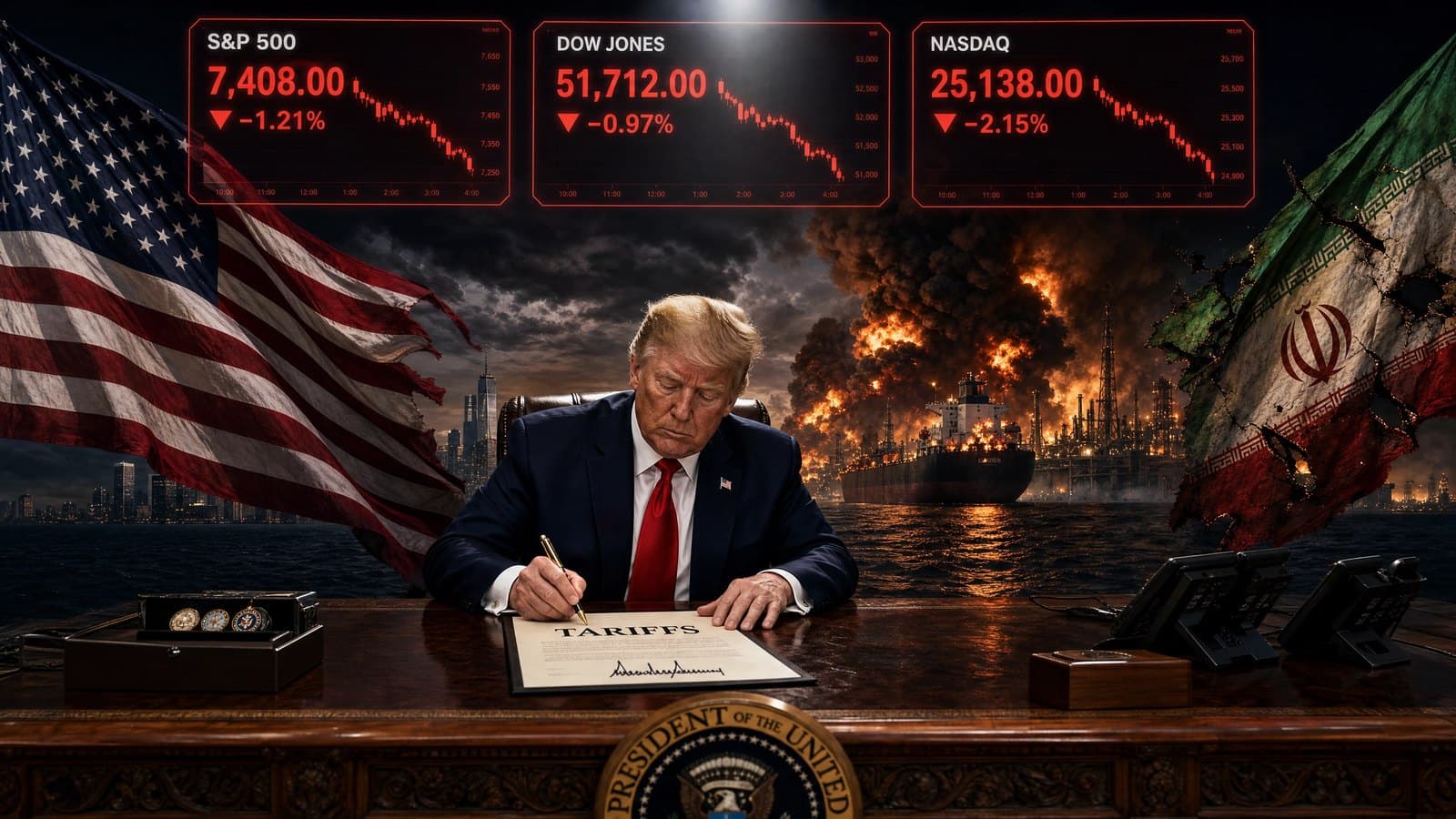
Wall Street closed red yesterday, oil jumped to the threshold of a hundred dollars a barrel, and this morning we woke up to a new line of tariffs on 60 countries. Three scary stories in one day - and precisely because of that it is worth stopping, making order, and saying what I really think: we have been in this story before. History repeats itself, and in the end - it passes.
But before the opinion - the facts, as usual, precise and verified.
What Exactly Happened Yesterday
Thursday, July 23, closed red across all the leading indices: the Dow Jones fell 0.97% (507 points, to 51,712), the S&P 500 fell 1.21% (to 7,408), and the Nasdaq fell 2.15% (to 25,138).
Behind the declines - four forces that acted in parallel, and it is important to separate them:
1. Iran and oil. President Trump escalated the rhetoric: he threatened to "bomb power stations and bridges" in Iran if the attacks on shipping in the Strait of Hormuz continue, said in an interview that he is considering a "massive strike" and that he is "close to a decision," and made clear that the U.S. will hold Tehran responsible for any Houthi attack. In parallel, the Houthis attacked tankers in the Red Sea. The result: Brent jumped about 6% and traded around the $100 mark - the highest levels since May - while during trading it even crossed the round threshold (the exact closing reports ranged from about $99 to $101, depending on the contract and the measurement).
2. The tariffs. Last night the administration announced a new tariff wave, which took effect overnight: 10% to 12.5% on 60 trade partners, covering about 99% of U.S. trade - Canada, Mexico, India and Britain at 10%; the EU and Taiwan up to 12.5%. The new wave was enacted under Section 301 of the trade law, after the courts struck down the previous legal route.
3. Bond yields. And here is the channel of influence most important to understand: the 10-year government bond yield climbed to 4.71% - the highest since January 2025. The mechanism is simple: oil at the threshold of $100 reignites inflation fears, and the bond market responds immediately - yields rise, financing costs get more expensive, and rate expectations flip. So much so that in the futures markets the bet on a rate hike in 2026 jumped to about 70% - a sharp turn from the cut expectations of early in the year. This is the channel through which geopolitics really touches everyone's portfolio.
4. Tech reports. And here precision matters: a significant part of the Nasdaq's drop yesterday is related neither to Iran nor to tariffs - but to reports. Tesla plunged about 14% and Alphabet fell about 7%, amid investor concerns over the jump in AI spending. We broke down these two reports separately - that is a different story, of earnings season, not of geopolitics.
Now - Why I'm Not Alarmed
Let us take the two "scary" stories - the tariffs and geopolitics - and put them against recent history. Not theory, real examples with dates and numbers.
The Tariffs: The Story That Has Already Folded Several Times
April 2025, "Liberation Day." On April 2, Trump announced a sweeping 10% tariff on nearly all imports, with high "reciprocal" rates on dozens of countries. The market crashed: the S&P 500 lost 12% in four days. And then, on April 9 - one week later - a 90-day pause on most of the tariffs was announced. That day the S&P jumped 9.5% - its best day since 2008. Within a few weeks, the market erased the entire drop and returned to positive territory.
China. Tariffs on China climbed to 145% - an effective embargo level. And what happened? On May 14, 2025, after a meeting in Geneva, the tariffs came down to 30% (and China cut its own from 125% to 10%).
The EU. On May 23, 2025, Trump threatened a 50% tariff on EU goods starting June 1. Two days later, after a single phone call with the Commission president, the threat came down. Later a deal was signed with a 15% tariff.
The pattern is consistent: the threat opens high, the negotiation closes low. And this brings me to the most interesting figure in the current wave: the tariffs that took effect this morning are 10% to 12.5% - significantly lower than anything that threatened the markets in 2025. Whoever held through those dramas knows how this movie ends.
The Geopolitics: The Market Has Seen This Too
Here too, no need to go far. The campaign against Iran is not new - it has continued since late February. The market has lived with it for five months now, and along the way we have seen ups and downs, but the big trend has not broken. Oil is the tool through which the Iran story really passes to the markets - which is why it responds sharply (and that makes sense, there is a real supply risk in Hormuz) - but the stock market itself has already learned to distinguish rhetoric from a substantive change.
And the Figure Most Worth Noting
Compare for a moment: in April 2025, a tariff threat knocked the market down 12% in four days. Yesterday, a combination of war threats + oil at the threshold of 100 + yields at an 18-month high + a new tariff wave brought the S&P down 1.2% in one day. This is not apathy - this is learning. The market has seen the pattern enough times to price it in: it responds less to every headline, because it knows that the distance between a dramatic announcement and economic reality is large.
And What the Noise Hides: The Businesses Themselves Are in Good Shape
And there is another layer the red headlines hide: while geopolitics makes noise, the businesses themselves are reporting - and the reports are positive. Last week the big banks opened the season with everyone - from JPMorgan to Citigroup - beating forecasts (Citi even recorded its best revenue quarter in a decade). And this week, in the reports we covered here one by one: Lockheed and RTX beat and raised guidance the same morning, GE Vernova nearly doubled its cash-flow guidance, Blackstone at a record $1.35 trillion in assets under management, Intel recorded its strongest revenue growth in 15 years, and Nokia posted a 105% jump in sales to AI customers. This is not a picture of an economy breaking down - this is an earnings season of businesses in full form.
And to the fear that yields will halt the AI journey - I do not share it. The giants leading this investment do not build data centers on cheap credit; they fund them from enormous cash flows, and whoever plans infrastructure for a decade does not stop for one more percent on money. And the great irony of yesterday: the reason Alphabet fell 7% is precisely that it is increasing its AI investment - the market complained about excess investment, not about a halt. In Intel's report this week too, the CFO explicitly said the company is "meaningfully increasing" its investment in equipment and infrastructure. This journey does not stop for a percent.
And what is still worth watching
"It passes" is not "it doesn't matter." Three things do require an open eye: oil settling above $100 over time - because it filters into inflation; bond yields - which already rose to 4.71% and turn the rate question from a cut to a hike, which affects the pricing of every risk asset; and a real escalation in Hormuz - a closure of the strait is a fundamentally different scenario from rhetoric. These are the axes that will decide whether this time is different. Until that happens - the historical pattern is in our favor.
In the End - My Opinion
Those who follow us know we wrote about this in our piece on investor psychology: the pain of a red day feels double the joy of a green day - and that is exactly the moment when bad decisions are made. So I will say mine simply: we have been in this story before. In tariffs, in threats, in oil. History repeats itself - and in the end, it passes. Whoever sold in panic in April 2025 got an expensive lesson; whoever stuck with the plan - got the recovery.
This is not a call for complacency, and as always - nothing here is a recommendation. It is a call for perspective: to separate noise from signal, to remember that the emotional reaction is the most predictable part of the story, and to let history - the very recent kind - remind us how these dramas tend to end.
Sources: index closing data and oil prices from international financial coverage (CNBC, Bloomberg, Yahoo Finance); tariff details from administration announcements and NBC and Bloomberg coverage (July 23-24, 2026); the timeline of the 2025 tariffs from coverage of the period. All data current as of the time of writing. Nothing herein is a recommendation or advice - see the full disclaimer at the bottom of the page.


