Aran Research and Development (1982) reported today, 18 August, to the Israel Securities Authority and the Tel Aviv Stock Exchange that it has agreed to sell the group's product development and manufacturing activity to the American company Ondas. The filing is signed by the company's chief executive, Ran Satav.
Errors or inaccuracies are possible. Spotted something that looks wrong? Write to me and I will correct it.
Who Aran Is
Aran Research and Development (1982) is an Israeli company based in Caesarea, listed in Tel Aviv. It is not a maker of a single product but a development house: it takes companies from concept and specification through mechanical and electronic design to prototype and series production.
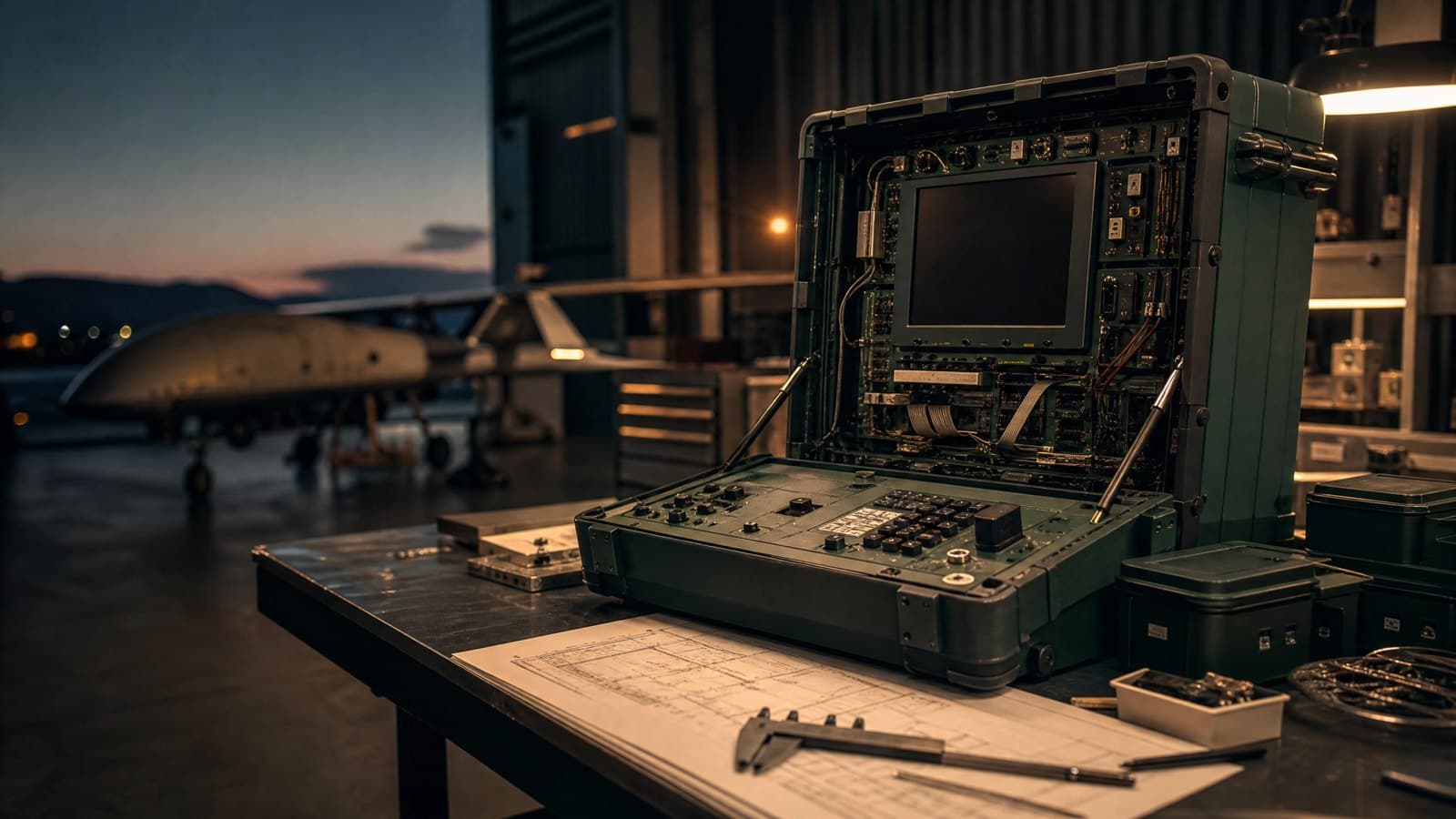
By its own description of its activity it works in four fields - defense and homeland security, medical devices, water, and consumer and industrial products. On the defense side it works, among other things, on portable and fixed control stations for unmanned systems, on electro-optics, and on ruggedised electronics for ground, marine and airborne platforms.
And that is the point that explains this deal, which we will come back to: a control station is the layer that connects an unmanned vehicle to its human operator.
What Is Being Sold, and What Is Not
The structure is not a sale of Aran itself. It is the sale of a company incorporated specifically for the transaction:
| Seller | Aran Research Development and Models - a wholly owned subsidiary of Aran |
| Company sold | Aran Defense Ltd - incorporated for the purpose of this deal |
| Buyer | Ondas Inc., Nasdaq, ticker ONDS |
| What transfers | The activity, assets and liabilities of the development services and product manufacturing division |
That is, Aran Models will transfer the division to Aran Defense, and then sell all of Aran Defense's shares. Lease agreements were also signed, under which Aran Models will lease real estate to Aran Defense.
And three things are expressly left outside the deal: the managed engineering service, the software and computing services provided through Aran Software - a limited partnership held at 80% - and the 3D printing activity.
The Consideration, and This Is the Heart of It
| Deal value | NIS 100,000,000 |
| Basis | cash free, debt free |
| Form of payment | Newly issued Ondas ordinary shares - all of it |
| Setting the share count | The average price over the five trading days preceding allocation |
| Registration | A prospectus supplement to the existing Nasdaq shelf |
| Adjustments | Working capital and transaction expenses, with a True-Up within 90 days of closing |
| Escrow | 10% of the consideration, for 18 months |
There is not a single shekel of cash in it.
And who carries the price risk - that is the question the pricing mechanism answers.
The share count will be set by the average over the five trading days before allocation. That is, the seller receives NIS 100 million of value whatever the Ondas share does.
If the share falls before completion, Ondas issues more shares to reach the same sum. If it rises, it issues fewer.
The risk here is dilution risk, and it belongs to Ondas and its shareholders - not to the seller. And that takes on added weight given that the company itself cannot estimate when the conditions precedent will be satisfied.
The Dilution Is Not a Side Effect - It Is the Method
This is the thing worth knowing about this company, and it sits in its own quarterly report:
| Ondas shares | |
|---|---|
| 31 December 2025 | 380,763,481 |
| 30 June 2026 | 529,838,610 |
| Added in six months | 149,075,129 shares, +39.2% |
| Authorised share capital | 1,200,000,000 |
And the weighted average says it more sharply: 500.7 million shares in the second quarter, against 150.7 million in the year-earlier quarter. A factor of 3.3 in a single year.
And the Aran purchase is not an exception - it continues a pattern. On 10 August Ondas completed its acquisition of the British company Cyberhawk for $118.2 million in cash plus 581,732 shares. Before that it announced a series of further deals, among them DZYNE, Mistral, Rotron Aero and 4M Defense.
And this is the tension anyone looking at Ondas has to hold in both hands.
On one side: an acquisition paid in stock burns no cash and adds no debt. A company growing at this rate can buy capability without touching the treasury.
On the other: every such purchase shrinks an existing holder's share of the business. Revenue growing 13-fold in a year sounds different when the share count grows 3.3-fold in the same year - because what is measured in the end is not revenue but revenue per share.
This is not an argument against the model. It is a statement that this model is measured in a different currency: not by how much was bought, but by whether what was bought creates more value per share than it cost in dilution.
Why Ondas Needs Aran Specifically
The price itself gives a hint. Revenue of the activity being sold was about NIS 54 million in 2025, and the deal is done at NIS 100 million - a multiple of about 1.85 times revenue.
That is not a software company's multiple, and it fits the fact that what is being bought is not a product but a capability.
And that capability can be described simply: Ondas has built itself over the past two years out of acquisitions. It bought aerial platforms, counter-drone systems, engines, command and control software and ground robotics. What it has now is a collection of capabilities acquired separately, each of which arrived with its own team and its own architecture.
And that is precisely the hard part. An acquisition adds a product; what turns a collection of products into a system is systems engineering work - interface adaptation, tooling, standards compliance, and the move from prototype to series production.
And that is exactly what a development house does.
Aran is not bringing Ondas a new product to add to the catalogue. It is bringing the layer that connects what has already been bought - a team that knows how to take a specification, design the mechanics and electronics around it, build a prototype and move it into production.
And two facts in the agreement support that reading.
The first - the non-compete. Aran Models and entities related to it undertook not to compete with Aran Defense's business in the development and manufacture of defense products, anywhere in the world, for four years. A buyer of a customer book does not need such a clause. A buyer of a team and a capability does.
And the second - the indemnity cap on intellectual property. While a breach of ordinary business representations is capped at the escrow, a breach of intellectual property representations reaches up to half the consideration, and the claim period for it is longer - 24 months against 18. The agreement itself prices intellectual property as the most sensitive item.
The Legal Mechanics, Briefly
| Basket | $175,000, and above it indemnity from the first dollar |
| Ordinary business representations | Capped at the escrow · 18 months |
| Intellectual property representations | Capped at half the consideration · 24 months |
| Fundamental representations and covenants | Up to 60 days after the statute of limitations |
| Fraud | Uncapped |
The fundamental representations include incorporation, capital structure, authority, intellectual property, taxes and brokerage fees - and for those the buyer can recover directly from Aran Models, not only from the escrow.
The Conditions Precedent - and This Is Where the Timetable Sits
Completion is subject to a set of conditions, of which these are the principal ones:
- Completion of the transfer of the activity to Aran Defense, including signing the leases
- Approval of the Israeli Competition Authority
- Third-party consents
- Ondas's eligibility to register the consideration shares, and a valid shelf prospectus
- The absence of an order suspending the effectiveness of the prospectus
- The absence of any impediment or delay arising from notice or comments from the SEC
- The absence of a material adverse event at Aran Defense
And the sentence worth flagging: as at the date of the filing, the company cannot estimate when the conditions precedent will be satisfied, and accordingly nor the completion date.
Note that four of the seven conditions concern Ondas's ability to issue and register the shares. That is the direct consequence of an all-stock deal: registration is not an after-the-fact formality but a condition to closing.
And What It Does to Aran Itself
The activity being sold is material to the company. Its revenue in 2025 was about NIS 54 million, and Aran expects a pre-tax gain of about NIS 75 million on completion.
A gain of 75 million on a sale at 100 million says the book value of the activity was low - meaning most of the consideration will be booked as gain rather than as a return of existing investment.
And what remains to Aran after the sale, per the filing: import and marketing of equipment and technology for the plastics industry and for recycling, engineering solutions in the environmental field including the design of waste separation plants, investment in medical start-up ventures, and software, computing and mechanical engineering services - including the 3D printing.
That is, Aran is exiting the defense field, and redefining itself around plastics, the environment and software.
A Note on the Timing of Publication
The filing states that disclosure of the negotiations was delayed from 25 March 2026, under Regulation 36(b) of the securities regulations. The reason given: at the negotiation stage, immediate disclosure could have frustrated the shaping of the terms and harmed the conduct of the talks.
That is, the contacts ran for about five months before reaching a binding agreement.
הזווית שלי
דעה אישית של אילן אברמוב - לא ייעוץ ולא המלצה
This purchase is small in its numbers, and I read it as one of the most consequential Ondas has made this year.
It deepens the engineering capability. Over two years Ondas bought platforms, engines, sensors and software - and each arrived with its own team and its own architecture. A development house is what turns a collection like that into one system, and that is exactly the gap another product acquisition cannot close.
It deepens the presence in Israel, and that is where the customers are. Ondas announced on 11 August that it had been selected to build the next generation of the Israeli military's tactical attack drones. A company whose customer is the Israeli defense establishment gains from having its engineering arm sit here - close to the customer, to the standards and to the language.
And it closes a manufacturing gap. Aran is a strong development house, but a development house is not a factory. Ondas brings the scale, and Aran brings the people who know how to carry a product to the point where it is ready for series production. Each side completes the other.
And what matters to me is that this is not the purchase of a promise. It is an activity that generated about NIS 54 million in 2025, with existing customers and agreements. Ondas has already shown it knows how to leverage a going concern and connect it to what it has.
And on whether it is cheap - the numbers say "not expensive", and I am careful not to say more than that.
What they do say: NIS 100 million against revenue of NIS 54 million is a multiple of about 1.85 times revenue. In a defense engineering business that is a comfortable level, certainly next to the larger deals Ondas has done this year.
What they do not: the filing does not give the profitability of the activity being sold, and without a profit line there is no telling whether the price is cheap or merely low. And there is a further layer: in an all-stock deal, "cheap" also depends on the price of the currency you pay with. The more expensive the Ondas share, the cheaper the deal in dilution terms - and the reverse.
And what I will be following: four of the seven conditions precedent depend on Ondas's ability to register the consideration shares, and the company itself wrote that it cannot estimate when. In an all-stock deal, the distance between signing and closing is also a distance of price.
(An important note: this is my personal opinion only, and nothing here is a recommendation to take any action.)


