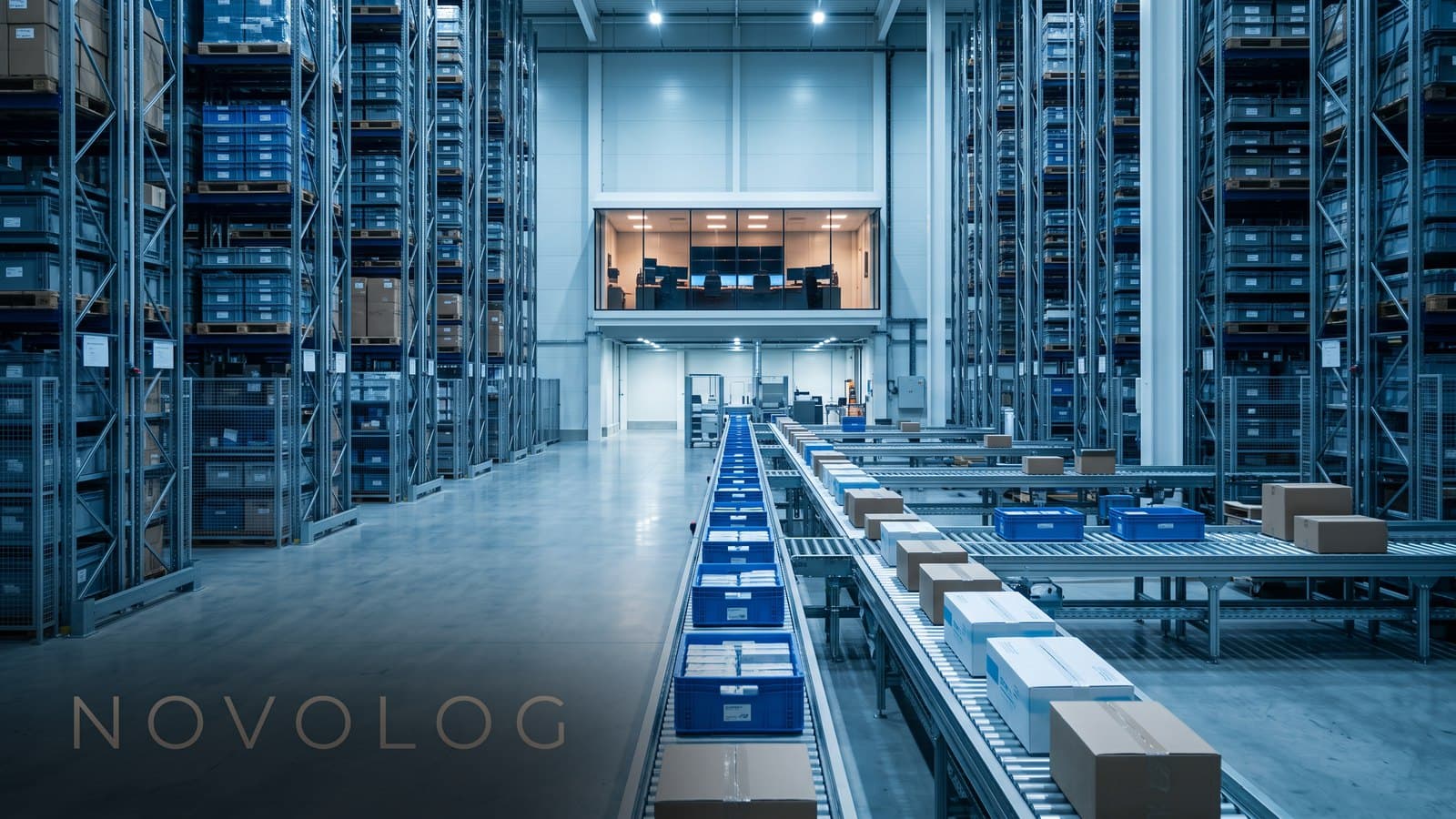
Novolog published its second-quarter report. It demonstrates what happens when a thin margin meets an asset-heavy structure.
Errors or inaccuracies are possible. Spotted something that looks wrong? Write to me and I will correct it.
The Quarter
| NIS millions | The quarter | Share of revenue |
|---|---|---|
| Revenue | 451.9 | |
| Gross profit | 36.3 | 8.0% |
| Operating profit | 8.6 | 1.9% |
| Pre-tax profit | 2.5 | 0.6% |
| Net profit | 0.541 | 0.12% |
| Attributable to shareholders | 0.559 | |
| Balance sheet total | 2,706.5 | |
| Shareholders' equity | 357.1 |
Four Lines, and at Each One Profit Shrinks
This is a report where you can follow profit until it almost disappears.
| The amount | What was taken | |
|---|---|---|
| Revenue | 451.9 | |
| Gross profit | 36.3 | 92.0% taken as cost of sales |
| Operating profit | 8.6 | 76.2% of gross |
| Pre-tax | 2.5 | 70.6% of operating |
| Net profit | 0.541 | 78.8% as tax |
And each stage here is explicable on its own, but the cumulative result is that almost nothing remains.
The gross margin, 8.0%, is characteristic of distribution. A distributor buys and sells - it does not manufacture, and so it does not add value through price. Its profit is built from volume.
Operating expenses swallowed three quarters of that margin. In pharmaceutical logistics that makes sense: temperature-controlled warehouses, refrigerated transport, quality control and regulation - all fixed costs that do not move with turnover.
And financing took 70.6% of what was left. The explanation is in the balance sheet: NIS 2,706.5 million of assets on equity of NIS 357.1 million - a ratio of 7.6 to one.
And finally tax, at 78.8% - a rate three times the corporate rate.
And the Tax: 78.8%
NIS 2.5 million before tax, NIS 541 thousand after. Tax took about NIS 2.0 million.
And that is a rate that looks extraordinary, and on a base this low it is almost always arithmetic rather than economics.
The tax charge in the accounts is not computed as a percentage of the quarter's accounting profit. It comprises several components: current tax on taxable income, movements in deferred taxes, and adjustments for prior years.
When pre-tax profit is large, those components are absorbed within it and the tax rate looks close to 23%. When it is small - here only NIS 2.5 million - those same components become an enormous percentage of it.
So "a tax rate of 78.8%" does not mean the company pays high tax. It means pre-tax profit was too small for the ratio to be meaningful.
And that is why I do not draw conclusions from a tax rate computed on a negligible base - exactly as I do not compute a percentage change on a negative base.
And the Minority Absorbed a Loss
Net profit is NIS 541 thousand, and the amount attributable to shareholders is NIS 559 thousand - larger than it.
The minority absorbed a loss of about NIS 18 thousand. A negligible sum in itself, but it tells you there is activity in the group that is not wholly owned and that ended the quarter at a loss.
הזווית שלי
דעה אישית של אילן אברמוב - לא ייעוץ ולא המלצה
What I take from this report is how little room there is in a business like this for error.
NIS 451.9 million came in, and NIS 541 thousand remained. That is a ratio of about one in a thousand. Any small change in one of the four stages - cost of sales, operating expenses, financing or tax - erases the result entirely or doubles it.
And that does not mean the business is bad. Pharmaceutical logistics is an essential service with real barriers to entry - regulation, cold chain, and manufacturers' trust. What it does mean is that its profitability is extremely sensitive.
And the central point I hold is that the balance sheet, NIS 2.7 billion, is six times quarterly turnover. In a business earning NIS 541 thousand a quarter, that is a very heavy balance sheet to carry - and the financing on it takes 70.6% of operating profit.
So the number I will follow is not net profit, which is in any case noisy at this scale, but operating profit. NIS 8.6 million a quarter is the figure that describes the business; everything below it describes the financial structure.
And what I would look for in the full accounts is how much of the leverage is warehouse leases and how much is genuine financial debt - two obligations that look identical on the balance sheet and behave entirely differently.
(It is important to stress: this is my personal opinion only, and nothing herein constitutes a recommendation to take any action.)


