Disclosure: the author holds shares in Next Vision (NXSN), as of the date of publication. Those holdings may change at any time without notice. Nothing here is a recommendation to take any action in any security. See the full disclosure and disclaimer at the foot of the page.
Next Vision Stabilized Systems reported its second quarter on 10 August 2026. We are writing about it today.
Errors or inaccuracies are possible. Spotted something that looks wrong? Write to me and I will correct it.
What the Company Does
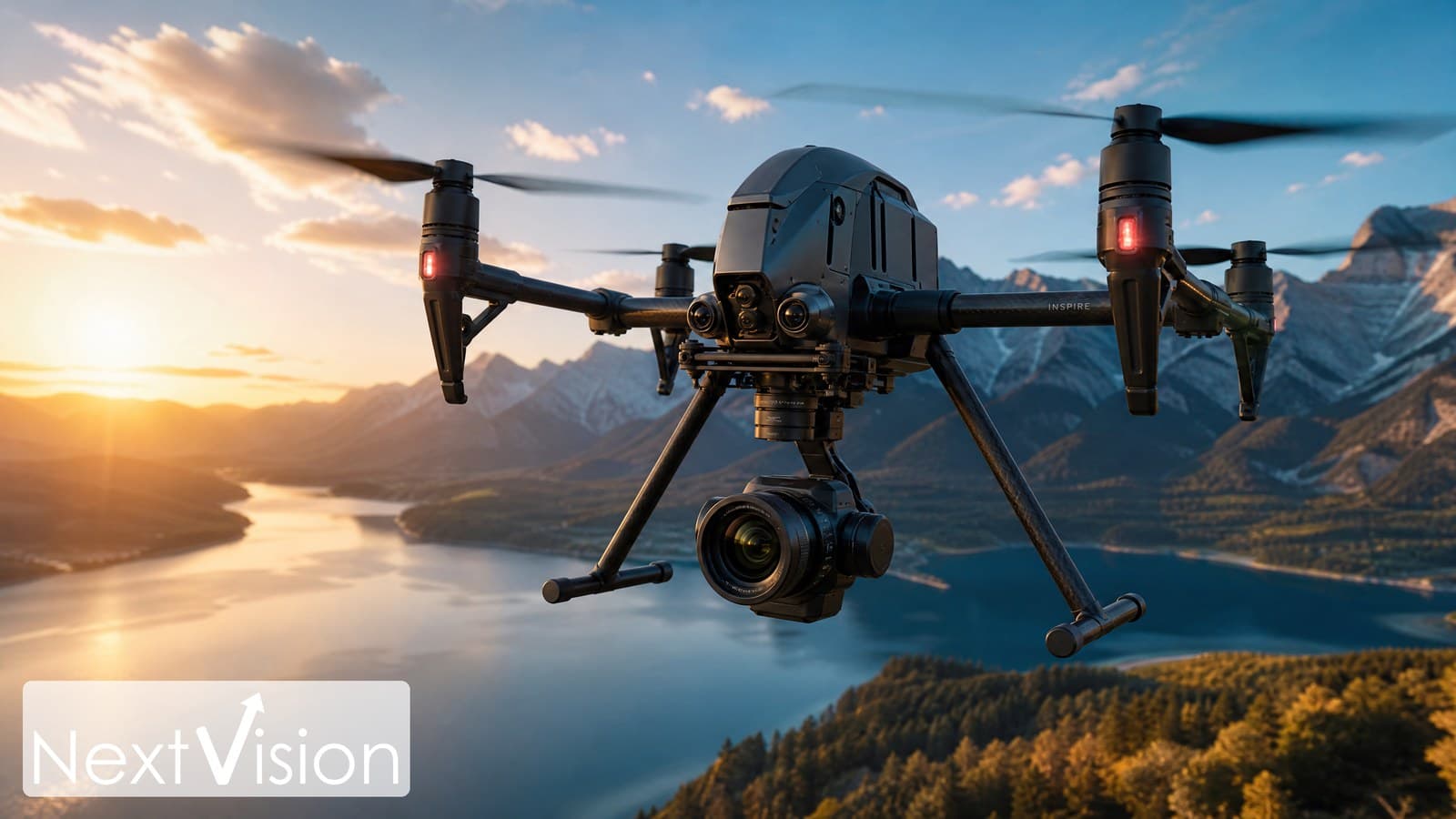
Next Vision makes stabilised cameras for unmanned platforms.
A stabilised camera is one that stays locked on a target even while the vehicle carrying it moves, shakes or turns. Without stabilisation, footage from a drone at speed is noise. With it, you can identify an object from kilometres away.
The products sit in a weight range between 2 grams and 115 grams, and that number explains the company: to mount a stabilised camera on a micro drone, every gram decides.
And who are the customers? Not end users. The company sells to the makers of the platforms - drone and UAV manufacturers who integrate the camera into their own product and sell it on. That detail explains one of the more unusual numbers in the report.
The Quarter
| The quarter | A year ago | |
|---|---|---|
| Revenue | $88.15 million | |
| Gross profit | $57.45 million | $26.56 million |
| Operating profit | $51.81 million | $23.01 million |
| Pre-tax profit | $57.33 million | |
| Net profit | $53.65 million | $23.22 million |
| Basic EPS | $0.583 | |
| Diluted EPS | $0.565 |
Quarterly gross profit grew 116%. Operating profit grew 125%. Net profit grew 131%.
And for the half as a whole: gross profit of $102.74 million against $53.05 million a year ago, operating profit of $90.15 million against $45.21 million, and net profit of $91.91 million against $43.80 million.
The Number You Cannot Walk Past
The net margin for the quarter was 60.9%.
Not the operating margin. Not the gross margin. The net margin, after every expense and after tax. It is higher than the gross margin of most hardware makers in the world.
How does that work? Here is the expense structure for the whole half:
| The half | A year ago | |
|---|---|---|
| Research and development | $3.63 million | $2.28 million |
| Sales and marketing | $1.67 million | $0.88 million |
| General and administrative | $7.30 million | $4.68 million |
$1.67 million on sales and marketing. In half a year. Against gross profit of $102.74 million.
That is under 2% of gross profit. And it is not thrift, it is market structure. The company sells to platform manufacturers, not to end users. There are no campaigns, no distribution network, no field sales force. There is a small number of customers who integrate the component into their own product. The contest is engineering, not marketing.
And in the same direction: research and development of $3.63 million for the half, roughly 3.5% of gross profit. For a hardware technology company that is very low, and it is the point I would want to understand properly - whether it reflects efficiency, or under-investment in the next generation.
Three More Things in the Report
Net profit is higher than operating profit, and that is not an error. Operating profit was $51.81 million and net profit $53.65 million. The gap comes from finance income of $6.26 million on large liquid balances. Net of $0.74 million of finance expense, pre-tax profit was $57.33 million.
The tax rate was 6.4%. Tax of $3.68 million on pre-tax profit of $57.33 million. That is a very low rate, and it comes from Preferred Enterprise status in Israel.
And the order backlog: about $265.2 million as of the report date. Against a quarter of $88.15 million, that is roughly three quarters of work already in hand. It is worth tracking quarter to quarter, because for a component supplier into industry it is the real leading indicator - not the revenue of the quarter just past.
The Balance Sheet
Equity stood at $671.92 million, against a total balance sheet of $734.40 million. That makes equity about 91.5% of the balance sheet - a company with almost no leverage.
Current assets were $721.21 million, meaning almost the entire balance sheet is liquid.
And in March 2026 the company paid a dividend of about $51.83 million.
הזווית שלי
דעה אישית של אילן אברמוב - לא ייעוץ ולא המלצה
This is one of the cleanest reports I have read this year, and precisely because of that it is worth asking what holds it up.
A hardware company earning 61% net is unusual. Not 61% gross - 61% net. The structural reason is clear and appears in the filing itself: it sells a component to manufacturers, not a product to consumers. It carries no distribution cost, no marketing, and it has a product that is hard to swap out mid-production-programme.
And what I am asking is how long that holds. A margin like this is a magnet for competition. The defences here are a patent, weight, and the customer's own engineering already built around the product - and the third is usually the strongest, because replacing a stabilised component mid-programme is real pain.
And what I will be tracking is not the profit, it is the backlog and the customer count. The backlog is about $265 million, roughly three quarters forward. That is the number that tells us whether this growth continues, long before it shows up in revenue.
And what I would want to hear on the investor call is about research and development. $3.63 million for the half, at a company that earned $91.9 million in the same period. If that is efficiency, excellent. If it is under-investment in the next generation, it is exactly the kind of thing you do not see in one quarter but do see across three.


