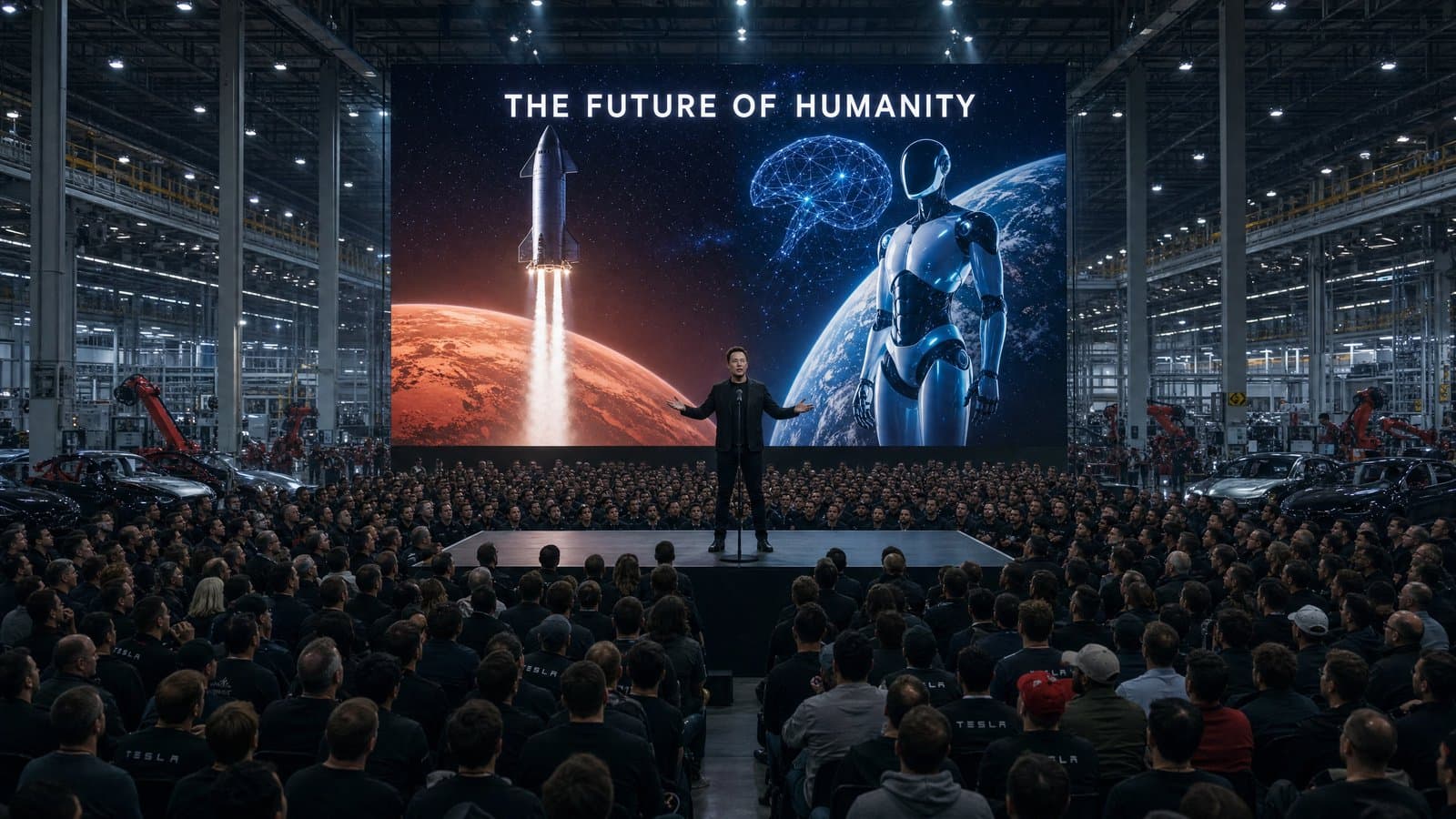
On July 20, Elon Musk sat down opposite Zanny Minton Beddoes, The Economist's editor-in-chief, for an interview of almost 90 minutes. The location was not a London studio and not a Silicon Valley office, but the main lobby of Giga Texas - Tesla's giant factory in Austin. When a company chooses the backdrop for the year's big interview, the choice itself is a statement: not the social network, not the spaceships - the factory. We will return to this point, because it tells half the story.
The interview, published on July 23, went within two days from the status of "another Musk interview" to a media event: extreme forecasts on the future of AI, a head-on confrontation with the interviewer over Europe and the media, and a strange ending in which Musk asked why The Economist does not write about air conditioning. Beneath that noise hides an hour and a half that is actually worth the serious investor's thorough unpacking - because alongside the provocative headlines, Musk said one sentence there that confirms, from the most authoritative direction there is, the central thesis we have been tracking all summer.
The Vision: Five, Ten, Twenty
Musk laid out a sharp timeline: "AI may exceed the sum of human intelligence in about five years", within a decade humans "will no longer run the world," and in 2036 - literally - "money will play no role."
Let us pause to explain the concept, because it underlies everything. When Musk talks about AI exceeding "the sum of human intelligence," he is describing what is commonly called superintelligence: not software that beats a human at a defined task (that has existed for a long time - from chess to analyzing financial reports), but a system that surpasses the cognitive ability of humanity as a whole, in every domain. It is a leap without precedent, and it is important to say in fairness: there is no consensus in the scientific community on either the date or the very feasibility within such a horizon. Five years is an aggressive forecast even relative to what is customary inside the AI industry itself.
From that forecast derives the economic vision. In his words: "the most likely outcome is an age of amazing abundance, where anyone can have anything they can think of." And the mechanism he described thus: "if you have vast numbers of robots with vast amounts of digital intelligence, you have a sort of quasi-infinite economy." Work, he said, "is going to be optional."
Here too, a moment of professional framing: Musk is describing a post-scarcity economy - a theoretical state in which the marginal cost of producing a good or service (that is, the cost of producing the next unit) approaches zero, because robots build robots that build everything. In such an economy, the price mechanism - whose entire role is to allocate limited resources - loses its function. It is a logically consistent idea on paper. The problems begin when you bring it down to earth.
The Hole in the Vision: "The Treasury Should Issue Checks"
And here comes the point where the interview turned from a vision show into an instructive document. Minton Beddoes did what many interviewers forgo: she pressed on the "how." If work is optional and billions of people are not earning - what do they live on during the transition? Who funds the consumption? Musk's answer, in full: "I think that the Treasury should just simply issue people checks."
That answer deserves serious unpacking, because it touches a real economic debate. The idea Musk touched is called Universal Basic Income (UBI): a fixed stipend the state pays every citizen, unconditionally, as a safety net in a world where automation replaces work. It is a legitimate idea researched seriously. But between UBI as budgeted policy and "the Treasury will issue checks" lies an abyss, and its name is funding:
- If the checks are funded by taxes - you must tax the owners of the robots and the capital, meaning exactly the companies Musk heads. On that taxation question he was not asked and did not answer.
- If the checks are funded by printing money - history is unequivocal: monetary expansion that finances consumption without a parallel growth in supply produces inflation. We saw it in miniature after 2020. "Abundance" financed by printing is not abundance - it is a transfer of wealth from holders of cash and bonds to holders of real assets.
- And if supply is truly infinite as he claims, no checks are needed at all - which contradicts the need he himself presented.
The economic coverage pounced on that answer justifiably. Not because the idea is illegitimate, but because it exposed a consistent gap in the interview: a remarkably detailed vision, a transition plan that does not exist. For the investor, that gap is important information in itself - we will get to it in "My Angle."
The Sentence That Really Matters: China and Electricity
And now to the part where Musk moved, in our view, from futurist lecture to the most solid ground there is. Asked about the race against China, he did not talk about algorithms and not about chips. He talked about electricity:
We checked the figure: China currently generates roughly twice as much electricity as the U.S., and its total generation is close to the sum of the U.S., Europe and India together. Musk's phrasing ("far more") is generous, but the direction is accurate - and above all, the logic behind it is accurate: an AI model runs on a data center, and a data center runs on electricity. Whoever has no electricity has no AI - no matter how many brilliant engineers they have.
Those who read us recognize the pattern immediately. This is exactly the thesis we laid out in the power scarcity piece, which received numerical confirmation in GE Vernova's report - a turbine backlog that jumped from 100 to 116 gigawatts in a single quarter - and in NextEra's report, with 3.6 new gigawatts of backlog thanks to data-center demand. When the man building some of the largest data centers in the world (Tesla and xAI) says the race's bottleneck is electricity - that is testimony from the inside, from the side that buys the turbines, not the side that sells them.
It is also the sentence with the clearest practical implication in the interview: electricity infrastructure - generation, transmission, storage - remains, in our view, one of the central axes of the decade, regardless of whether superintelligence arrives in five years or in twenty.
The Business Context: Why Giga Texas, of All Places
Let us return to the backdrop, because now it decodes itself. Musk described in the interview the missing link in his abundance vision: "you need the end effectors, in the form of humanoid robotics... vastly intelligent robots can shape atoms into goods." In practical translation: software alone does not produce abundance - you need a physical body to execute. And that is exactly the product Tesla is trying to build with Optimus, its humanoid robot.
The choice to film the interview at Giga Texas positions Tesla not as a carmaker but as the robotics company of the AI era. And the timing is not accidental: as we broke down in the Tesla report review, this is exactly the quarter in which the company doubled the bet - capital expenditures jumped 142% to $5.79 billion, the Fremont production lines were cleared for Optimus, and free cash flow turned negative. The interview is, in a sense, the marketing campaign of that investment decision: Musk explaining to investors why it is worth burning cash today.
Is it working? That is exactly the question the market will decide in the coming quarters, and it is the same question we asked about the AI cycle as a whole: the pace of investment versus the pace of return. The interview did not answer it - it supplied the narrative meant to bridge the period between the investment and the return.
The Noise: Britain, DOGE and the Confrontation with the Media
A large share of the coverage focused on the political parts, and for accuracy's sake we will survey them briefly and with balance.
Britain. Musk repeated his claim that "if current trends continue, civil war in Britain is inevitable." Minton Beddoes confronted him with data: London is safer than any large American city on violent-crime metrics, the trend in Britain is declining, and Musk - she noted - has not visited in a few years. Readers should know: Musk's crime claim is factually disputed, and the data presented to him in real time contradicts it.
DOGE and politics. Here a rare note was actually heard: "I got a little too involved in politics, got carried away, frankly." A partial admission from a man who almost never admits - a point of interest for whoever tracks how much of Musk's time goes to the businesses.
The media. The interview ended in a head-on confrontation. When Beddoes said his political involvement is why "people loathe you," Musk replied: "maybe some people do loathe me. I don't care... the shoe is on the other foot - they hate you far more than they hate me," and claimed journalists' favorability rating is "like 15%" (his claim, which we did not verify). For our purposes, this part matters less for its content and more for what it teaches: the Musk of 2026 is not trying to please anyone - including his own shareholders.
How to read a Musk forecast
This man has a double track record, and both halves are true. On long-term vision he was right again and again while everyone laughed: electric vehicles at scale, reusable rocket landings, satellite internet. On short timelines he was wrong again and again: full self-driving was promised "next year" almost every year since 2016, and early robotaxi targets slipped. The practical conclusion: Musk's "what" deserves to be taken very seriously; his "when" deserves a large safety margin. The "five years to superintelligence" forecast sits exactly on the seam between the two.
My Angle
A personal opinion of Ilan Abramov - not advice, not a recommendation
I watched this interview twice, and what stays with me is not the headlines.
The first thing: the gap between the depth of the vision and the shallowness of the plan. Musk knows how to describe 2036 in dazzling detail, but when asked about 2027-2030 - the transition period, the one investors actually live in - the answer was "checks from the Treasury." To my eye that is not accidental. Visionaries of this magnitude live at the endpoint, and the road to it is a technical detail. An investor cannot afford that luxury: we live exactly on the road, and the road is where portfolios are built and destroyed.
The second thing: when you filter out everything Musk said about the far future and keep only what he said about the present - you are left with electricity. That is the domain where he is not predicting but testifying, as a customer fighting for turbines and transformers like everyone else. And that testimony we already see in the reports: at GE Vernova, at NextEra, at Texas Instruments selling power-management chips to data centers. Musk's vision may arrive or may not - but his electricity bill is already being paid today, and on the receiving side of that payment sit companies that can be analyzed with ordinary tools.
That, in my view, is the right way to consume the whole interview: less as prophecy, more as the shopping list of the man building the infrastructure.
Summary
Musk's interview with The Economist is an extraordinary document precisely because of its contrasts: the most extreme AI forecast ever heard from a public CEO, alongside an economic answer that would not survive a first-year seminar; a jarring political confrontation, alongside a rare personal admission; and a vision of a world without money, filmed in the lobby of a factory built with billions. The investor who extracts value from it is the one who separates the layers: set 2036 aside, flag the interim forecasts with caution - and take fully seriously what Musk said about the present: the race is over electricity, and China is leading it. On that last insight there is no need to argue with him. This quarter's reports have already proven it.
Sources: the full interview as published by The Economist on July 23, 2026 (economist.com, and full versions on YouTube); coverage and transcripts: CNBC (interview with Zanny Minton Beddoes, July 24), Gizmodo, Fox News, The London Economic and the Elon Musk Archive. Electricity-generation figures are based on International Energy Agency data, accurate as of the time of writing. Nothing herein constitutes a forecast, recommendation or advice.


