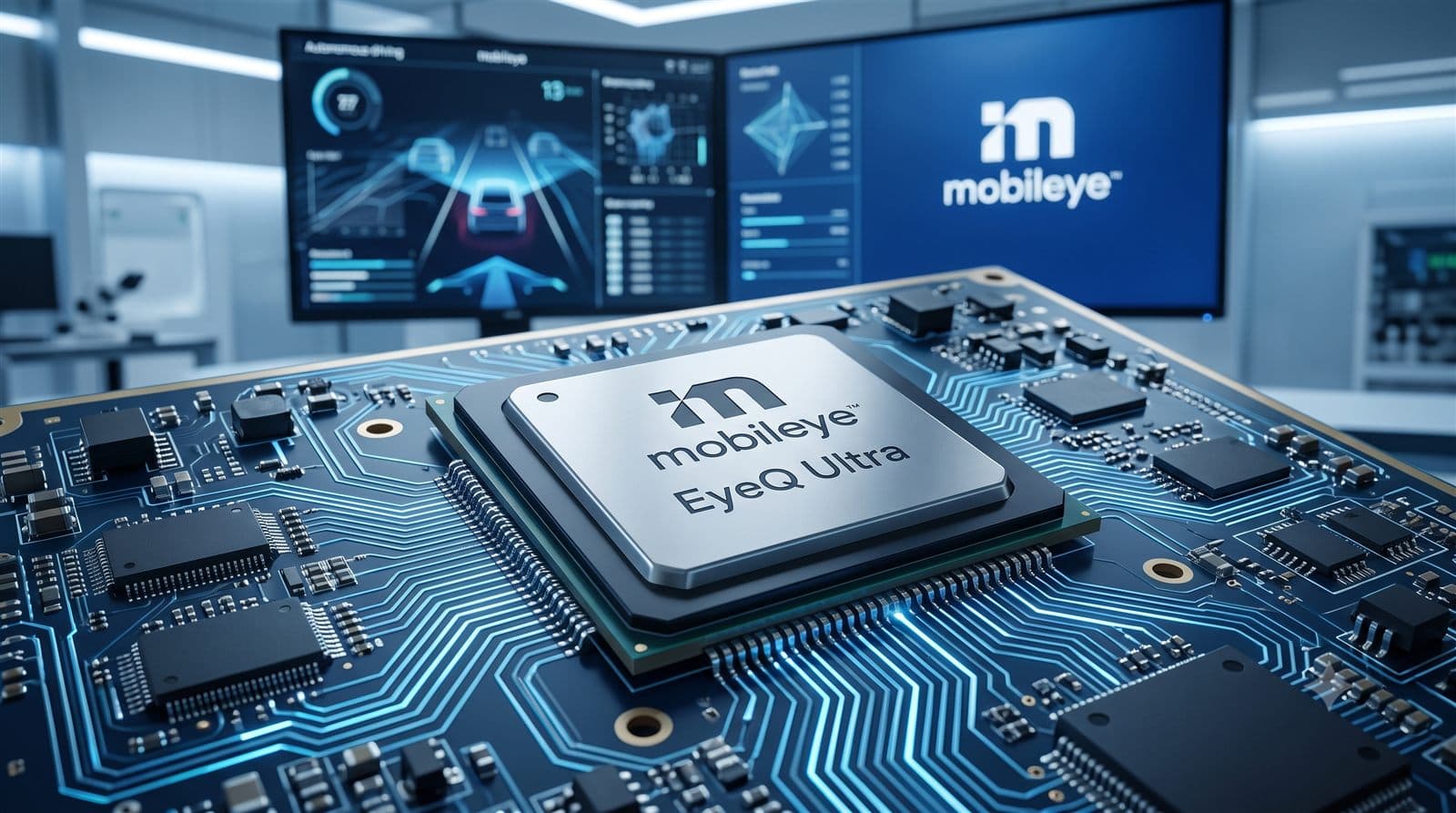
Disclosure: the author holds shares of Mobileye (MBLY) and Innoviz (INVZ) mentioned in this article, and these holdings may change at any time without notice. Nothing herein constitutes a recommendation, advice, or an invitation to act in any security - see the full disclosure and disclaimer at the bottom of the page.
Some companies are priced by the market for what they are today, and some are priced for what they promise to become. Mobileye (NASDAQ: MBLY) sits in the strange place where both are true at once - to its detriment. Within six months it announced three moves, each of which alone would have earned a headline of the year: the $900 million acquisition of humanoid-robot company Mentee Robotics, the launch of a wholly owned robotaxi business slated to debut in a major U.S. city in 2027, and the start of production of Israel's Innoviz lidars for its autonomous-driving platform. And at that very same time, the stock is trading, per market data, well below its 2022 re-IPO price, and the balance sheet absorbed a $3.8 billion goodwill impairment in the first quarter. On Thursday (7/23), before the open, it reports the second quarter - a good opportunity to unpack the whole story: the technology, the data, the taxis, the robots, the competitors - and the gap between all of that and the price.
From EyeQ to "Mobileye 3.0": The Evolution
The path can be told through four points. Mobileye was founded in Jerusalem in 1999 around an idea that sounded delusional at the time: a single cheap camera, with a dedicated chip, would be enough for a car to "see." The first EyeQ chip shipped in 2007 and made the company the world's largest supplier of advanced driver-assistance systems (ADAS). It went public in New York in 2014, was acquired by Intel in 2017 at a valuation of about $15.3 billion - the largest exit in Israel's history at the time - and returned to the Nasdaq in 2022 at $21 a share. To date, per company data, over 200 million EyeQ chips have shipped - roughly one in every seven to eight new cars worldwide carries its technology. Intel remained the controlling shareholder, with about 96.9% of the voting power per the 2026 proxy materials, and it is selling shares gradually - a point we will return to.
At the CES show this past January, CEO Prof. Amnon Shashua defined the current phase "Mobileye 3.0": after the ADAS era and the autonomous-driving era, the company is expanding into "Physical AI" - a single umbrella for the autonomous vehicle and for robots. This is not a marketing slogan: it is a business claim we will test immediately, because it rests on the company's real asset - the data.
The Data: The Asset That Is Hard to Replicate
Mobileye's quiet engine is called REM: millions of cars with EyeQ chips around the world harvest road information as they drive - in tiny packets of about 10 kilobytes per kilometer - and together build a live, continuously updated map of the global road network. This is the structural advantage over any competitor that fields a dedicated collection fleet: Mobileye's fleet is simply its customers' cars. On top of that infrastructure sits another layer unveiled at CES: a simulation engine (ACI) that generates, on the REM maps, billions of simulated driving hours in a single night - to train systems on scenarios that almost never occur in the real world - alongside a "fast thinking and slow thinking" architecture that combines a vision-language model with a formal safety layer. Note the pattern: data from the fleet, simulation at scale, and cheap dedicated silicon at the edge. This is exactly the chain of assets robots also require - which is why the expansion into robotics is less far-fetched than it sounds.
The Product Ladder - and the Chip War Around It
The business is built as a ladder, each rung leveraging the one below. At the base - EyeQ chips for basic ADAS, the cash business. Above it, Surround ADAS on a single EyeQ6H chip, which won a third customer this year - India's Mahindra - and a large American manufacturer. Above that, SuperVision, an "eyes-only" supervised-driving system (L2++), which per company reports is now operating for the first time in the U.S. on pre-production vehicles, including a drive of more than 2,000 km on an unplanned route that met reliability targets. Above it, Chauffeur (L3) - and at the top, Drive, the full autonomous driving system (L4) that powers the robotaxi. At CES the company reported an estimated future design-win pipeline of $24.5 billion over eight years - up 42% from the end-2023 estimate - and a 3.5x jump in ordered volumes of the EyeQ6L chip versus 2024.
But it is important to place this ladder inside the arena, because it is more crowded than ever. NVIDIA has turned its DRIVE platform into a genuine front: at the recent GTC it announced that BYD, Geely, Isuzu, Nissan, Hyundai and Kia are adopting its Hyperion platform to develop Level 4 autonomous vehicles around the new Thor chip. Qualcomm reports that more than one million vehicles already drive with Snapdragon Ride processors, with adoptions at GM, BMW and the VW Group per reports. And in China, local player Horizon Robotics is eating market share thanks to a localization advantage - in exactly the market where Mobileye was a dominant ADAS player. Mobileye's relative edge is not raw compute but the complete system: a cheap dedicated chip, software, maps and data - one package a manufacturer can assemble without building an AI team of thousands of engineers. The open question, and it is the key question of the decade, is whether the large manufacturers will want a complete package - or a powerful chip on which they build themselves.
The Lidar: The Decision That Made Innoviz a Partner
Here a technical moment is needed, because this is a point that sets Mobileye apart from every competitor. Lidar (LiDAR) is a sensor that fires laser pulses and measures their return time, building a precise 3D map of the surroundings - entirely independent of lighting and cameras. In Mobileye's approach, a true autonomous system requires "true redundancy": a camera subsystem capable of driving on its own, and alongside it a separate subsystem of radars and lidars that is also capable - so that a failure in one does not bring down the other. This is the absolute opposite of Tesla's camera-only approach, and it is the heart of the professional dispute across the entire industry.
In September 2024 Mobileye made a clear "make or buy" decision: it shut down its internal lidar development (of the FMCW type), citing officially the progress of computer vision, the maturation of the imaging radar it developed in-house - and faster-than-expected price declines in third-party lidars. Three months later the other side of that decision was announced: Innoviz (NASDAQ: INVZ) was selected to supply the lidars for the Drive platform - InnovizTwo models for long range and short-to-medium range - with production starting in 2026. And to illustrate the quantitative meaning: per Volkswagen's spec, every autonomous ID.Buzz carries 13 cameras, 9 lidars and five radars. Nine lidars per vehicle, times deployment plans of tens of thousands of vehicles - that is the multiple that explains why this deal is critical for Innoviz.
The Global Lidar Market: Hesai Dominates, Luminar Warns
Anyone who wants to understand Innoviz's position must know the balance of power. Over the past two years the market has undergone brutal consolidation, and the big winner is China's Hesai (NASDAQ: HSAI) - the world's largest lidar maker, with 43% of the global long-range ADAS lidar market in 2025 per company data, about 472,000 units in the first quarter alone, guidance for 3 to 3.5 million units this year - and, crossing into profitability for the first time in the industry. It is already an approved Level 3 supplier for Mercedes-Benz and the primary lidar supplier of NVIDIA's Hyperion platform, and per industry reports the Chinese suppliers together hold about 95% of global ADAS lidar shipments. At the other end of that market is America's Luminar - which at its peak was worth many billions, and today, after a 1-for-15 reverse split, a debt restructuring and waves of layoffs, is mainly a cautionary tale about an industry where good technology is not enough without manufacturing economics.
Within this map, Innoviz has an asset the numbers do not show: it is one of the only serious Western alternatives left. In a world where Washington restricts Chinese components in connected vehicles, a Western manufacturer looking for non-Chinese automotive-grade lidar arrives at a very short list - and that, in my estimation, is part of the explanation for Innoviz's wins at BMW, Volkswagen, Daimler Truck and Mobileye. It is also a double-edged sword: the price war the Chinese are waging squeezes the pricing of the entire industry.
Innoviz in Brief: A Leveraged Option - With All That Implies
Israel's Innoviz, from Rehovot, has a customer list that companies far larger than it would sign for with their eyes closed: BMW (a 2018 win that matured in 2024 into L3 vehicles in production), Volkswagen as a direct supplier across multiple brands, Daimler Truck which chose it in September 2025 for L4 trucks in North America - and Mobileye. In recent months it has been broadening the story beyond the vehicle too: in April it launched the InnovizTwo Ultra Long-Range with sensing range of up to a kilometer, announced entry into the defense and security markets, reported engagements with Kela Technologies and an agreement with a large holding group in the field, alongside a letter of intent with LOXO and an evaluation agreement with a "leading autonomous driving company" for perception software running on the sensor itself.
And against all that - the hard numbers, which must be presented: first-quarter 2026 revenue was just $7.1 million (versus $17.4 million in the comparable quarter, mainly due to the shifting of engineering milestones), a quarterly loss of about $26 million, and a cash balance of about $60 million that management estimates will suffice for at least the next 12 months, alongside an at-the-market (ATM) offering program. In March the company even received a Nasdaq notice over a share price below a dollar, with an extension to September. The company's full-year guidance - $67 to $73 million - depends on hitting milestones and on the start of production for Mobileye. This, then, is the thesis in its full sharpness: Innoviz is a leveraged option on the success of Drive and the robotaxi, with a bonus of the opening defense market. If deployment accelerates - it has a rare position in the chain; if it is delayed - it has no safety cushion. Both sides are real, and anyone entering such a security must understand they are holding an option, not a value stock.
The Taxi Business: From Three Layers - to Full Ownership
Until June, Mobileye's robotaxi story was a supplier's story: it sells the brain, others operate the fleet. That ecosystem was running at full speed - and per the quarterly report and company announcements, these are the facts as of today: more than 100 Drive-powered ID.Buzz vehicles driving on public roads in six cities (Los Angeles, Austin, Orlando, Munich, Berlin and Hamburg), with Oslo on the way; Volkswagen and MOIA began pre-series production at the Hanover plant in March; MOIA chose Orlando, together with shuttle operator Beep, as the first launch site without a safety driver; and in Los Angeles, validation rides began with Uber, ahead of commercial service on Uber's platform by the end of 2026 and driverless service in 2027. Meanwhile, Lyft announced its intention to launch Mobileye-based robotaxis in Dallas as early as 2026, in a model where Japan's Marubeni owns and finances the vehicles. And at CES, MOIA presented an ambition to deploy more than 100,000 autonomous vehicles by 2033.
Then, on June 16, Mobileye crossed the lines: it announced it would build a wholly owned robotaxi business - its own fleet, its own app (on the Moovit infrastructure it owns), its own control and operations center - to launch in a major U.S. city in 2027 with about 100 vehicles, and a target of about 17,000 vehicles within five years. The economics will be presented at an investor day by year-end. Shashua put it this way: "The robotaxi revolution has only just begun" - and the company stresses that the move complements its manufacturers' and partners' plans, not replaces them.
The Global Map: Between Waymo and China
To judge this bet you need the full picture, and it is insanely competitive. In the U.S., Alphabet's Waymo reportedly reports about half a million paid rides a week across ten cities, with a target of a million weekly rides by year-end; Tesla, per industry trackers, expanded its robotaxi service to seven cities within about a year. And in China a whole ecosystem is being built in parallel: Baidu's Apollo Go operates in about 20 cities with more than 17 million cumulative rides, and is expanding into Europe - with Lyft, no less - and into the Gulf with Uber; Pony.ai (NASDAQ: PONY) is aiming for a fleet of more than 3,000 vehicles by year-end; and WeRide (NASDAQ: WRD) is already deployed in more than 30 cities worldwide. The meaning for Mobileye is twofold: on the one hand, it is arriving at an arena where others are already running. On the other, almost all of these players built closed systems around a single fleet - whereas Mobileye is the only one that arrives with a manufacturing chain of Western automakers (Volkswagen already produces for it in Hanover) and with a model that also sells to third parties. Whoever sells only the brain leaves most of a ride's value to the operator; the move to ownership is an attempt to capture the large part of the value chain - exactly the bet the market is not yet willing to pay for in advance.
The Robots: $900 Million on the Next Bet
And that brings us to the boldest move of all. In January, on the CES stage, Mobileye announced the acquisition of Mentee Robotics for about $900 million - roughly $612 million in cash and the remainder in stock - a deal that closed in early February. Mentee develops a third-generation humanoid robot, and its key components sound remarkably familiar: simulation-based learning (Real2Sim2Real) instead of expensive data collection from the physical world, generalization from few examples, in-house-developed hands with tactile sensing - and zero teleoperation, i.e. no remote human operator. The stated timeline: pilots at customers in logistics and manufacturing centers already this year, initial production from 2027 with manufacturing partner Aumovio (the former automotive division of Continental) per industry reports, and serial production in 2028.
Here too, the scale of the market explains the appetite: Goldman Sachs estimates the humanoid-robot market at $38 billion by 2035, and Morgan Stanley speaks of a total market of up to $5 trillion in 2050. The big money is already moving: America's Figure raised at a reported valuation of about $39 billion, and Tesla, per industry reports, is converting production lines in Fremont toward mass production of its Optimus robot. At what point in the value chain can Mobileye sit? In my estimation, at two simultaneously: as a vertical maker of a complete robot for the logistics and industrial markets (the Mentee path), and in the long run - as a "brain" supplier for others' robots too, exactly as EyeQ sits today in the cars of dozens of manufacturers. The assets that make this possible are the same assets: cheap, efficient edge silicon, simulation and training infrastructure, a safety methodology, and an automotive manufacturing chain that knows mass production. The humanoid robot is, in a deep sense, an autonomous car with hands.
And it is worth saying in full transparency: Shashua himself was a co-founder of Mentee, so this is the acquisition of a related company - a point that requires the investor's trust in corporate governance, and we will return to it in the failure points.
The Numbers: A Strong Quarter, a Giant Write-Down
And finally, the ground. The first quarter of 2026 was better than expected: revenue of $558 million, up 27%, on the back of a 28% jump in EyeQ shipments (among other things thanks to inventory replenishment at customers after a weak fourth quarter); adjusted operating profit of $95 million, up 61%, at a 17% margin; and positive operating cash flow. The company raised its full-year guidance to revenue of $1.94 to $2.02 billion and adjusted operating profit of $185 to $235 million, and announced a buyback of up to $250 million - partly to offset the dilution from the Mentee-deal shares.
And in that very same report - a goodwill impairment of $3,788 million. It is important to understand what it is and what it is not: this is a non-cash accounting item, inherited from the 2017 Intel deal that was "pushed" onto the balance sheet in the 2022 IPO. The trigger for the write-down, in the company's words, was the decline in its market value. And here is the irony that sums up the whole article: the market's skepticism is itself what got recorded on the books.
The Strengths - and Against Them, the Failure Points
For the picture to be fair, I will set the two sides against each other - without deciding.
What stands for the thesis:
- The data moat - hundreds of millions of chips on the roads feeding a live map and a simulation engine. This is an asset no competitor, including Waymo, can replicate without a decade of deployment.
- A profitable, cash-generating core business - unlike most autonomous vehicle companies, Mobileye's core earns money, generates cash, and funds the bets.
- An estimated $24.5 billion pipeline and three new growth engines - robotaxi, robotics and integrated lidar-radar - all riding on the same technology base. One bet, three tickets.
- Real deployment proof - Mobileye is one of the few in the world with driverless vehicles actually driving on two continents, and with a large automaker's manufacturing chain (Volkswagen) already working for it.
- The status of the Western alternative - in a world of technological decoupling between the U.S. and China, Mobileye (and Innoviz alongside it) are on the side Western regulation prefers.
And what could ruin the thesis:
- Robotaxi economics are unproven. Operating a fleet is a capital- and regulation-intensive business, city by city, against Waymo already at half a million weekly rides. Even the successful players in the field are still burning capital, and Mobileye will present the economic model only at the investor day at year-end. Until then - it is a promise.
- Erosion in China and in chips. Local Horizon, NVIDIA and Qualcomm are all eating, from different directions, into a market that was once nearly exclusive to EyeQ. Core growth is modest - the annual guidance implies single-digit growth - and that is the market's basic source of skepticism.
- A controlling shareholder that is selling. Intel holds about 96.9% of the voting power and has sold billions of dollars of shares in recent years. Such a potential supply overhang over the stock is a structural weight, and the fate of the holding also depends on Intel's own needs.
- Corporate governance. The acquisition of Mentee - a company the CEO himself founded - for $900 million is a classic related-party transaction. Even if the strategic logic is sound, it adds a layer of trust the investor is required to extend.
- Fragile mutual dependence in the chain. Innoviz, the lidar supplier, is a company with a $60 million cash balance and a Nasdaq notice; a delay there would hurt Mobileye, and a delay at Mobileye could be critical for it.
- The timing of robotics. The entire humanoid market is still in the pilot phase; Morgan Stanley itself warns of a shakeout among the startups. Serial production in 2028 is a promise two years out - and in the meantime the expenses are here and now.
The debate in one line
The bulls see a company with data no competitor has, a profitable core business, and three new growth engines - at a price that mainly reflects the existing ADAS business. The bears see a core growing slowly, a risky shift into a capital-intensive operational business against Waymo and the Chinese, the acquisition of a related company, and a controlling shareholder that is selling. The coming reports - and the 2027 deployments - are what will decide which reading wins. There is no recommendation here in any direction - there is a map.
What to Watch on Thursday
On Thursday morning (7/23), before the New York open, the second-quarter report will be published (market forecasts imply a decline versus last year, after the demand was pulled forward into the first quarter). I will watch less the profit line and more three things: the pace of EyeQ shipments after normalization, any new detail on robotaxi economics ahead of the investor day - and whether Mentee expenses stay within the range the company defined. And on that same day, by the way, after the close, Intel - the controlling shareholder - also reports, and the fate of its Mobileye holding is a story in its own right.
The Bottom Line
Mobileye is one of those rare cases where you can watch a company build its third act in real time: from the eyes of the car, through the driverless taxi, to the robot. The thesis rests on one asset that is very hard to replicate - hundreds of millions of chips on the roads feeding a map and a simulation engine - and on one assumption not yet proven: that this asset can be translated into new operational businesses before the cash and the patience run out. Our job as investors is neither to fall in love with the vision nor to dismiss it, but to track the milestones: the launch city, the deployment pace, the ride economics, and the robot expenses. The market has chosen skepticism for now. I am not here to say it is wrong or right - only that whoever tracks these milestones will know before the market which way the scale is tipping. And that, in the end, is all the edge a private investor can ask for.
Sources: official company SEC filings (Mobileye's Q1 2026 report, Innoviz and Hesai 6-K filings), official announcements from Mobileye, Innoviz, Volkswagen Group, NVIDIA, Qualcomm and Intel, Mobileye's official posts on X, and ongoing international coverage (including CNBC, TechCrunch and Business Wire). Data on Waymo, Tesla, Apollo Go, Figure and Optimus - per reports and industry trackers. Charts are shown in real time via TradingView.


