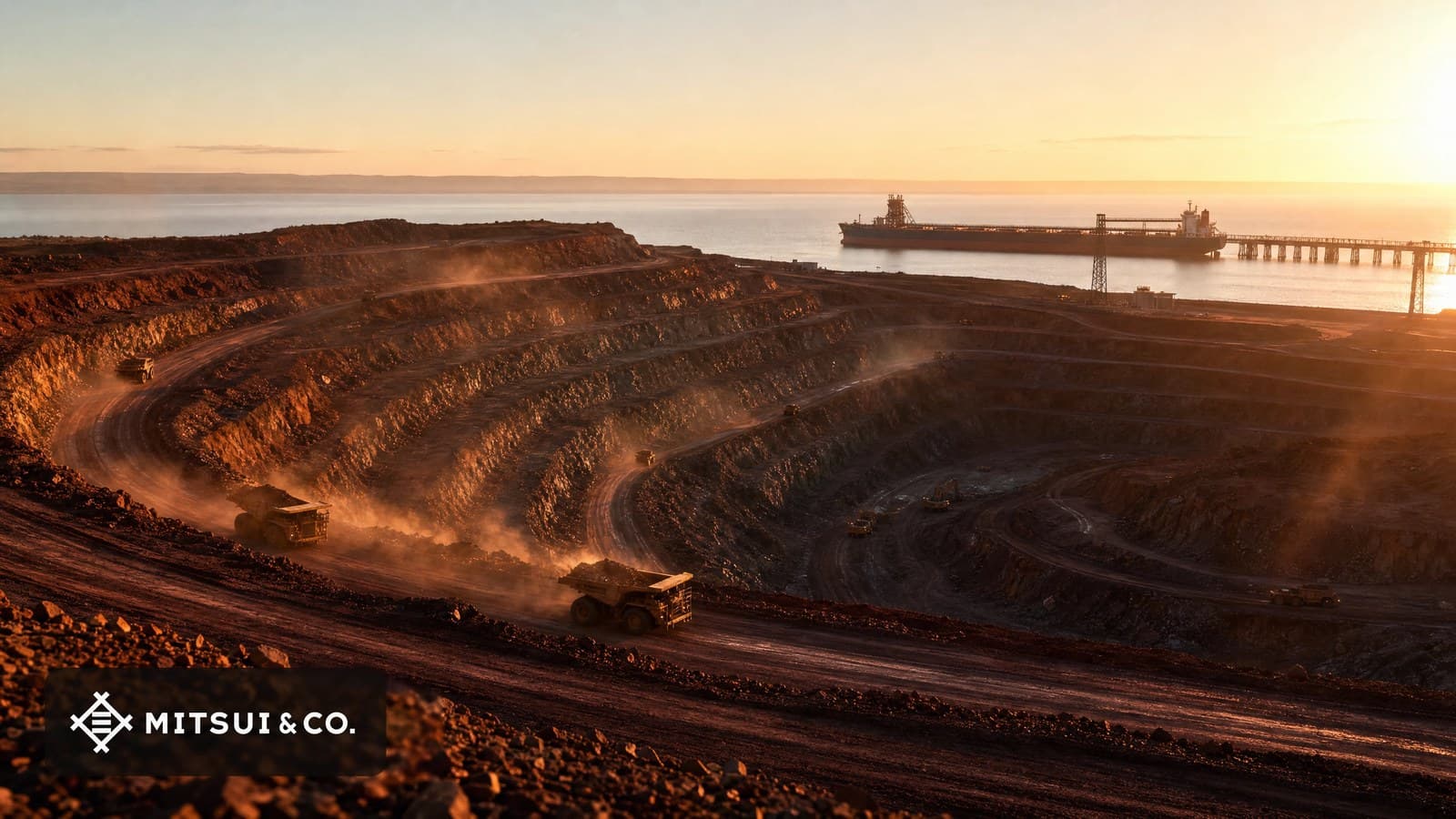
Mitsui reported on 4 August, closing the five trading houses' run - with the strongest number in the group.
What was reported
| Quarter | Year ago | Change | |
|---|---|---|---|
| Revenue | 4,347.6 | 3,299.9 | +31.7% |
| Gross profit | 413.7 | 301.4 | +37.3% |
| Profit before tax | 362.2 | 234.2 | +54.6% |
| Net profit | 294.1 | 191.6 | +53.4% |
| EPS (yen) | 103.73 | 66.68 | - |
In billions of yen
The company stated explicitly this is its highest-ever first quarter, and the result beat consensus.
Gross profit rose ¥112.3 billion, from energy, chemicals, and the innovation and corporate development division.
And core operating cash flow
Core operating cash flow - the internal metric Mitsui itself manages against - reached ¥280.9 billion, up ¥64.6 billion, and 27% of the full-year plan.
The drivers the company names: energy, including the IPO of an energy business outside Japan and US gas; dividends from equity-method investees in infrastructure and mobility; and the IPO of a quantum computing business in the innovation division.
And the contrary figure in the same report
Here sits the detail no headline carried, and it matters more than the record.
| Quarter | Year ago | |
|---|---|---|
| Operating cash flow | 42.3 | 262.6 |
| Free cash flow | -46.4 | +92.9 |
In billions of yen
Operating cash flow collapsed to ¥42.3 billion - less than a sixth of the prior year - and free cash flow turned negative.
The reason is explicit in the report: a working-capital build of ¥271.5 billion, mainly an increase in trade receivables.
Why this happens, and why it is not necessarily bad
This is the mechanical cost of a commodity boom.
A trading house buys goods and sells them. When the price rises 30%, the same physical volume requires 30% more cash to finance inventory and customer credit. Profit is booked at the moment of sale; the cash arrives only when the customer pays.
This is not a sign of weakness in the business - it is a sign the business is growing fast. But it does mean this record profit has not yet become cash, and that anyone reading only the profit line gets half the picture.
And what makes it especially interesting: Marubeni, reporting a day earlier, posted a record in core operating cash flow. The same quarter, the same boom, opposite cash outcomes - a difference in business mix and working-capital structure.
The context: Mitsui is the heaviest in resources
Among the five, Mitsui carries the greatest weight in iron ore and energy. That explains both the sharpest jump in the group - and the highest sensitivity to a reversal in prices.
On the reporting day the board also resolved on a share buyback, disclosed in parallel.
The full map of Japan's earnings week: The Week Japan Reported
My Angle
A personal opinion of Ilan Abramov - not advice, not a recommendation
This is the report most worth reading twice.
On a first read: a historic record, up 53%, beating consensus. On a second read: negative free cash flow, and operating cash flow at a sixth of what it was.
Both things are true at once, and neither cancels the other. The profit is real, and the working-capital build is a consequence of growth rather than weakness.
But I do take a reminder from it: in a trading company, profit and cash are two different things that meet with a delay. Anyone looking at only one of them sees half a company.
And the comparison with Marubeni teaches something: the same quarter, the same environment, and still one posted record cash flow and the other negative. Structure matters as much as price.


