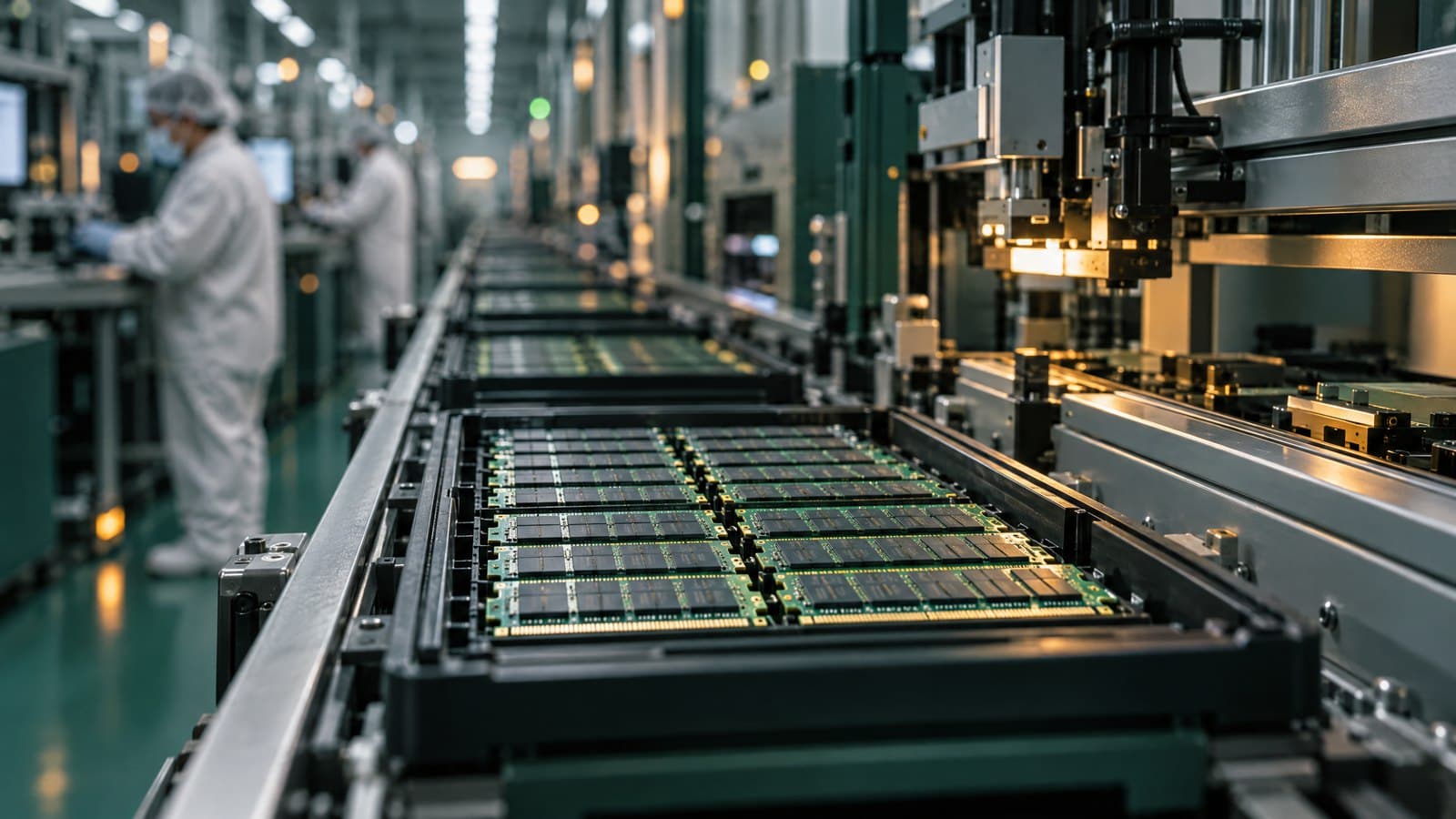
The three largest memory chip makers are in the best quarters in their history, and none of them expects a slowdown next quarter. And in the first two weeks of October their stocks fell between 15% and 31%.
There may be errors or inaccuracies. Found something that looks wrong? Write to me and I will fix it.
The Producers' Numbers
On October 8, Samsung published its preliminary third-quarter figures: revenue of about 195 trillion won and an operating profit of about 107.4 trillion. A year earlier those were 86.1 and 12.2 trillion, and in the second quarter 171.5 and 89.5 trillion. According to the Korea Herald, the operating margin stood at 55.1%. According to FnGuide, operating profit was 0.7% above expectations, and revenue was 2.8% below them.
Micron, the only one of the three that reports to the US Securities and Exchange Commission, published on September 30 revenue of $54.23 billion for the fourth quarter of its fiscal year, with a gross margin of 86.8%. For the next quarter it expects revenue of $61.5 billion, within a range of $1.5 billion in either direction.
SK Hynix has not yet published figures for the quarter. Its earnings call is set for October 28, and the following day Samsung will publish its full results.
Prices: Contracts Are Rising, the Spot Market Is Not
| Forecast or figure | Source | |
|---|---|---|
| Conventional DRAM contracts, Q4 2026 | 10%-15% rise from the previous quarter | TrendForce, Sep 30 |
| NAND contracts, Q4 2026 | 15%-20% rise | TrendForce, Sep 30 |
| DDR4 spot market, October 6-7 | $46.32, unchanged on the week | TrendForce |
| NAND wafer spot market, October 6-7 | $18.833, 2.9% decline | TrendForce |
| Average HBM price in 2027 | 121% rise (forecast) | TrendForce, Sep 29 |
Contract prices, at which most output is sold to the large customers, are still rising according to the forecasts. In the spot market, where smaller volumes trade, TrendForce described weak demand for modules and excess NAND inventory in early October. The two markets are currently sending different signals.
The Decline
| Closing prices | October 1 | October 15 | Change |
|---|---|---|---|
| SK Hynix (won) | 1,833,000 | 1,262,000 | -31.1% |
| Samsung Electronics (won) | 276,000 | 210,000 | -23.9% |
| Micron (dollars) | 1,097.39 | 931.24 | -15.1% |
Source: closing data from the Korea Exchange and Nasdaq.
The hardest day was October 15. The KOSPI fell 7.57% to 5,554.22 points, trading was briefly halted at 12:38 Seoul time by the circuit breaker, and according to the Korea Times foreign investors were net sellers of 3.6 trillion won of stocks. That day SK Hynix fell 11.1% and Samsung 9.5%. Two days earlier, on October 13, the index had fallen 5.5%.
The explanation for the drop does not appear in any company report. The JoongAng Daily listed three factors the market weighed that day: doubts about the return on AI investments, fear of Chinese supply, and a high US inflation reading - the September consumer price index, which stood at 3.7% and was released the day before. These are the factors the paper listed, not a proven explanation.
The Chinese Side
The fear of Chinese supply got a name on October 10: the president of CXMT, China's largest DRAM maker, announced at a conference in Shanghai a new DRAM architecture that would reach a server memory product by the end of 2026. According to Bloomberg, the company gave no output figures, specifications or customer names, and Samsung and SK Hynix are also developing a similar architecture. CXMT listed on the Shanghai exchange on July 27, and at the close of the first trading day its stock was up 466%.
And that same week Reuters reported that Solidigm, SK Hynix's subsidiary, is asking the US for approval to export additional equipment to its NAND fab in Dalian, China, under a framework tied to the construction of a plant in the US. SK Hynix said it is not expanding production capacity there.
What Comes Next
- October 28: SK Hynix's third-quarter earnings call.
- October 29: Samsung's full results.
- October 27-28: the Fed meeting, following the September inflation reading.
הזווית שלי
דעה אישית של אילן אברמוב - לא ייעוץ ולא המלצה
What interests me here is that there is no contradiction between the numbers and the price, even if it looks that way. The companies report on the past and on the next quarter, while the stocks are pricing the year after that. The memory industry is cyclical, and a 55% operating margin at Samsung is exactly the kind of peak that the market starts asking how long it can last.
And both sides exist in the data itself: contract prices are still rising and HBM is booked forward, but the spot market is no longer rising, and China is announcing new technology - even if without numbers. I do not know which side will win, and the results at the end of the month will say more than any headline. It is worth remembering that even a 31% drop in two weeks is as much a reaction to emotion as it is to data.
(To be clear: this is my personal opinion only. Nothing here is a recommendation to take any action, and there is no forecast here of the price of any security.)
Ilan Abramov, the author, or anyone on his behalf may hold some of the securities or funds mentioned in this article.


