A rumour is circulating about an alternative route opening around the Strait of Hormuz.
I found no public confirmation of it. I also found no denial - it emerged in the past few days, and nobody has addressed it either way. What follows is what can be verified.
Errors or inaccuracies are possible. Spotted something that looks wrong? Write to me and I will correct it.
First - The Fact That Frames Everything
The Strait of Hormuz is not open.
It was closed to normal commercial traffic on 28 February 2026, after military escalation in the Gulf. An understanding reached reopened it around 17 June - but traffic remained far below normal, and the agreement collapsed in early July following attacks on commercial vessels.
As of late August 2026 the strait remains effectively closed.
| Ship transits on 23 August | 3 |
| In normal conditions | about 85 a day |
This is not a rumour. It is a six-month-old reality.
And it also explains why any report of a bypass route is genuine news rather than geographic curiosity: roughly a fifth of global oil and gas supply normally passes through the strait.
What Is Documented: A Bypass Pipeline Under Construction
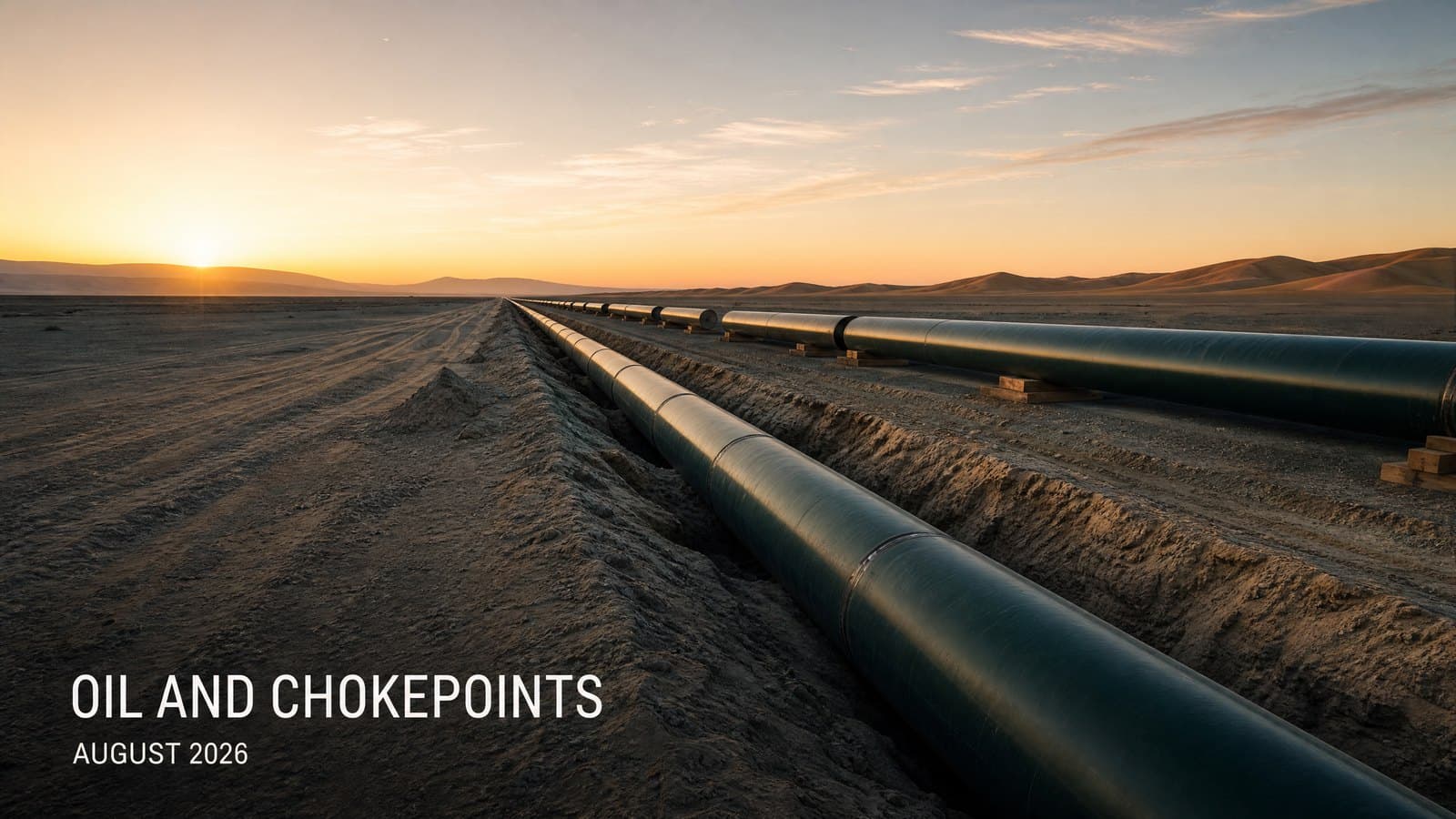
On the "American route" claim I have no source either way, so I assert nothing about it. What is publicly documented is that the Emirates are building a second pipeline that bypasses the strait.
| The new pipeline | |
|---|---|
| Name | West-East 1 |
| Route | Habshan to Fujairah - from inland to the Gulf of Oman coast |
| Length | 252 miles |
| What it does | Parallels the existing ADCOP pipeline |
| Combined bypass capacity | 3.6 million barrels a day - a doubling |
| Target completion | 2027 |
| Status reported in May 2026 | About half complete |
And to understand why that matters, you have to see the physical map.
Fujairah sits outside the strait. A port on the Gulf of Oman, which a tanker can reach without passing through Hormuz at all. Which is why all these pipelines lead there, or to the Red Sea.
And what already exists today:
| Capacity | In use | Spare | |
|---|---|---|---|
| The Saudi East-West pipeline - Abqaiq to Yanbu, on the Red Sea | 7 million b/d | about 2 million | 3 to 5 million |
| The Emirati ADCOP - Habshan to Fujairah | about 1.8 million | about 1.1 million | about 700,000 |
And per the US Energy Information Administration's assessment, there is capacity of 3.5 to 5.5 million barrels a day to move oil out of the Gulf by alternative routes.
And here the number has to be said plainly, because it explains why this is a real crisis:
Roughly 20 million barrels a day normally pass through the strait. All existing alternative capacity combined is 3.5 to 5.5 million.
Which means that even in the good scenario, the pipelines replace about a quarter of what the strait carries. And the new Emirati pipeline will add about another 1.8 million - significant, but not a substitute.
And Now Venezuela - Yesterday's Announcement
On 29 August 2026 President Trump announced, in a post on Truth Social, a deal giving the US - in his words - "majority control of more than 65 BILLION BARRELS of proven Oil Reserves in Venezuela, at no cost to the American Taxpayer".
| What was stated | |
|---|---|
| Scale | More than 65 billion barrels of proven reserves |
| What Venezuela receives | $209 billion to the state treasury |
| Alongside it | Per Secretary of State Rubio, nearly $100 billion in private investment |
| Duration | Long-term access guaranteed to US companies |
| On the Venezuelan side | Interim President Delcy Rodríguez welcomed the deal |
| Signing | Agreements are due to be signed in the coming week |
And Trump added that the deal "will substantially lower gas prices for all Americans" and "more than doubles American oil reserves".
And four things do not appear in the announcement, and I note them because their absence is information:
One - the structure of the deal. No fields were named, no companies, and no legal definition of "control".
Two - sanctions. The announcement contains no mention of lifting or changing US sanctions on Venezuela.
Three - a timetable. There is no date for increased production and no output target.
And four - who operates. Producing oil requires an operator, contractors and capital. No name was given.
This does not mean the deal is not real. It means the announcement is a declaration, not a published contract.
And the Distinction That Decides: Reserves Are Not Barrels Per Day
This is the heart of the piece, and it is the distinction easiest to miss.
| Venezuela | |
|---|---|
| Proven reserves | about 303 billion barrels - the world's largest |
| Its world rank in reserves | First; Saudi Arabia 267 billion, Iran 209, Canada 163 |
| Its share of world reserves | about 18% |
| Actual output | about 1.25 million barrels a day |
Venezuela sits on the world's largest reserves and produces less than countries whose reserves are smaller by tens of multiples.
That is not an accident, and it is not a problem money alone solves.
Venezuelan oil is mostly extra-heavy crude from the Orinoco Belt. It is too viscous to flow through a pipeline as it is, so it requires diluents and upgrading facilities - large plants that convert it into oil that can be refined. Those facilities cost billions and are built in years, not quarters.
And above them: degraded infrastructure, a workforce that emigrated, and sanctions the announcement did not touch.
So the number relevant to an oil market whose strait is closed is not 65 billion barrels in the ground. It is how many barrels a day reach a refinery - and the announcement does not answer that.
"And That Could Be Positive for Markets" - A Distinction Worth Getting Right
That assessment reached me together with the rumour, and it is correct - provided you separate two questions that are easy to conflate.
The first question: is it already in the price? No.
The Venezuela announcement was published on 29 August, which is a Saturday. Exchanges closed on Friday, and the last price set predates it. The Brent oil ETF, BNO, closed Friday at $51.48, down 0.44% - a price that knows nothing about the deal.
The second question, and the relevant one: what should it do on the next trading day?
And here the logic is simple and strong. The oil price today carries a risk premium built from accumulated negative factors - a blocked strait, fear of shortage, and damaged supply routes. A premium like that rests on an assumption: that there are no alternative sources.
And any news weakening that assumption works in the opposite direction - before a single barrel moves. When the damage was built from blockage and shortage, the opposite news is, by definition, the relief.
This is not speculation. It is the same mechanics, with the sign reversed.
And there is something else worth saying plainly: sometimes a strong rumour alone is enough to ignite a market.
And that is especially true in commodities. An oil market prices expectations about future supply, and expectations change on the news itself - not on actual delivery. Trading can move on a headline, on a leak, and even on a denial read as a confirmation.
So the distinction I am drawing here is not between "real" and "not real". A price move driven by a rumour is an entirely real move - money genuinely changes hands.
The distinction is between a move with barrels behind it and a move with an expectation of barrels behind it. The first persists. The second holds as long as the expectation holds - and reverses quickly when it emerges that there is no deal structure, no timetable, or when next week's signing slips.
And that is exactly why I note what is missing from the announcement. Not to dismiss it - but to know what precisely the expectation rests on.
The Two Ways This Can Resolve, and the Difference Between Them
| Hormuz | Venezuela | |
|---|---|---|
| What it solves | The supply route | The supply source |
| Status | Pipeline under construction, about half complete | An announcement, agreements not yet signed |
| Timetable | 2027 stated | Not given |
| The addition | about 1.8 million b/d | Depends on years of investment |
| What constrains it | Engineering and build schedule | Sanctions, infrastructure, crude type |
| Verifiable | Yes - a measurable physical project | Not yet - no public document |
And what I take from that table is that the less dramatic project is the easier one to verify. A 252-mile pipeline halfway through construction is a fact you can measure. An announcement about 65 billion barrels is a promise you have to watch materialise.
הזווית שלי
דעה אישית של אילן אברמוב - לא ייעוץ ולא המלצה
I started from the rumour I received, and finished with three conclusions, none of which was in it.
The first - there is a bypass route genuinely under construction, and it is Emirati. That neither confirms the rumour nor contradicts it; it is simply what is documented. And for anyone looking today for a concrete sign of relief at the strait, this pipeline is the sign you can measure - without relying on a source nobody has checked.
And the second - the distinction between reserves and production is, in my view, the most useful concept to take from this day. Venezuela holds 18% of world reserves and produces about 1.25 million barrels a day. The large number has existed for decades and has never lowered the oil price by a single cent, because oil in the ground is not supply. It is an asset. Supply is what flows.
So when I read a headline with an enormous reserves figure, my first question is not "how much" but "when, and at what rate".
And the third, and practical: beware of swapping the expectations channel for the supply channel. A price can fall tomorrow because of the announcement, and that will be entirely real - but it will not be because there is more oil in the world. There will be exactly the same amount of oil, and a different mood.
And what I would not do is build a long-term thesis on an announcement with no structure, no companies, no timetable and no reference to sanctions - and which is meant to be signed next week. Next week is a short, clear test, and it is worth waiting for.
And what I will track is precisely the boring thing: the construction pace of the pipeline to Fujairah. It will not make headlines. It will move barrels.
(It is important to stress: this is my personal opinion only, and nothing herein constitutes a recommendation to take any action.)


