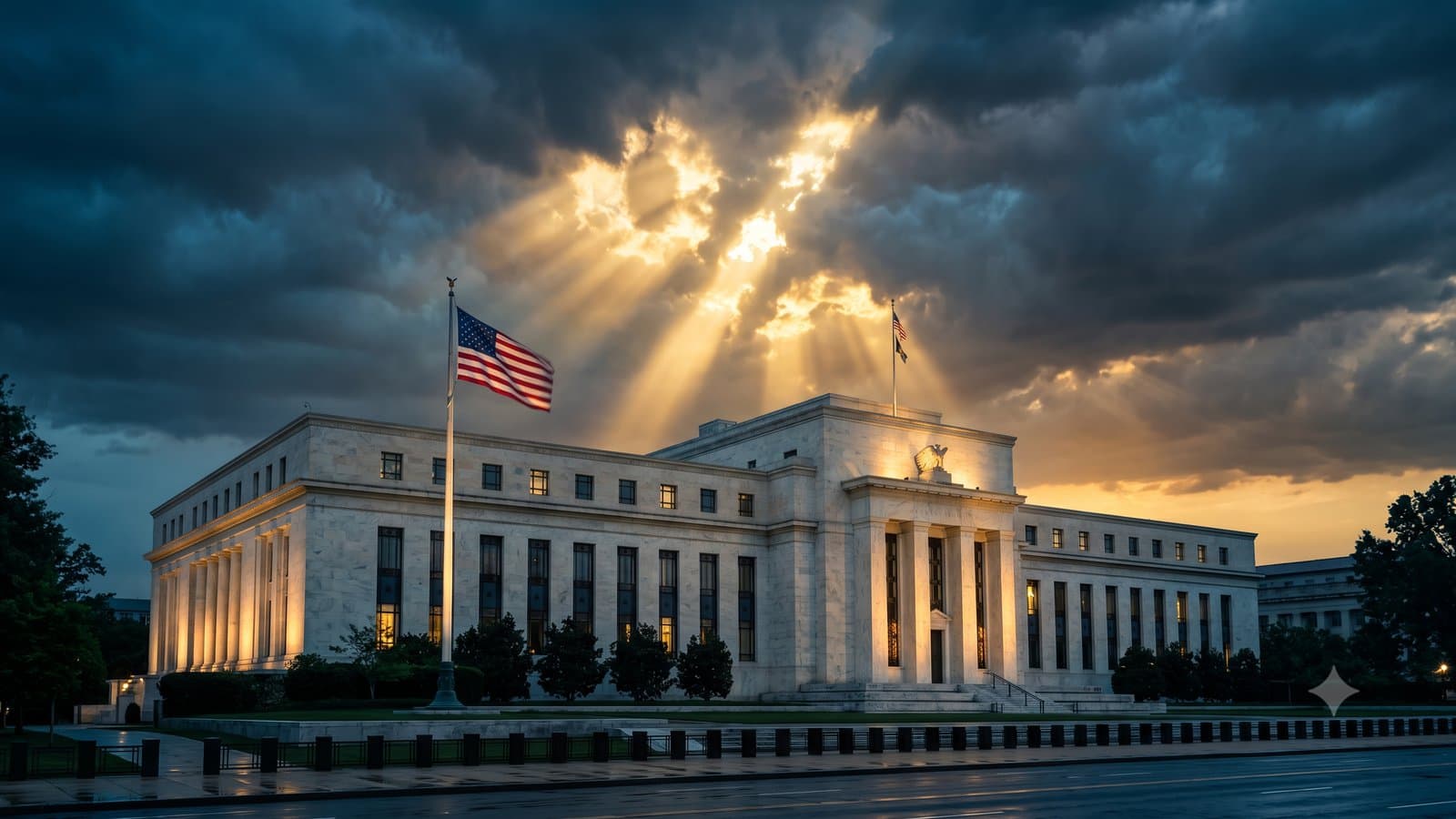
On Wednesday at 9:00 PM Israel time the U.S. central bank publishes its rate decision - and this is not another routine decision. For the first time in years, the market is pricing a real chance of a rate hike; the decision arrives in the middle of earnings season's busiest week, hours before Microsoft and Meta; and it is only the second meeting chaired by a new Chair who has already managed to change how the Fed speaks - and to establish five task forces examining how it thinks. Let us go through everything in order: the man, the previous meeting, the data accumulated since, and what will really be decided on Wednesday.
The New Chair: Who Is Kevin Warsh
For those just joining the season: since May the Fed has been headed by Kevin Warsh, the 17th Chair in the institution's history. Warsh, formerly a Fed governor during the 2008 crisis, was nominated by President Trump at the end of January, confirmed by the Senate on May 13 by a 54-45 vote (only one Democratic senator, John Fetterman, crossed the lines), and sworn in on May 22 for a four-year term.
Already in the first two months it is clear this is a Fed different in style. Warsh removed from the rate statement the "easing bias" - the wording that hinted the next move would be a cut - and moved to a simple declaration: the coming decisions will be set by the data. And in his congressional testimony in mid-July he chose a sharp message: "high inflation has been an undue burden on American households and businesses," and in even simpler words - "prices are too high." Commentators have already dubbed the period "the end of predictability" - a Fed that is harder to forecast, and willing to move the wheel in both directions.
One term worth knowing here: Forward Guidance is the tool by which a central bank signals in advance where the rate is heading, so markets price gradually rather than in shock. Deliberately giving up that tool - as Warsh has done - is a statement in itself: the Fed keeps full freedom of action, and transfers the weight of uncertainty onto the market.
What Happened at the Previous Meeting: The Full June Minutes
The June 16-17 meeting was Warsh's first as Chair, and its minutes are the foundation for understanding Wednesday. These are its essentials, per the official publication:
The decision and the vote. The rate remained in the range of 3.50%-3.75%, in a unanimous 12-0 vote. And an interesting historical detail: among those voting in favor was Jerome Powell - the outgoing Chair, who ended his term as Chair but remains a member of the Board of Governors, and voted at the meeting as a regular member alongside his successor.
The assessment. The committee noted that inflation "remained elevated relative to the Committee's 2 percent longer-run objective," and listed three drivers: the tariffs, the supply disruptions around the closure of the Strait of Hormuz, and demand strength stemming from the AI investment wave - the three forces we have been covering here all summer, in a single Fed paragraph. Risks to inflation were defined as "tilted to the upside." On the other hand, the labor market was described as stable, growth "solid," and productivity growth - strong.
And the point critical for us: oil was defined as transitory. Committee members assessed that inflation would begin to decline "as the effects of tariffs and energy price increases wane," and noted that optimism around the memorandum of understanding between the U.S. and Iran had pushed the oil futures curve materially lower. In other words: the June Fed adopted exactly the logic of "this too shall pass" - a geopolitical supply shock is not structural inflation. The problem: since July the arena has flipped again, and oil has returned to the 100 threshold. Wednesday is the test of whether that assessment survived the month.
The Five Task Forces: A Fed Under Renovation
And in parallel with the rate decisions, Warsh announced at the June meeting a move unprecedented in its scope: the establishment of five independent task forces to examine how the Fed conducts monetary policy. In early July the rosters were revealed - a mix of senior academics (including four Harvard professors in leadership positions), former central bankers and business figures, among them Marc Andreessen (co-founder of the venture fund a16z), Doug McMillon (Walmart's former CEO) and Asha Sharma of Microsoft. The areas of examination:
- The Fed's communications strategy - how it speaks to markets.
- The balance sheet - about $6.7 trillion of assets accumulated since 2008.
- Data sources - including a shift to real-time data instead of indicators published with a lag.
- Productivity and employment - how to measure a labor market in the AI era.
- Inflation frameworks - whether the existing models are still relevant.
The recommendations are due to be submitted to the committee by the end of the year. The meaning for the investor: beyond any single decision, the Fed itself is under renovation. A chair re-examining the inflation framework and the data sources is a chair who may, in due course, change the rules of the game as well - and that is an additional source of volatility in forward rate pricing.
The Data Accumulated Since June: Two Parallel Stories
Since the previous meeting a series of data has been published - and all of it tells two opposing stories at once.
The reassuring story: inflation actually fell. The June consumer price index, published July 14, surprised to the good side: a monthly decline of 0.4% - the sharpest drop since April 2020 - led by that month's plunge in energy prices. Annual inflation fell to 3.5% (versus a 3.8% estimate), and the core - excluding food and energy - remained at 2.6%, softer than expected. The June employment report showed unemployment of 4.1% and an addition of 147 thousand jobs (most of it, worth noting, from the government sector). And on the consumer side, the earnings season we have accompanied here day by day provided living evidence: American Express reported spending at the fastest pace in three years with falling credit provisions, the five big banks beat forecasts, provisions at the regional banks were nearly zero, and General Motors and 3M raised guidance. A growing economy, a paying consumer - and inflation that cooled. On paper, a picture supporting a continued cutting path.
The worrying story: July brought the oil back. Since mid-month, the escalation with Iran returned oil to the neighborhood of the $100 threshold, bond yields jumped to an eighteen-month high, and in the trade arena - the temporary 10% global tariff expired on July 24 with alternative tracks converging, as we detailed in the weekly review. The data point that reassured on July 14 reflects June; Wednesday's question is how the Fed reads July.
What the Market Prices: The Month's Seesaw
The swings in the probabilities tell the story better than any analysis. Per futures data as covered in the financial press: at the start of July the chance of a Wednesday hike stood at 18%; by July 13, with the oil spike, it climbed to 42%; one day later, after the soft CPI and Warsh's testimony, it plunged to 16%; and since then, with the renewed escalation, it has returned to about 35%. In parallel, the market prices at about 80% probability zero rate cuts in all of 2026 - while the committee members' own June forecast (the SEP, the quarterly projections document) stood at a median of one cut this year.
And here a short explanation matters: the July meeting has no projections update and no "dot plot" - the projections document is published only once a quarter (next: September). Therefore all of Wednesday's weight rests on just two things: the statement's wording, and Warsh's press conference in the half hour that follows.
The Three Scenarios for Wednesday
Scenario 1 - no change, balanced tone (the base case per pricing). The Fed holds the rate, repeats the phrasing "inflation is elevated but expected to moderate," and keeps oil in the transitory category. A market pricing a third for a hike would receive such a scenario as relief - positive for stocks and bonds, and especially for the rate-sensitive sectors that have been squeezed.
Scenario 2 - no change, hawkish tone. The rate stays, but Warsh repeats "prices are too high" and signals that a hike is a live option for September if oil stays high. This is effectively "tightening in words" - rising yields, pressure on growth multiples, without a change in the rate itself.
Scenario 3 - a quarter-point hike. The scenario the market prices at about a third. A first hike since 2023 would be a dramatic statement by the new Chair - that the Fed will not let the oil shock roll into inflation expectations, even at the cost of shaking the markets. In the immediate term: pressure on stocks and bonds alike. In the long term, some will argue, actually a credibility boost - the most important asset of a central bank.
The Israeli Angle
The decision will be published at 9:00 PM Israel time - after the close of trading in Tel Aviv - so the local market will react to it fully only at Thursday's open. Three main channels of influence: the rate differential between the Fed and the Bank of Israel, which affects capital flows and the shekel-dollar rate (we detailed the full mechanism in the Bank of Israel rate piece); bond yields - a rise in American yields historically pulls local yields with it, in an environment where the market is already pricing the costs of the northern reconstruction; and sentiment - Thursday morning in Tel Aviv will open on the basis of Wall Street's reaction to the decision and to the Microsoft and Meta reports from that same evening. And a strong or weak shekel is not just an exporters' matter: it rolls into import prices, into local inflation - and ultimately into the Bank of Israel's own rate decisions.
The debate in one line
The hawkish side points to oil at the 100 threshold, tariff risks, strong AI demand and risks "tilted to the upside" - the Fed's own definition. The dovish side points to a CPI that fell 0.4% in a month, core of 2.6%, a balanced labor market, and a history in which central banks look through geopolitical supply shocks - as the Fed itself did in June. Wednesday's verdict is not between the numbers - it is over which reading Warsh chooses to voice.
My Angle
A personal opinion of Ilan Abramov - not advice, not a recommendation
Two things interest me on Wednesday, and neither of them is the number itself.
The first: whether the Fed stands behind its own logic. In June the committee wrote in black and white that the oil shock is transitory - exactly the thesis we wrote here in the "this too shall pass" piece. July's escalation is the first test of that assessment. A central bank that swaps narratives every time oil moves loses its anchor; a bank that holds to its analysis despite the noise - builds credibility. To my eye, the consistency matters here more than the direction.
And the second: Warsh himself. A new chair, at his second decision, with a Congress that heard him say "prices are too high" and a market betting against him in both directions - stands at a point where every word at the press conference will be read as precedent. My bet is not on the rate but on the style: Warsh has built in two months an image of deliberate unpredictability, and the cheapest way for him to preserve it is a hawkish tone without an act. For the investor, the practical conclusion is not to try to guess - but to make sure the portfolio is not built on a single scenario. That is exactly what July's seesaw taught us: from 18% to 42% to 16% and back - within three weeks.
Summary
Wednesday's decision is much more than "will they hike or not." It is the first meeting between a new Fed
- a new chair, new language, and five task forces examining its foundations - and a real test: oil at the 100 threshold against inflation that actually cooled, a strong economy against yields at a high. The data supports both stories, and therefore the verdict will come from the tone. At 9:00 PM Israel time we will know the number; at 9:30, at the press conference, we will know the story. And we will be here the next morning with the full breakdown - within a day in which Microsoft and Meta also report. This Wednesday, as we wrote in the weekly review, is the busiest day of the year.
Sources: the minutes of the June 16-17, 2026 FOMC meeting and Federal Reserve Board announcements (federalreserve.gov), including the vote, the assessments and the task-force announcement; Fed announcements and CNBC, Bloomberg, CNN and American Banker coverage of the task-force appointments (July 9); coverage of Warsh's Senate confirmation (CNBC, NPR, PBS, Fox); Warsh's congressional testimony as covered by Motley Fool and Chase; June CPI data from the Bureau of Labor Statistics (BLS) and CNBC and Fox Business coverage; futures-pricing data as covered by Forbes, CNBC and Motley Fool; and the consumer data from the company reports we covered this week (SEC). Data accurate as of the time of writing (July 26, 2026). Nothing herein constitutes a forecast, recommendation or advice - see the full disclaimer at the bottom of the page.


