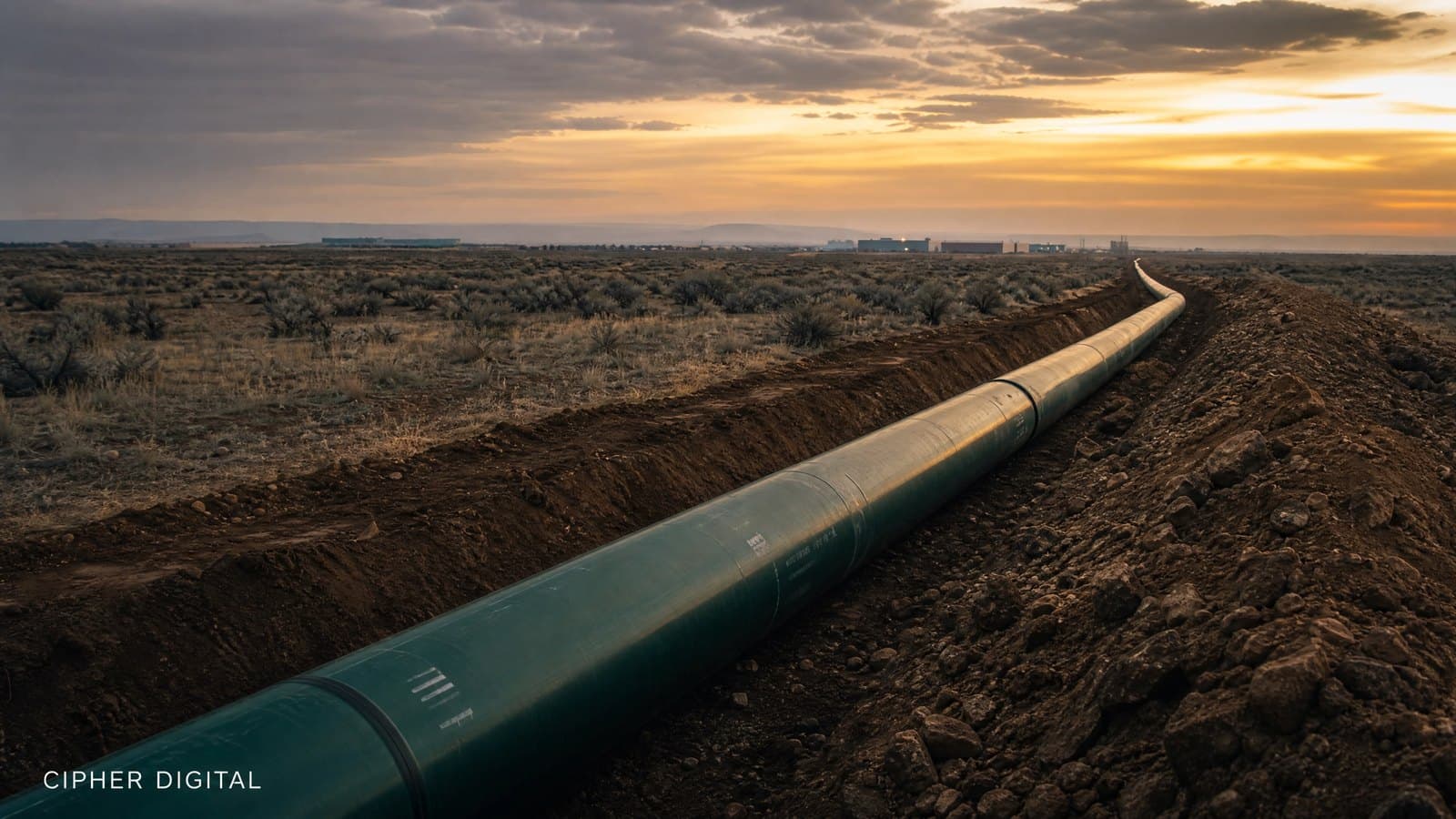
Cipher Digital announced yesterday that it has begun developing lateral gas pipelines at several of its sites. The pipelines will connect the sites to nearby natural gas supply and enable on-site generation of up to 2.5 gigawatts.
Per the announcement, the new power should be available before the end of 2027.
It sounds like an infrastructure and engineering item. It is actually about an entirely different question: how long it takes to connect a data centre to power in the United States.
Errors or inaccuracies are possible. Spotted something that looks wrong? Write to me and I will correct it.
What Was Said, and What Was Not
Tyler Page, the company's chief executive, framed the move this way: "Securing and delivering power is the foundation of everything we do and bringing our own electricity generation allows us to unlock significant new capacity quickly."
And what the announcement does not include deserves equal note:
- It names no sites, referring only to "multiple sites" near natural gas resources.
- It attaches no tenant to the new capacity. It says the company plans to use it to develop and lease additional capacity to "premier tenants", in the future tense.
- This is a press release, not a current report to the SEC. I checked the company's filings - the most recent 8-K was filed on 4 August. That is not a fault, but it does mean there is no document here prepared to a filing standard.
Why 2.5 Gigawatts of Own Generation Is a Story
To see what has been bought here, you need the numbers on the other side.
| The US interconnection queue | |
|---|---|
| Projects in the queue | about 2,600 gigawatts |
| Median wait to commercial operation | approaching five years |
| In cases reported for data centres | up to 12 years |
| In Northern Virginia, the world's largest market | up to seven years |
| Share of projects that withdraw | about 80% |
| Interconnection costs as a share of a withdrawn project's budget | 30% to 37% |
That queue is the real bottleneck of the data centre industry - not chips, not cooling, and not capital.
And against it, the figure that explains why everyone is turning to own generation:
Behind-the-meter generation turns a five-to-seven-year wait into a schedule of roughly 12 to 18 months of equipment delivery and commissioning.
That is not a marginal improvement. It is a difference of years, and in a market where a tenant signs a 15-year contract, whoever can commit to an earlier date is selling a different product.
And on the McKinsey estimate cited in this context, between 25% and 33% of incremental data centre demand through 2030 will be met behind the meter - so this is not a niche, it is a third of the market.
What Cipher Already Held Before the Announcement
This announcement sits on an existing base rather than on intent alone.
| Tenant | Site | Scale |
|---|---|---|
| Amazon Web Services | Black Pearl | 300 MW, 15-year lease, about $5.5 billion |
| Fluidstack, with Google credit support | Barber Lake | 168 MW of load, 10-year agreement, about $3 billion |
| Amazon Web Services | Stingray | about 70 MW of critical load |
In the business update the company published on 4 August, it presented about $11.4 billion of contracted revenue and a development portfolio of 5.3 gigawatts.
In other words: capacity actually leased today is measured in hundreds of megawatts, and the portfolio is measured in gigawatts. The announcement is about the gap between them - how you get from one to the other.
And the Question the Announcement Does Not Answer
To generate 2.5 gigawatts from gas you need two things: a pipeline and turbines. The announcement is about the pipeline.
And turbines are currently the more severe bottleneck:
| The turbine market | |
|---|---|
| GE Vernova's order backlog | 116 gigawatts |
| Of which, firm equipment backlog | about 53 gigawatts |
| Of which, paid slot reservations | about 63 gigawatts |
| Delivery date for a new heavy-duty turbine order | 2031 |
| Lead times for combined cycle | about five years, up to seven for heavy frames |
Cipher is talking about power before the end of 2027. A heavy-duty turbine ordered today arrives in 2031.
This does not mean the announcement is wrong - and there are several entirely plausible explanations. It may involve lighter units or reciprocating engines, whose lead times are far shorter. The "power providers" Cipher mentions as partners may already hold reserved slots. And the capacity may be phased.
The announcement simply does not say. Which is why this is, in my view, the one question worth asking about it: not whether there is demand for power - but how the turbines that will generate it are made, and when.
And the Financial Side, Because It Cannot Be Left Out
In the piece we published on Cipher's quarterly results, the balance sheet was noted: long-term debt of $5.45 billion against equity of only $562 million.
Building gas pipelines and generation infrastructure for 2.5 gigawatts is not a cheap undertaking. The announcement notes that Cipher will work with power providers who will develop and operate the generation infrastructure - wording that implies not all of the investment falls on Cipher's balance sheet - but it does not detail how the costs are split.
The shares closed yesterday at $17.37, a gain of 14.43%, after trading in a range of $15.02 to $17.57. That was the session in which the announcement was published - but bitcoin rose 5.1% the same day and the three leading indices rose more than 1%, so not all of the move should be attributed to the announcement itself.
הזווית שלי
דעה אישית של אילן אברמוב - לא ייעוץ ולא המלצה
What I take from this announcement is not the gigawatts but what it reveals about what Cipher actually sells.
Until recently this company was called Cipher Mining, and I wrote here in August that its old business no longer exists. But its real asset was never the miners - it was sites with access to power. Bitcoin mining was simply the first way to monetise them.
And this announcement says it is no longer waiting for the grid for the additional capacity. In a market where the median queue approaches five years and 80% of projects withdraw, the ability to commit to a date is the product. That explains how a company this size signed a $5.5 billion contract with Amazon - not because it builds better than others, but because it had power when others did not.
And what I try to be careful about is exactly where the thesis feels most convincing. When a story's logic looks perfect, it is easy to stop asking what actually has to happen. And here what actually has to happen is that someone supplies turbines within under two years, in a market where a new order arrives in 2031.
There are entirely reasonable possible answers to that, and I could not confirm any of them from the announcement itself. So that is what I will look for in the next release: not more gigawatts in the portfolio, but an equipment order with a date.
And a last word on the risk structure. $11.4 billion of contracted revenue against $562 million of equity is very high leverage by any standard. It works well when tenants pay on schedule, and it is a very narrow place to stand if something slips. That remains true even when the thesis is right - the two statements do not contradict each other, and both are worth holding.
(It is important to stress: this is my personal opinion only and nothing herein constitutes a recommendation to take any action. Ilan Abramov, the writer, or parties on his behalf may hold positions in the securities mentioned, and those holdings change from time to time.)


