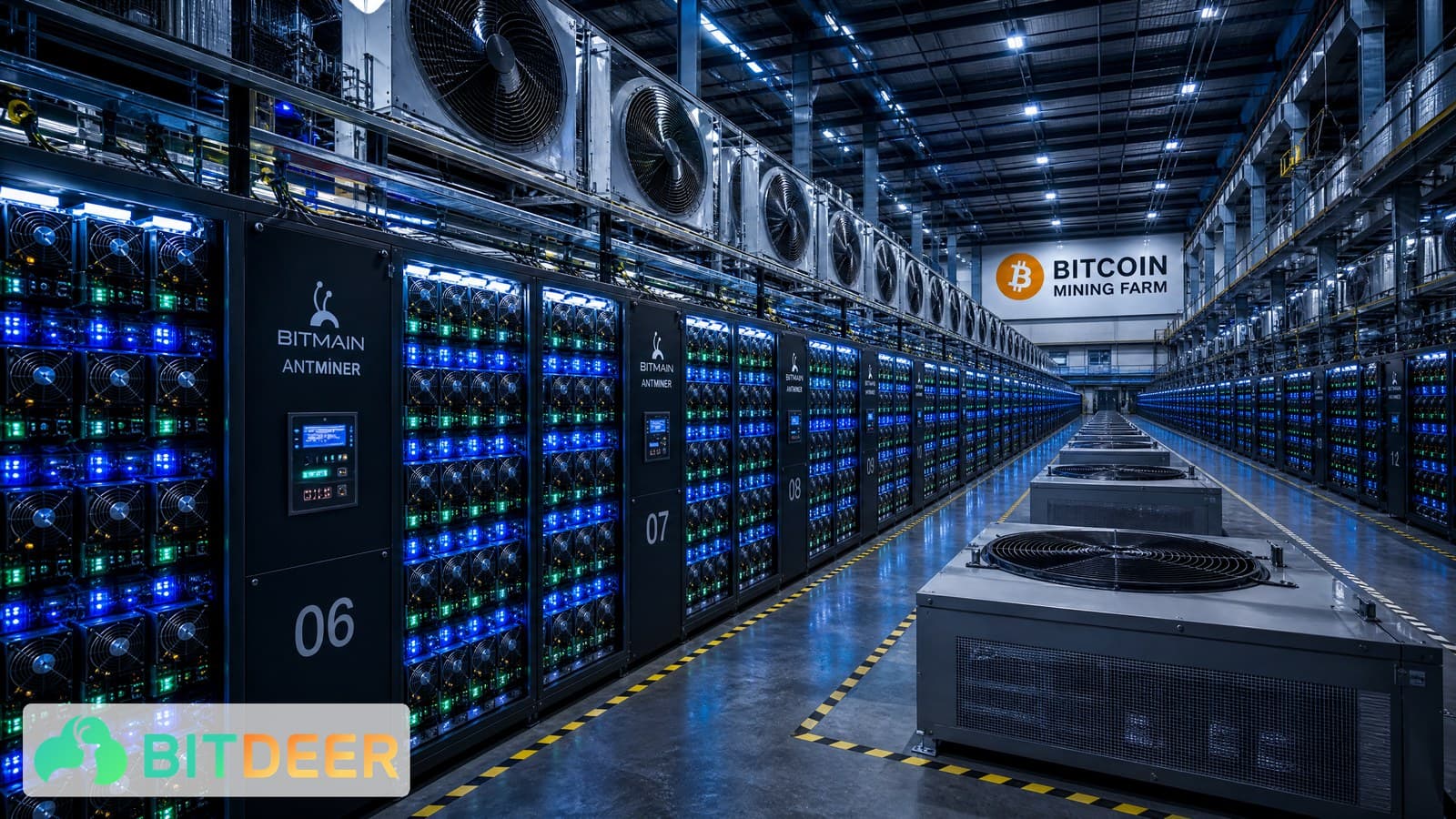
Bitdeer reported its second quarter on Monday, 10 August 2026, before the market opened. We are writing about it today.
Errors or inaccuracies are possible. Spotted something that looks wrong? Write to me and I will correct it.
What Bitdeer Does
Bitdeer, based in Singapore, originally ran three businesses: mining bitcoin for its own account, hosting other people's machines, and manufacturing and selling its own mining rigs under the SEALMINER name.
It is now trying to become a fourth: a landlord of power and space for AI data centres.
And this is the thesis that makes the company interesting in the first place. Bitcoin miners spent years holding an asset they did not know was valuable: large power contracts, already connected to the grid and already permitted. In a world where AI data centres wait years for a grid connection, that asset is worth far more than mining. The only question is who actually executes the conversion, rather than announcing it.
One accounting note that affects every comparison: from 1 January 2026 the company moved from IFRS to US GAAP, and prior periods have been recast accordingly.
The Quarter
| The quarter | A year ago | |
|---|---|---|
| Revenue | $228.8 million | $155.6 million |
| Cost of revenue | $237.3 million | $143.6 million |
| Gross profit (loss) | $8.5 million loss | $12.0 million profit |
| Gross margin | minus 3.7% | 7.7% |
| Operating expenses | $72.6 million | $42.2 million |
| Net loss | $92.3 million | $62.9 million |
| Adjusted EBITDA | $31.1 million | $4.6 million |
Revenue rose 47%. Gross margin turned negative.
That is the number that matters here: cost of revenue, at $237.3 million, was higher than revenue itself. The company sold more, and every dollar coming in cost it more than a dollar.
The company's explanation: higher electricity and depreciation costs as a large number of new rigs came online, a slightly higher per-unit power cost, and increases in staff costs, AI cloud service fees and hosting fees for the co-mining business.
What Actually Happened in Each Line
| Revenue line | The quarter | A year ago |
|---|---|---|
| Self-mining | $168.4 million | $59.3 million |
| Co-mining | $25.0 million | nil |
| AI Cloud | $14.0 million | $1.3 million |
| Cloud hash rate | $3.7 million | nil |
| Membership hosting | $12.8 million | $14.6 million |
| General hosting | $2.8 million | $9.3 million |
| SEALMINER rig sales | $0.4 million | $69.5 million |
And here is the real explanation for the report.
Rig sales evaporated: from $69.5 million to $0.4 million. The company effectively stopped selling machines to other people - and started running them itself.
Which is exactly what shows up on the other side: average self-mining hash rate jumped 389.4%, from 14.2 to 69.5 EH/s, and self-mining revenue rose from $59.3 million to $168.4 million.
This is a deliberate swap of one-off, high-margin revenue for recurring, lower-margin revenue - and in the short term it hurts, because instead of selling a machine and collecting immediately, the company operates it and pays its electricity bill.
And three lines not to skip over.
1. 2,694 bitcoin were mined against 565 a year ago - close to five times as many. Mining revenue rose less than three times. The company's explanation: a lower average bitcoin price at which mining rewards were recognised. The company is mining far more and receiving less per coin.
2. The bitcoin balance held fell from 1,502 coins to 150. The company mined 2,694 coins in the quarter and holds 150. That means it is selling almost everything it mines to fund the build. That is a perfectly legitimate decision for a company building infrastructure, but it also means there is no store of value here waiting on the price.
3. Operating expenses rose from $42.2 million to $72.6 million, with general and administrative expenses rising from $20.0 million to $34.3 million.
What Did Improve, Substantially
Fleet efficiency: 15.8 joules per terahash, against 25.7 a year ago.
That is roughly a 39% improvement in energy consumed per unit of work - and in a business where electricity is the primary raw material, it is the single most important operating metric. Average electricity cost was almost unchanged, $44 per MWh against $43 - so the company did not improve what it pays, it improved what it extracts from each kilowatt.
Adjusted EBITDA also jumped from $4.6 million to $31.1 million - a very wide gap against the gross loss, driven mainly by depreciation on the new mining equipment.
The Deal That Changes the Story
At the Tydal site in Norway, a data centre lease for AI and high-performance computing was signed with Volta.
The terms as the company reported them:
- Size: $4.7 billion
- Term: 16 years
- 121 MW of critical IT capacity will be configured to run NVIDIA GPUs for the end customer, which the company describes as a leading AI lab
The site is being built in three phases: a first phase of 66.5 MW in the fourth quarter of 2026, a second phase of 66.5 MW in the first quarter of 2027, and a third phase of 47 MW in the second half of 2027.
Why it matters: this is the difference between a mining company that talks about moving into AI and a mining company that has signed a long-term contract, at a known price, with a customer running models. CFO Michael Potter calls it the "first large-scale proof point" for the colocation strategy.
"Earlier this month, we converted a meaningful portion of our power portfolio into long term, contracted revenue with the Tydal, Norway agreement, our first large-scale proof point for the colocation strategy we plan to continue to build upon"
The Power Portfolio, and Where It Stands
Rockdale, Texas: 563 MW, connected and live today, designated for a move from crypto to colocation and AI cloud. The company notes the site is "in active evaluation of AI transition" - meaning it has not been converted yet.
Knoxville, Tennessee: 86 MW. Here there is a delay worth naming: the project has been fully redesigned to meet demand for larger-scale deployments, and completion has been pushed to the third quarter of 2027.
Wenatchee, Washington: 13 MW, with the ready-for-service date still to be updated.
So the portfolio is real and it is large, but most of it is still ahead.
The Balance Sheet
Cash, cash equivalents and restricted cash: $496.3 million as of 30 June 2026.
Digital assets and digital assets receivable: $196.9 million.
The Market Reaction
The stock fell 20.1% on Monday and closed at $8.70, against $10.88 on Friday.
For comparison, on exactly the same day: Riot Platforms also reported, announcing a 20-year, 191 MW data centre lease with a leading AI lab worth roughly $9.1 billion in contract revenue. Its stock fell 5.5% that day.
הזווית שלי
דעה אישית של אילן אברמוב - לא ייעוץ ולא המלצה
I look at this report and see two entirely different businesses inside one company, pulling in opposite directions.
The first business is mining, and it is in trouble. Not through mismanagement, but through arithmetic: the company mines five times as many coins and receives less for each one, while depreciation on the new rigs and the electricity they consume have turned gross margin negative. A negative gross margin is not accounting noise. It means that before you spend a single dollar on management, marketing or research, you have already lost.
The second business is infrastructure leasing, and it is standing in exactly the right place. The Tydal deal is not a statement of intent: $4.7 billion, 16 years, a defined customer, a three-phase build schedule. That is speculative power converted into contracted revenue, which is precisely what this thesis was looking for.
What makes the report complicated is that this transition costs money now and returns money later. The company stopped selling $69.5 million of rigs per quarter in order to run them itself; it sells almost all the bitcoin it mines to fund construction; and it is building three sites that come online between the end of 2026 and the end of 2027. Each of those moves makes sense on its own. Together they say the company is burning today to collect tomorrow.
And the comparison with Riot is, to me, what explains why the market prices them differently. Both companies made exactly the same strategic move, on the same day. The difference is that Riot's 563 MW at Rockdale is already delivering power to a paying customer, while Bitdeer's own Rockdale site is still "in active evaluation of AI transition". That is the gap between a contract that is running and a contract that has been signed.
What I will watch is two numbers, both measurable: whether gross margin returns to positive, and whether phase one in Norway actually energises in the fourth quarter. If both happen, this is an entirely different company. If the phase slips the way Knoxville slipped to the third quarter of 2027, then what is here is a loss-making mining business holding an expensive option.


