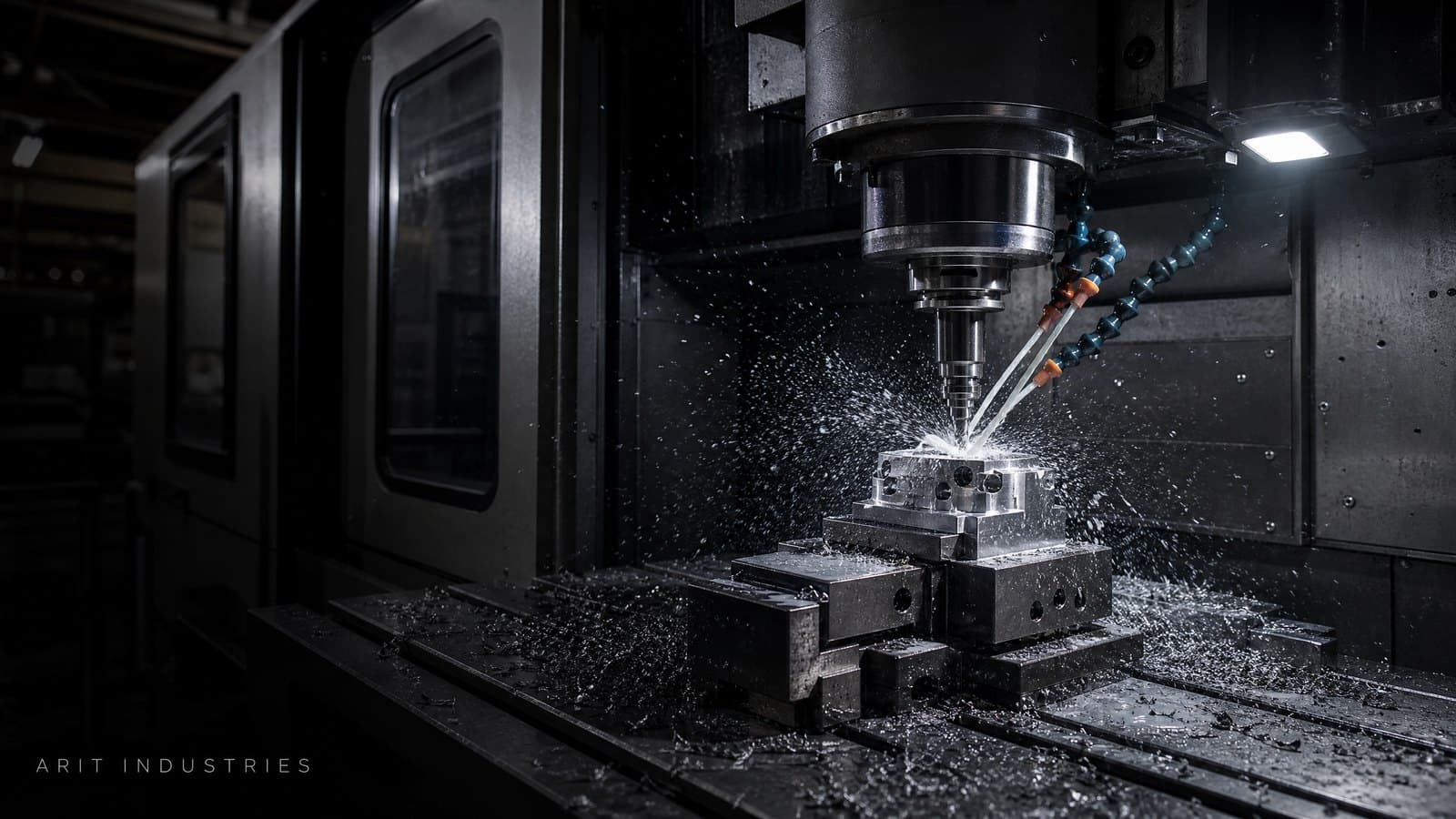
Arit Industries published its second-quarter report. According to the filing it is a holding company, operating through its subsidiary Reshef Technologies in the development, manufacture and marketing of electronic fuzes for the defence market in Israel and abroad.
Errors or inaccuracies are possible. Spotted something that looks wrong? Write to me and I will correct it.
The Quarter
| NIS millions | The quarter | Share of revenue |
|---|---|---|
| Revenue | 56.3 | |
| Gross profit | 33.1 | 58.7% |
| Operating profit | 25.7 | 45.6% |
| Pre-tax profit | 12.4 | 22.0% |
| Net profit | 9.7 | 17.3% |
| Attributable to shareholders | 5.0 | |
| Non-controlling interests | 4.7 | |
| Basic earnings per share | NIS 0.05 | |
| Balance sheet total | 1,302.3 | |
| Shareholders' equity | 1,216.7 |
A Margin That Fits the Sector
A gross margin of 58.7% and an operating margin of 45.6% are high numbers by any industrial standard.
And in precision defence work they are explicable: the product is sold on performance and on qualification, not on material cost. The number of qualified manufacturers is limited, and so pricing power differs from general industry.
And about 78% of the gross margin survives to the operating line - a high figure, pointing to a small head office relative to turnover.
For comparison from today: Gaon Group kept 53%, Sugat 29%, and Victory 15%.
And the Line Below the Operating Line - Which Does Not Fit the Balance Sheet
From NIS 25.7 million of operating profit, NIS 12.4 million was left before tax. NIS 13.3 million was taken out - 51.9%.
And that does not square with interest, so it is worth pausing on.
| Balance sheet total | NIS 1,302.3 million |
| Shareholders' equity | NIS 1,216.7 million |
| Total liabilities | about NIS 85.7 million |
| Leverage ratio | 1.07 to one |
This is the lowest leverage ratio among the 40 Israeli filers today. For comparison, Prime Energy stands at 9.4.
And on liabilities of about NIS 85.7 million, a charge of NIS 13.3 million in a single quarter is not plausible as interest - it would imply a very high double-digit quarterly cost of debt.
So this item is almost certainly not interest alone. At a company with a balance sheet like this it could include impairments of investments, losses from held companies, or fair-value changes on financial assets.
The structured filing does not detail the composition of the item, so I do not assert. What can be said: at a company that is barely leveraged, a movement like this is not a running financing cost - it is more likely an event, and events do not necessarily recur.
And Almost Half the Profit to the Minority
Of net profit of NIS 9.7 million, NIS 4.7 million is attributable to non-controlling interests - 48.3%.
And that follows directly from the structure the filing describes: Arit is a holding company, and the activity is conducted through Reshef Technologies. It consolidates 100% of Reshef's results and sets aside the partners' share in the final line.
The meaning: the 45.6% operating margin describes Reshef, not an Arit shareholder's share in it. What reaches them is NIS 5.0 million, and that explains the earnings per share - NIS 0.05.
And this is the phenomenon that recurred today again and again - at Neto Holdings 55.8% to the minority, at G City 33.1%, at IBI 32.1%.
And International Expansion
The filing notes that Reshef has established subsidiaries in the United States and in India, and that it is working to obtain the permits and approvals required for manufacturing licences in those countries.
And that is a fact with no expression in this quarter's financial lines - it concerns the coming quarters. In defence manufacturing, a local manufacturing licence is sometimes a condition for bidding, and so this is market expansion rather than merely capacity expansion.
הזווית שלי
דעה אישית של אילן אברמוב - לא ייעוץ ולא המלצה
What I take from this report is that three layers separate an excellent quarter from what reaches the shareholder.
At the Reshef level this is a strong quarter: a 58.7% gross margin, 45.6% operating, and almost no debt.
And then NIS 13.3 million is taken out below the operating line, tax takes 21.3%, and 48.3% of what remains goes to the minority. The result for an Arit shareholder: NIS 5.0 million - about a fifth of the operating profit.
And what I would want to know, and do not, is exactly what those NIS 13.3 million were. If it is interest, it will recur every quarter. If it is a one-off impairment, the next quarter will look entirely different - and at a company with a NIS 1.3 billion balance sheet and equity almost equal to it, both are plausible.
So I do not reach a conclusion about the business here. The structured filing gives the lines but not their composition, and the gap between the two readings is too large to guess at.
And what I would look for in the full accounts is the financing note, the holding percentage in Reshef, and the order backlog. In defence, the backlog is the figure that describes the coming quarters, and it is not in the structured filing.
(It is important to stress: this is my personal opinion only, and nothing herein constitutes a recommendation to take any action.)


