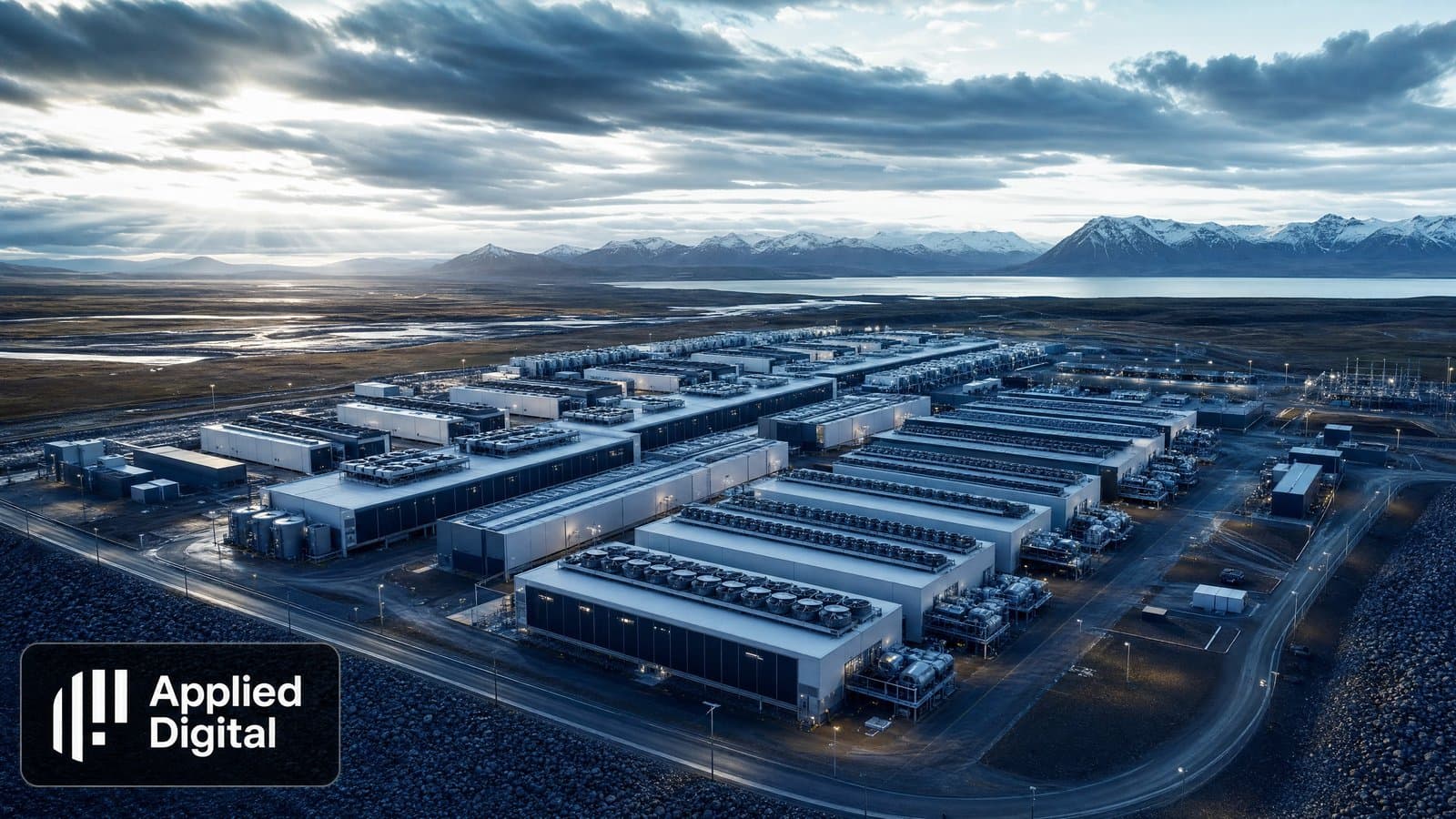
In Monday's review we presented Applied Digital (NASDAQ: APLD) as "the real estate of AI" - the last link in the chain, the one that builds the structure everything sits inside. The report it published last night demonstrates exactly what that means, in both directions: revenue that jumped 407%, alongside a loss of $110.6 million.
About the Company: A Capacity Landlord, Not a Chip Supplier
Applied Digital, of Dallas, designs, builds and operates high-performance data centers - facilities intended for AI workloads and power-intensive computing. It does not manufacture chips and does not develop models; it supplies the physical infrastructure: the building, the power, the cooling and the connectivity.
The model resembles income-producing real estate more than technology. The company invests large capital upfront in building a facility, then leases capacity to customers on long-term contracts. The financial implication matters: the expense comes first, and the revenue spreads over years. So such a company can look loss-making precisely when it is succeeding - because it is building faster than it is collecting.
And that is why its report requires reading in three layers, not one.
What Was Reported: Three Layers of the Same Report
This is the company's fiscal fourth quarter, which ended at the end of May 2026.
First layer - revenue. $258.7 million in the quarter, a jump of 407% versus the comparable quarter. For the full fiscal year: $611.3 million, up 167%. These are growth rates indicating facilities entering service and beginning to bill.
Second layer - the bottom line. The GAAP loss attributable to common stockholders stood at $110.6 million, or $0.39 per share. For the full year: a loss of $249.2 million.
Third layer - and here it gets interesting. Excluding one-time and non-cash items:
| Metric | Amount |
|---|---|
| Adjusted net income | $12.9 million |
| Adjusted EBITDA | $42.4 million |
| Net operating income | $39.9 million |
Meaning: the operation itself is already generating profit. The gap between adjusted income of $12.9 million and a GAAP loss of $110.6 million stems from the costs that characterize precisely this stage - depreciation on new facilities, financing expenses on the debt that funded them, and accompanying accounting items.
Net operating income ($39.9 million) is the metric worth noting in particular. It is a measure from the world of income-producing real estate: it measures the profitability of the assets themselves, before financing and depreciation. When it is positive and meaningful, it says the facilities built are a good business - even if the financial structure around them is still expensive.
The Bull Thesis
Whoever reads it positively will point out that the shift from promise to realization is already happening: revenue that jumped fivefold in a year is not a forecast - it is signed contracts and operating facilities. Positive adjusted EBITDA and net operating income prove the model works at the asset level.
And above all, the positioning. Applied Digital sits exactly at the junction that all of Monday's reports pointed to: Baker Hughes reports energy equipment orders that doubled, Celestica reports server assembly at a record pace - and someone has to supply the building where all of it sits. Demand for data-center capacity, per every report we saw this week, exceeds supply.
The Bear Thesis
And the other side relates directly to the financial structure.
The debt. Building data centers is capital-intensive, and it is funded with debt. The faster the company builds, the more leverage grows - and financing costs hurt the bottom line, as seen in the gap between adjusted income and the GAAP loss. In a high-rate environment, like the one the Fed may sustain, this is a real risk.
Accounting profitability. An annual loss of $249.2 million is a material figure. A company can justify it as investment, but it needs to reach a point where depreciation is absorbed by revenue - and it is not clear when.
Customer concentration. In a capacity-leasing model, a small number of large contracts constitutes most of the revenue. A contract renewal, or its absence, is a material event.
And the valuation. Per the coverage preceding the report, the stock entered it with a high valuation and rising debt - a combination leaving little room for error.
The debate in one line
The bulls see revenue that jumped 407% in the quarter and 167% in the year, positive adjusted EBITDA and net operating income of $39.9 million - meaning a model that works at the asset level, in a market where demand exceeds supply. The bears see an annual loss of $249 million, leverage that grows with every new facility, and dependence on a rate environment outside the company's control. Both sides are reading the same report.
My Angle
A personal opinion of Ilan Abramov - not advice, not a recommendation
This report is the cleanest demonstration I have seen this season of what I call the building phase - and precisely because it is small.
At Alphabet the pattern appeared on a scale of tens of billions: doubling investment until free cash flow flipped. At Tesla the same. Applied Digital shows exactly the same structure, only at a size where all the parts are visible: revenue jumping fivefold, assets already profitable at the operating level, and a bottom line swallowed by depreciation and interest.
And that leads to the question that decides every company at this stage, and it is not "is the demand real." The demand is real - all of this week's reports prove it. The question is whether it will reach a size where revenue absorbs the construction costs, before financing costs absorb it. That is a race between two paces, and the annual loss of $249 million is a reminder that the race is not yet decided.
What I will follow: net operating income relative to the debt. If it keeps growing faster than financing costs - the company wins the race. If the gap narrows, that will be the early sign that leverage is starting to overtake growth.
Summary
Applied Digital delivered a report that demonstrates the building phase in full: revenue that jumped 407% in the quarter to $258.7 million and 167% in the year to $611.3 million, alongside a GAAP loss of $110.6 million in the quarter and $249.2 million for the year. And beneath the bottom line, figures telling a different story: adjusted income of $12.9 million, adjusted EBITDA of $42.4 million and net operating income of $39.9 million.
The question for the investor is not whether demand for data centers exists - all of this week's reports answer that. The question is whether the pace at which the assets begin to earn will outrun the pace at which the debt accumulates. That we will only know in the coming quarters.
Sources: Applied Digital Corporation's official results announcement for the fiscal fourth quarter and fiscal year 2026 (July 27, 2026), including quarterly and annual revenue, the GAAP loss, adjusted net income, adjusted EBITDA and net operating income; StockTitan and Zacks coverage. Data accurate as of the time of writing. The chart is shown in real time via TradingView. Nothing herein constitutes a forecast, recommendation or advice - see the full disclaimer at the bottom of the page.


