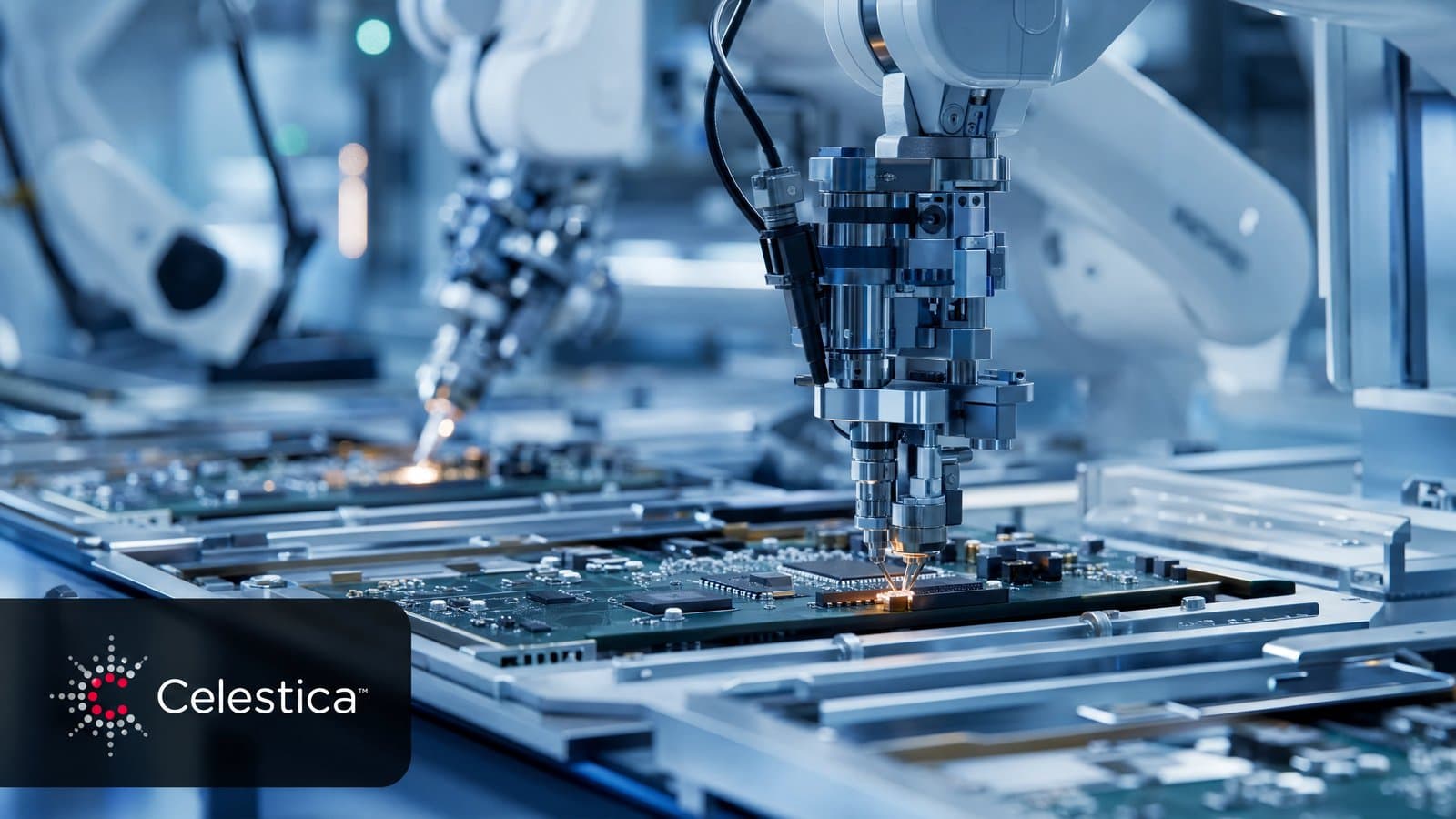
There are companies whose report is interesting in its own right, and there are those whose report is interesting mainly for what it reveals about others. Celestica (NYSE: CLS) belongs to the second category - and the report it published last night is one of the strongest of the entire season: revenue that jumped 62%, adjusted profit that jumped 83%, and an annual outlook raised by $1.5 billion.
(Celestica's investor call on the quarter's results is scheduled for Tuesday, July 28, at 8:00 AM New York time. If material figures emerge on it, we will update.)
About the Company: The One That Assembles What Others Design
Celestica, of Toronto, is an electronics manufacturing services company - EMS. It does not design chips and does not sell a product under its own name. It builds for customers: servers, network switches, storage systems and cooling solutions - the racks and systems that fill data centers.
Its customers are the hyperscalers: the giant cloud providers. And here sits the point that makes its report especially interesting - Celestica sees the orders before they appear in its customers' own reports. When Microsoft or Meta decides to expand capacity, someone has to assemble the hardware, and the order reaches the contract manufacturer months before the server powers on.
Business-wise, this is a model of thin margins and large volume. A contract manufacturer does not earn like a software company; it earns from scale. And therefore the two things to check are the volume - and the direction of margins.
The company reports in two segments: CCS (Communications and Cloud Solutions) - the division serving data centers, and ATS (Advanced Technology Solutions) - industrial, medical, aerospace and defense.
What Was Reported: A Beat on Every Metric
Revenue. $4,698.6 million - a jump of 62% year-over-year. For proportion: consensus stood at about $4.35 billion, meaning the company beat it by about $350 million.
Earnings. Adjusted EPS came to $2.54, versus $1.39 a year ago - a jump of 83%. And here is the important point: management's own guidance for the quarter stood at $2.14-2.34, meaning the actual result came in above the top end of the range. Net earnings totaled $368.8 million.
And the breakdown reveals the engine. The CCS division - communications and cloud - leapt 84% to $3.81 billion. Meaning: out of $4.7 billion in revenue, about 81% comes from the division serving data centers, and it is the fastest-growing one. AI demand is not merely a contributing factor in this report - it is the report.
The Outlook: A $1.5 Billion Jump
And here is the part that changes the forward picture. The company raised its 2026 revenue outlook from $19.0 billion to $20.5 billion - an addition of one and a half billion dollars in a single raise. In addition, management signaled that the growth pace in 2027 is expected to accelerate beyond 2026's, on the back of strong customer demand and new program wins.
It is important to grasp the magnitude: an outlook of $20.5 billion for 2026 represents growth of about 65% versus last year. Companies of this size simply do not grow at that pace - unless they are sitting squarely on a wave.
Why This Matters Far Beyond the Stock
And here is the connection that makes this report a market-level event, not a company-level one.
Microsoft and Meta report on Wednesday. Apple and Amazon on Thursday. The four giants that order this hardware. And the question accompanying the market all season, since Alphabet's report, is whether the pace of AI infrastructure investment continues or is beginning to moderate.
Celestica provides an early answer, from a different direction: it does not report what the hyperscalers declared, but what they actually ordered. And the orders, per the report, are not only failing to moderate - they justified a $1.5 billion outlook raise and a statement that next year will be faster still.
This joins two further confirmations from that same day: Baker Hughes reported that orders at its energy division doubled and attributed it explicitly to data centers, and Cadence reported a record chip-design backlog. Three entirely different links in the same chain, all reporting the same thing.
The Bull Thesis
Whoever reads it positively will point to a rare combination: 62% revenue growth with 83% profit growth - meaning profit is growing faster than revenue, and that is real operating leverage. At a contract manufacturer working on thin margins, this is evidence of better factory utilization and an improving product mix.
Beyond that: a $1.5 billion outlook raise is an unusual statement of confidence; the comment about acceleration in 2027 extends the visibility horizon; and the positioning at the core of AI infrastructure, together with new program wins, provides visibility for years ahead.
The Bear Thesis
Whoever reads it critically will recall first the business model. A contract manufacturer is, ultimately, a supplier. Its margins are lower than those of the party designing the product, and its pricing power is limited. It benefits from the wave, but does not capture most of the value in it.
Second, customer concentration. When about 81% of revenue comes from a division serving a handful of cloud giants, the company is exposed to a single customer's decision. Losing one significant program is felt immediately.
Third, the cyclicality of the investment. Exactly as the accelerating investment pace lifted Celestica, a slowdown in it would hurt it first - because it sits at the ordering stage, not at ongoing operations.
And fourth, the valuation. A stock that has surged over the past two years enters every report with high expectations, and even a beat like this is already partly priced in.
The debate in one line
The bulls see a company growing 62% and increasing profit 83%, jumping its outlook by a billion and a half dollars, and sitting exactly at the junction where the hyperscalers' money flows. The bears see a thin-margin contract manufacturer, dependent on a handful of customers, sitting in the first link that would be hurt if the investment pace moderates. Both sides are reading the same report.
My Angle
A personal opinion of Ilan Abramov - not advice, not a recommendation
This report is, to my eye, the most important data point published yesterday - and not because of Celestica itself.
All season we have been asking the same question: is the pace of AI infrastructure investment continuing. Until now the answers came from the declaring side - CEOs making promises, outlooks being raised. Celestica answers from the other side: it reports what has already been ordered and paid for. And the order numbers told it to raise its outlook by $1.5 billion and say next year would be faster.
Two days before Microsoft and Meta take the stage, that is the cleanest early indication available. If the hyperscalers were slowing, it would have appeared here first.
And yet, I remind myself where Celestica sits in the chain. It assembles, it does not design. In an upturn it wins big, and in a downturn it is hurt first - because a postponed order disappears at its end before it is felt anywhere else. This is a stock that reflects the cycle in magnification, in both directions. Whoever buys it is buying the pace, not the moat.
Summary
Celestica delivered an exceptional quarter: revenue of $4.7 billion growing 62%, adjusted EPS of $2.54 jumping 83% - both above guidance - and a communications and cloud division that leapt 84% and is now the bulk of the business. The annual outlook was jumped from $19 to $20.5 billion, with a signal that growth in 2027 will accelerate.
Beyond the company itself, this is a small macro data point: the link that assembles the hardware of data centers reports that orders are accelerating, two days before its customers report themselves. The question that remains open is not whether the demand exists - but how long it lasts, and what happens to a company sitting at the start of the chain on the day it moderates.
Sources: Celestica Inc.'s official results announcement for the second quarter of 2026 (July 27, 2026) and its SEC filings, including revenue, net earnings, adjusted earnings, segment breakdown and the updated annual outlook; prior management guidance from the first-quarter report; TradingView and StockTitan coverage. Data accurate as of the time of writing. The chart is shown in real time via TradingView. Nothing herein constitutes a forecast, recommendation or advice - see the full disclaimer at the bottom of the page.


