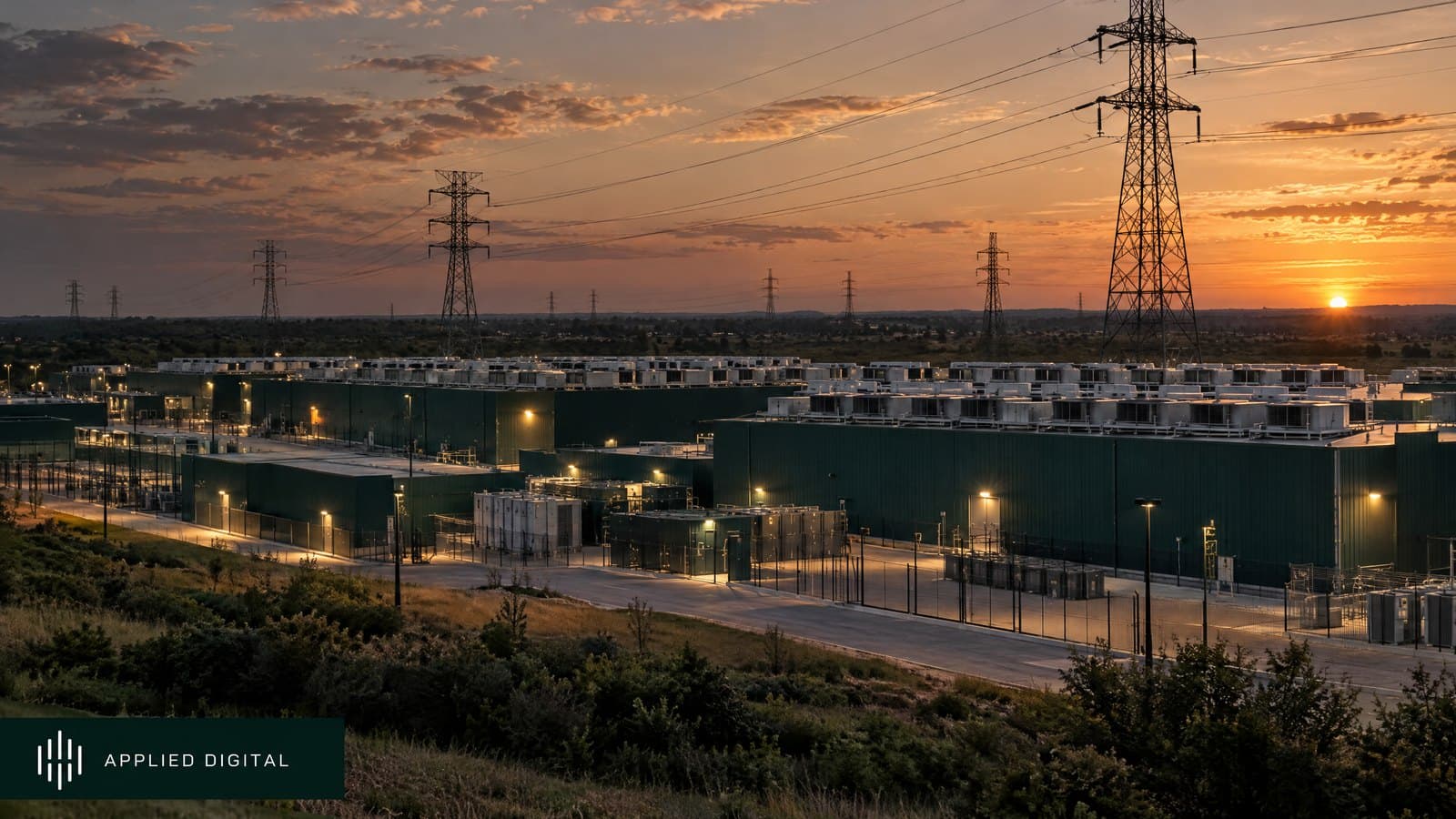
Applied Digital, which develops data center campuses for AI workloads, reported on October 7, after the market close, its fiscal first quarter 2027, which ended August 31. Revenue: $341.9 million, up 322% from the same quarter a year earlier. The net loss to common shareholders from continuing operations was $221.0 million, $0.76 a share, and the adjusted loss was $4.1 million, $0.01 a share.
There may be errors or inaccuracies. Found something that looks wrong? Write to me and I will fix it.
What was reported
| Fiscal first quarter 2027 | Fiscal first quarter 2026 | Change | |
|---|---|---|---|
| Revenue | 341.9 | 80.9 | +322% |
| HPC Hosting | 262.6 | 26.3 | +899% |
| Data Center Hosting | 37.8 | 37.9 | -0.4% |
| ChronoScale, under "Other"* | 41.5 | 16.7 | +149% |
| Adjusted revenue, excluding ChronoScale | 300.4 | 64.2 | +368% |
| Adjusted EBITDA | 64.4 | 0.5 | |
| GAAP operating loss | 62.4 | 9.8 | Loss grew |
| Net loss to common shareholders, continuing operations | 221.0 | 18.5 | Loss grew |
| Loss per share (dollars) | 0.76 | 0.07 | |
| Adjusted net loss | 4.1 | 7.6 | Loss narrowed |
| Purchases of property and equipment* | 2,074.7 | 249.9 | +730% |
* The percentage change is calculated from the figures in the table.
In millions of dollars, except loss per share. Prior-year figures are recast, so ChronoScale is included in them. Source: the company's earnings release and its quarterly report (10-Q), October 7, 2026.
Where the revenue came from
More than 90% of the growth in revenue came from one segment, HPC Hosting. It brought in $262.6 million, versus $26.3 million in the same quarter a year earlier, and its profit swung from a loss of $2.0 million to a profit of $33.4 million.
The segment's revenue has three components. Base rent was $65.8 million, about a quarter of the segment - the contractual payment for capacity that is already operating. Tenant fit-out revenue was $183.5 million, about 70% of the segment. This is the component that comes from the work of adapting the infrastructure to the tenant's requirements, rather than from rent on operating capacity. The third component, tenant recoveries, was $13.3 million. The earnings release contains no numerical financial guidance, so the report gives no indication of how much of the second component will recur in coming quarters.
The Data Center Hosting segment, where the Jamestown (106 MW) and Ellendale (180 MW) sites are full, brought in $37.8 million, almost the same as a year earlier, but its profit more than doubled: $13.3 million, versus $6.0 million. The company's cloud business, ChronoScale, of which the company owns about 96%, is no longer reported as a segment and is shown under "Other." It brought in $41.5 million, versus $16.7 million, including $23.0 million from sales of GPU hardware.
Several growth rates are circulating around this report, and only two of them compare like with like. Total revenue rose 322% ($341.9 million versus $80.9 million), and adjusted revenue, excluding ChronoScale, rose 368% ($300.4 million versus $64.2 million). The figure of about 432% that appears in some coverage compares this year's total revenue with last year's adjusted revenue, so it is not a valid comparison.
The campuses, the contracts and the power
Contracted capacity reaches about 1.41 GW across five campuses. The contract value is about $36 billion over the base term, and about $86 billion including renewal options. Minimum contractual payments remaining through the end of fiscal 2027 are $468.0 million, according to the quarterly report (10-Q). In practice, 175 MW were live on August 31, and 250 MW on October 1.
The Polaris Forge 1 (PF1) campus is leased to CoreWeave, and an additional 150 MW building is being built there, with a 2027 target. The Polaris Forge 2 (PF2) campus is leased to a hyperscaler with an investment grade credit rating, and its initial operations are expected in the second half of 2026. Three more campuses are under construction:
| Campus | Capacity | Estimated contract value | Operations begin |
|---|---|---|---|
| Delta Forge 1 | 300 MW | $7.5 billion | First half of 2027 |
| Polaris Forge 3 | 300 MW | $7.5 billion | Second half of 2027 |
| Delta Forge 2 | 210 MW | $5.2 billion | First half of 2028 |
Source: the quarterly report and the company's earnings release.
At these three campuses the customer is described as a tier-one hyperscaler with an investment grade credit rating, and is not named. The Delta Forge 2 contract was signed on June 5, for about 15 years, with three renewal options of five years each. The quarterly report also lists three major customers without naming them - A, B and C - whose share of the company's customer concentration is 56%, 21% and 11%. It does not link the letters to company names.
In North Dakota, the live load is expected to reach 300 MW by the end of 2026, with the start of PF2 operations. The company also cites potential power of up to about 1 GW in Finland. On October 4 it signed a power purchase agreement (PPA) with Base Electron, for about 1,200 MW of gas-based generation; Applied Digital owns about 10% of Base Electron. CEO and Chairman Wes Cummins said that every new restriction elsewhere makes what the company already owns harder to replicate. Management's message is to build AI infrastructure campuses on long-term contracts with hyperscalers, and that sites in Dakota with available power are scarce.
Profitability: adjusted versus GAAP
At the operating level the quarter improved. Adjusted EBITDA rose to $64.4 million, from $0.5 million a year earlier and $42.4 million in the previous quarter - an increase of about 52% on the quarter. Its ratio to adjusted revenue was 21.4%, versus 17.6% in the previous quarter. Net operating income (NOI) was $58.8 million, at a rate of 89%, versus $39.9 million and 91% in the previous quarter. Adjusted operating income swung from a loss of $3.6 million to a profit of $37.8 million.
But on a GAAP basis the operating loss was $62.4 million, versus $9.8 million. The net loss to common shareholders from continuing operations reached $221.0 million, $0.76 a share, versus $18.5 million and $0.07 a share a year earlier, and $110.6 million and $0.39 in the previous quarter. Including discontinued operations, the loss was $237.1 million, $0.82 a share. The discontinued operation is Ekso, which was sold on September 30 and whose loss in the quarter was $16.1 million.
The reconciliation in the release, between the adjusted measure and GAAP, includes among other items: stock-based compensation of $59.4 million, versus $14.4 million a year earlier (within SG&A, compensation rose by $51.7 million, on the back of performance awards and a larger headcount); a loss of $49.5 million from a change in the fair value of derivatives, mostly a warrant related to B&W; a loss of $11.4 million from a change in the fair value of an investment in B&W shares; and diligence and acquisition costs of $11.9 million. SG&A expenses rose 289%. Interest expense was $77.4 million, up 866%, and interest income was $35.8 million.
Investment, financing and the balance sheet
Purchases of property and equipment reached $2,074.7 million in the quarter, versus $249.9 million a year earlier. Operating cash flow was positive, $63.9 million, versus negative $81.5 million a year earlier.
The investment was funded mainly by debt. On June 16 the company raised $1.59 billion in senior secured notes at 7.000% due 2031, issued at par. The proceeds were used to repay a $300 million bridge loan and to fund the additional 150 MW building at PF1. The company also raised Series G preferred stock of $275.0 million gross; a Texas Capital note of $58.5 million; and an $82.4 million draw on its revolving credit facility, whose commitments were upsized to $430 million. On June 18 the escrow for $2.15 billion of 6.750% notes was also released. The company issued no common stock in the quarter. The cash flow statement shows borrowings of $1,648.5 million and repayments of $315.9 million.
Cash, including restricted cash, fell to $3,677.9 million, from $4,153.4 million at the end of May - a decline of 11.5%. Of this, $2,949.9 million is unrestricted and $728.0 million is restricted. Debt rose to about $6.4 billion ($6,376.6 million at carrying value), versus about $5.0 billion at the end of May.
Versus expectations, and the stock
The estimates published before the report are far from the reported figures, and their basis is unclear. According to Yahoo Finance, citing Investing.com, revenue of $111.19 million and a loss of $0.27 a share were expected; Quartz, citing Barron's, gives $116.3 million and a loss of $0.29. Against them, reported revenue is $341.9 million ($300.4 million on the adjusted measure), and the loss per share is $0.76 on a GAAP basis and $0.01 on the adjusted measure. Since it is not clear on what basis the estimates were calculated, there is no finding here on whether the company beat them or missed.
The report came after the close, so the reaction is the October 8 close: the stock closed at $23.85, up 0.17%, versus $23.81 on October 7. Trading volume on October 8 was 55.5 million shares, versus 48.8 million the day before. On October 7 itself, before the release, the stock fell 6.04%, from $25.34 on October 6. On October 15 the stock closed at $20.39, 14.5% below the October 8 close.
הזווית שלי
דעה אישית של אילן אברמוב - לא ייעוץ ולא המלצה
What interests me in this report is not the pace of growth, but what it is made of. Of the segment's $262.6 million in revenue, $65.8 million is base rent and $183.5 million is revenue from fitting out the facilities for tenants. In other words, most of the jump in revenue is not rent on capacity that is already operating.
There are two ways to read this. One: fit-out revenue is the run-up to rent. The capacity under construction is covered by contracts, worth about $36 billion over the base term, and as the campuses go live, base rent will become the big line. Two: as I read the component, revenue that arrives with fit-out work is not the same revenue as recurring rent, and it rests on growing financing - debt rose to about $6.4 billion, purchases of property and equipment reached $2.07 billion, and operating cash flow was $63.9 million. Both readings fit the same numbers, and on the day after the report it did not look as if the market decided between them.
What I will track in the coming quarters is the ratio between base rent and fit-out revenue, and the start dates of PF2 and Delta Forge 1.
(To be clear: this is my personal opinion only. Nothing here is a recommendation to take any action, and there is no forecast here of the price of any security.)
Ilan Abramov, the author, or anyone on his behalf may hold some of the securities or funds mentioned in this article.


