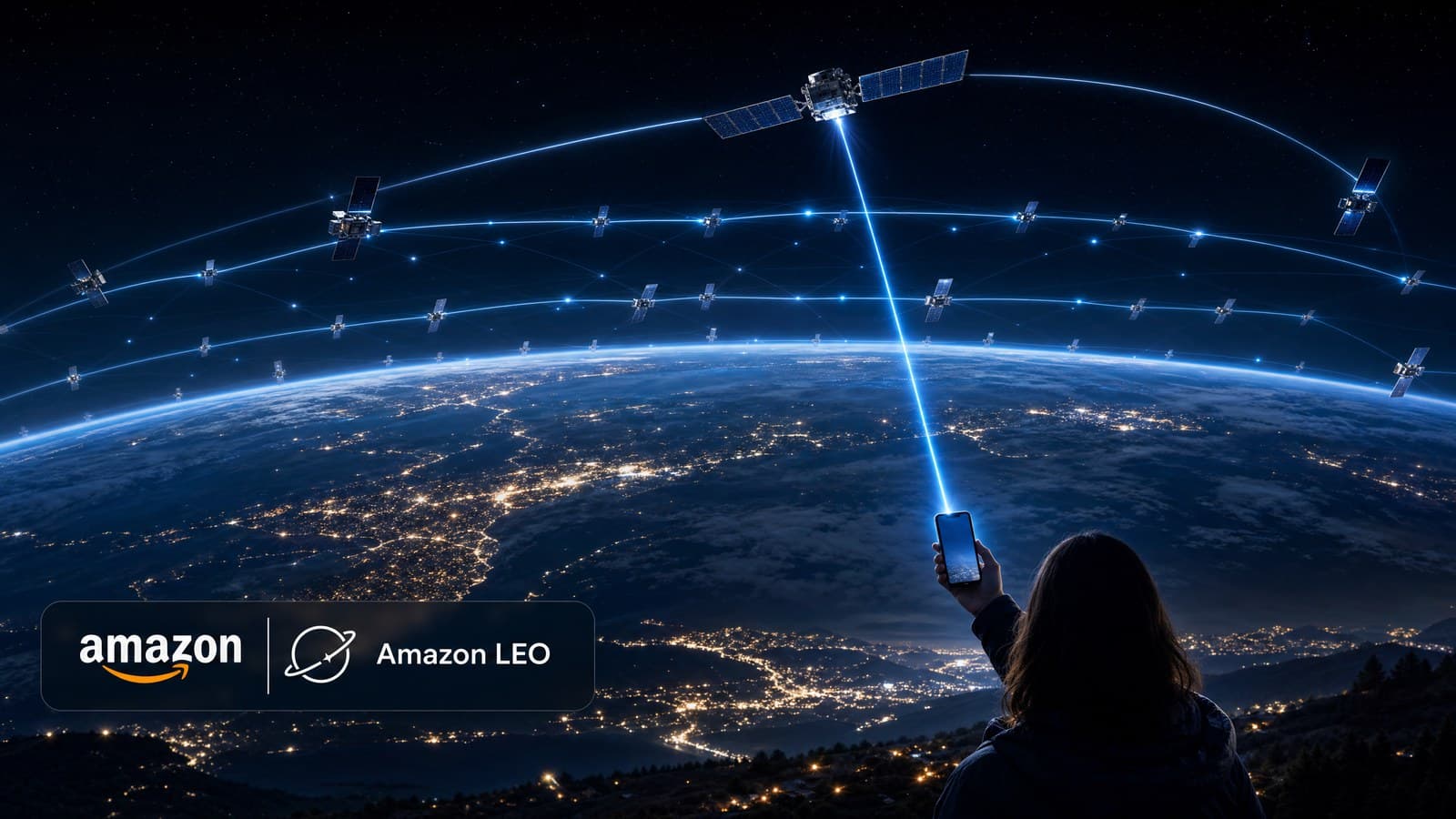
Amazon (NASDAQ: AMZN) filed today with the U.S. Federal Communications Commission (FCC) a request to approve a move that reshapes the communications map: a network of 5,105 satellites that would connect directly to mobile phones - no dish, no modem, no special equipment. If approved, it would provide messaging, data and emergency services anywhere without terrestrial tower coverage.
This is not an extension of what Amazon already does. It is a second, separate front - and in exactly the market SpaceX currently leads.
First the Explanation: What "Direct-to-Device" Means
The term Direct-to-Device (D2D) describes a satellite that functions as a floating cellular antenna. Instead of the phone talking to a tower kilometers away, it talks to a satellite hundreds of kilometers away - with the same hardware already in the pocket.
And this market is interesting for one simple reason: a mobile operator will never cover deserts, seas and mountainous regions with towers, because it is not economical. D2D eliminates the physical coverage limit. The potential customer, by definition, is every phone on Earth.
Those who read us have met this idea before: in the AT&T review we wrote about its partnership with AST SpaceMobile on exactly this technology. Amazon is now entering the same arena - but not as an operator's partner, rather as the party building the network itself.
What Exactly Was Filed - and How It Connects to Globalstar
Today's filing does not stand alone. It is the missing piece in a puzzle Amazon has been assembling since April.
In April 2026 Amazon announced the acquisition of Globalstar for about $11.6 billion. Globalstar is not a large company, but it holds an asset that is very hard to obtain: S-band spectrum licenses, with global authorizations. Spectrum, as we explained in the AT&T review, is the real estate of the communications world - the quantity is physically limited, the state allocates it, and no more can be manufactured.
The acquisition, per the announcements, is expected to close in 2027 subject to regulatory approvals and milestones. And one detail in it is especially interesting: about 85% of Globalstar's network capacity is currently dedicated to Apple's satellite SOS and messaging services - and Amazon announced it will honor the agreement and even expand it. Meaning, indirectly, Amazon is set to be the party holding the infrastructure behind one of the best-known emergency services on the iPhone.
And today's filing is the next stage: not settling for Globalstar's existing constellation, but building a new network of 5,105 satellites on top of it. Deployment, per Amazon, is expected to begin in 2028.
Three Satellite Layers - and This Is the Point Many Miss
To grasp the scale of the move one must see that Amazon is in fact building three separate layers in space:
| The layer | What it does | Status |
|---|---|---|
| Leo (formerly Kuiper) | Broadband for homes and businesses, competing with Starlink | Over 390 satellites operational; initial service expected during 2026; first-generation target about 3,200 satellites by mid-2029 |
| Globalstar | Existing constellation + global S-band spectrum | Acquisition in process, closing expected 2027 |
| The new D2D network | 5,105 satellites direct to phone | Filed today for approval; deployment from 2028 |
This combination is the story. Amazon is not trying to be "another Starlink" - it is trying to hold both home broadband, and global spectrum, and the direct connection to the phone. And above all of these sit AWS to run the network, and a Prime customer base for distribution.
Why This Is Strong
First, the spectrum. This is the asset that cannot be built, only bought. Amazon paid $11.6 billion precisely for it, and received global authorizations - not American ones alone. In a market where regulation is the central barrier to entry, that is a shortcut of years.
Second, the size of the market. Satellite broadband is limited to those without a wired connection. D2D, by definition, addresses every phone owner. Even if revenue per user is low, the potential user base is larger by orders of magnitude.
Third, a synergy competitors lack. SpaceX launches better than anyone, but Amazon has AWS, a logistics network, devices and a subscriber base. A satellite service integrated into Prime or AWS is a product hard to replicate.
And fourth, no less important - it validates the sector. When the third or fourth largest company in the world spends billions to enter a market, it is effectively declaring that market is large. This is the same pattern we saw in the Anduril piece: a giant's move raises the valuation of the entire sector, not just its own.
And What Must Be Understood From the Other Side
Here proportion is required, because between the announcement and the outcome lies a long road.
This is a request, not an approval. The FCC must approve, and such processes take time and include objections from competitors. The Globalstar deal itself has also not yet closed.
The timetable is distant. Deployment begins in 2028. That means material revenue from this network is not within the foreseeable horizon - this is an investment that will appear in the reports as an expense long before it appears as revenue.
SpaceX has a tangible head start. Starlink already has over 650 direct-to-cell satellites in orbit, an active commercial service with T-Mobile since 2025 (at about $10 per month, supporting dozens of phone models), and it purchased AWS-4 and H-block spectrum from EchoStar for about $17 billion - a deal approved by the FCC in May. Meaning: Amazon is filing a request for a network that will begin deploying in 2028, while its competitor is already selling the service.
And Amazon is behind on the first layer too. The Leo constellation numbers about 390 satellites - a figure behind the milestone the FCC set for the company (over 1,600 satellites by mid-2026). The initial service will launch in a geographically limited format. Anyone assessing the new filing must weigh the pace of execution on the layer that already exists.
The debate in one line
The positive reading: Amazon is buying with money the hardest regulatory barrier in the market (global spectrum), opening a second front in a market whose customer is every phone on Earth, and holding a synergy with AWS and Prime that no competitor has. The cautious reading: this is a request not yet approved, for a network that will begin deploying in 2028, against a competitor already selling the service - and from a company running behind the milestones of its existing constellation. Both sides are reading the same filing.
The Connection to Thursday's Report
And here is the angle connecting this news to earnings season: Amazon reports on Thursday, July 30, after the market close. The estimate is for revenue of about $196.71 billion and EPS of about $1.82, with the number that will decide the reaction being AWS growth - the consensus looks for about $40.5 billion in cloud revenue.
Today's announcement adds another question to that report, and in our view an important one: the capital expenditure. A network of 5,105 satellites is not cheap, and it comes on top of the Leo constellation currently being built and $11.6 billion of acquisition. This is exactly the pattern we identified this quarter at Alphabet and at Tesla - companies doubling investment until free cash flow flips. The question we will ask on Thursday is not whether the vision is correct, but what it costs, and who pays for it in the interim.
We will cover the report itself in depth on Thursday, including AWS, capital expenditure and guidance.
My Angle
A personal opinion of Ilan Abramov - not advice, not a recommendation
What caught me here is not the number of satellites - but what Amazon chose to buy with the money.
It did not buy technology and did not buy a team. It bought spectrum for $11.6 billion. And that returns me to the pattern that recurs for me all summer, in every thesis we have written - from electricity and turbines, through fiber and light, to radio frequencies: in the world of AI and communications, the moat is physical and defined by regulation. Software can be replicated; a frequency the state allocated, a satellite already in orbit and a turbine with a production slot - far less.
And in the same breath, I remind myself of the gap between announcement and execution. Amazon announced Kuiper in 2019, and today, seven years later, it has about 390 satellites in orbit and a service not yet launched - while its competitor is selling. Today's filing is a strong strategic statement, but it is a statement about 2028. Between 2026 and 2028, what will determine the stock is AWS and advertising - not the satellites.
And beyond all of that, the question I return to at every company we have covered this summer is one: will there be a return on the capital expenditure. Not whether the vision is correct, and not whether the demand is real - but whether the money poured out earns itself back, and at what pace. Alphabet doubled its investment and its free cash flow flipped; Tesla doubled and its cash flow flipped; and Amazon is now adding a third satellite constellation on top of a cloud infrastructure already swallowing tens of billions. A company can be entirely right about the direction and still destroy value if it pays too much or too early.
So when I look at today's filing, I am not asking "are satellites the future." That answer is clear. I am asking how much it will cost, when it starts bringing in revenue, and what happens to cash flow along the way. We will get the first answer to that question as soon as Thursday - in the report's capital expenditure line.
Summary
Amazon's filing today is a strategic move of large scale: 5,105 satellites that would connect ordinary phones directly to space, backed by global spectrum bought for $11.6 billion. It turns Amazon from a satellite broadband player into one competing across every layer of communications from space, and sets up a second front against SpaceX.
And against it stand three facts: the request has not yet been approved, deployment begins in 2028, and the competitor is already collecting money from customers. The move is real and the direction significant - but within the horizon relevant to Thursday's report, it is a line on the expense side, not the revenue side. Both of those we will measure precisely there.
Sources: CNBC and Bloomberg reporting from July 27, 2026 on the FCC filing for a network of 5,105 satellites; the Amazon and Globalstar announcement of the acquisition for about $11.6 billion (April 14, 2026) including the spectrum, the Apple arrangement and the timetable; CNBC, GeekWire and The Register reporting on the state of the Leo constellation (over 390 satellites as of July 2, 2026) and on deployment targets; Starlink direct-to-cell figures and T-Mobile's T-Satellite service, and the FCC's approval of the SpaceX-EchoStar spectrum deal; analyst consensus for Amazon's report as covered ahead of July 30. Data accurate as of the time of writing. The chart is shown in real time via TradingView. Nothing herein constitutes a forecast, recommendation or advice - see the full disclaimer at the bottom of the page.


