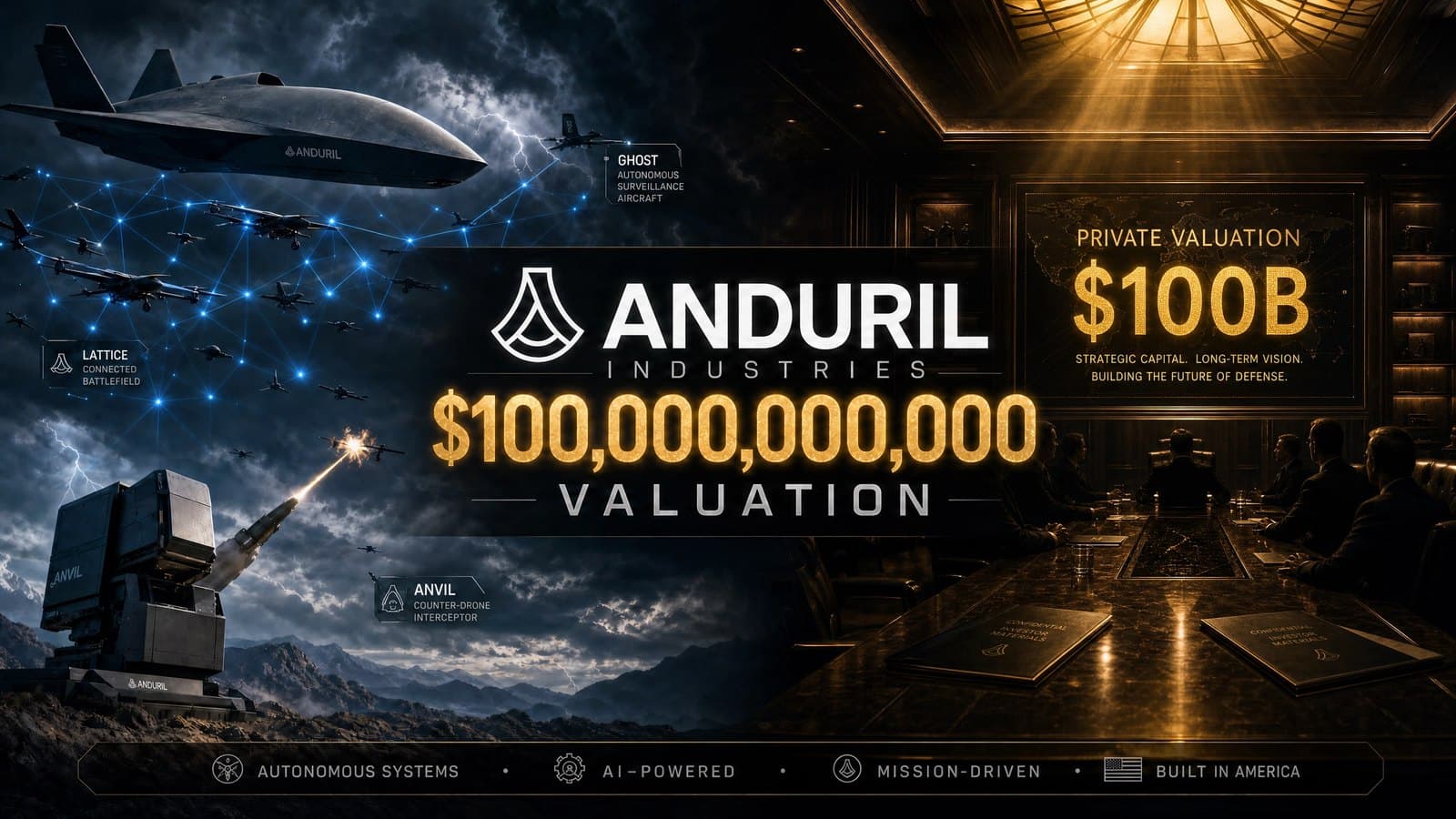
This morning a report was received that lights a red flag - in the good sense - for anyone following the defense-tech revolution: Anduril (Anduril) is in talks to raise capital at a valuation of about $100 billion. We will stress immediately, because precision matters: this is a report of talks, not a round that has closed. But even so, this number - if it matures - is a peak moment in the story we have been telling for months: an era of rearmament, in which capital flows to the new generation of defense.
Let us make order: who Anduril is, how it got here, and why this report matters far beyond one company.
Who Is Anduril
Anduril was founded in 2017 by Palmer Luckey - the entrepreneur who invented the Oculus virtual-reality headset and sold it to Facebook, and then turned to the most unexpected field: weapons. His vision was simple and radical: the American defense industry is built on giant, slow and expensive projects - and it can be done differently. Instead of building one fighter jet for $100 million, build thousands of cheap autonomous systems that talk to each other. The doctrine is called "affordable mass," and CEO Brian Schimpf leads it.
The heart of Anduril is not a single piece of "iron" - it is the software. The Lattice operating system is the brain: it connects thousands of sensors, drones and interceptors into a single system, even in low-bandwidth environments, and turns data into decisions. Around the brain is an impressive product layer: the Fury attack drone (a candidate for the Air Force's CCA program, an unmanned aircraft that accompanies fighter jets), Ghost, Barracuda and Bolt; the Roadrunner interceptor against cruise missiles and drones; the autonomous Ghost Shark submarine (under contract with the Royal Australian Navy); and Wisp sensors and sentry towers. All manufactured at the giant Arsenal-1 plant in Ohio (about a million square feet), which entered full production this month.
And this is no longer an experiment: in March 2026 Anduril won a U.S. Army enterprise contract worth up to $20 billion over 10 years - and Lattice is becoming the backbone of nearly every counter-drone program in the U.S. Army. Revenue in 2025 doubled to about $2.2 billion.
The Valuation Leap: 7x in Less Than Two Years
And here is the story that fascinates the investor. Here is Anduril's valuation path, from all the reports:
| When | Valuation | What happened |
|---|---|---|
| August 2024 | $14 billion | Series F |
| June 2025 | $30.5 billion | Series G, $2.5 billion (led by Founders Fund) |
| May 2026 | $61 billion | Series H, $5 billion (Thrive and a16z) |
| Today (talks) | ~$100 billion | per report - not yet closed |
If the current talks mature, this is a jump of 7x in less than two years - a pace that resembles a hyped software company more than a defense contractor. And that is exactly the point: the market no longer prices Anduril as a weapons factory, but as a software platform that happens to also build hardware. In total the company has raised over $11 billion, and the CEO recently made clear he is in no rush for an IPO - Anduril can stay private for a long time yet.
IPO vs. Private Raise - and What the Multiple Tells
And here it is important to be precise. Had Anduril gone public (IPO), this would have been exactly the SpaceX case - because then the private valuation would have become a public price every investor could touch, and would have pulled the whole sector openly along with it. The current private raise is not yet that: an IPO would be required to truly cement the standing and translate the private valuation into a public anchor from which all the other valuations are derived.
And yet - the raise itself already lets us see the power of the sector. When sophisticated investors are willing to price a nine-year-old company at $100 billion on revenue of about $2.2 billion, this is a multiple of about ~45x sales - a number that tells a story. It does not rest on current profits (Anduril is still in growth mode, investing more than it earns), but on a bet on the future. And once the private leader is priced this way, the question returns to the whole sector: how much is this growth worth relative to revenue and profits - and which of the public companies trade at a gap versus this new reference frame.
And Here Is the Big Angle: What It Does to the Whole Sector
And now to the most important part - because a report about one private company should not, ostensibly, move the public market. But it does, and greatly. We saw this movie with SpaceX.
When SpaceX climbed in tender offers from a valuation of $350 billion (late 2024), to $400 billion (July 2025), to about $800 billion (late 2025), something happened beyond the company itself: investors began to re-price the whole space sector. SpaceX was priced "like a high-growth software monopoly, not like a traditional aerospace company" - and at that moment, every other space company received a new reference frame. The rising tide lifted all the boats.
The Anduril report is exactly the same mechanism, in a different sector. Here is how it trickles through:
- A new pricing frame for the whole field. When the leading private defense-tech company gets a 40x+ revenue valuation, it forces the market to ask: maybe the rest of the sector is priced too low too?
- Pressure - and also validation - on the traditional primes. Lockheed and RTX, which we covered, are suddenly asked an uncomfortable question: does the future belong to the disruptors? But at the same time, Anduril's valuation confirms the very existence of the enormous demand - and that lifts the whole category.
- Channeling capital and attention to the sector's public companies - which trade at a discount. And here is the sharp point: while Anduril's private valuation soars, many of the small public companies in the sector actually suffered sharp declines - not a few of them over 50% off their highs - amid dilutions, raises and volatility. That is, a valuation gap formed: while the private leader gets a premium valuation, the public companies trade at a discount. From a reference-frame standpoint, a report like Anduril's is exactly the catalyst that could narrow the gap - channeling attention, capital and comparisons to the small players. A notable example in this group is Ondas (ONDS), which itself fell about 56% from its June high (disclosure: the author holds ONDS stock).
- Confirmation of the "decade of rearmament" thesis. Exactly as we wrote: we are inside a structural change, not a passing storm. A $100 billion valuation for a nine-year-old company is the proof that the big money believes in it.
The Other Side: Caution on the Numbers
And as always, balance. First, this is talks, not a deal - a valuation discussed in negotiations can change, be delayed or not close. Second, a 40x+ revenue valuation implies enormous expectations; if growth slows, or if a large government contract is delayed, the gap between price and execution can close painfully. Third, the SpaceX comparison works both ways - it also reminded investors that premium valuations in the private market do not always translate into public profits at a pace that justifies them. A rising tide lifts all boats - but a low tide also lowers them all.
Summary
The report of Anduril's talks to raise at $100 billion is much more than a headline about one company. It is a marker that the largest capital in the world is voting, with real money, on the same thesis we have been tracking: the next generation of defense - autonomous, software-based and cheap-in-mass - is one of the megatrends of the decade. Exactly as SpaceX taught investors to re-price space, Anduril may teach them to re-price defense. The question for the investor is not whether the trend is real - the flow of capital confirms it is - but how much of it is already priced in, and which of the public companies will really benefit from it. We will keep tracking, and update as the talks progress.
Sources: the report of the fundraising talks was received during the day (July 24, 2026) and has not yet been officially confirmed by the company; it should be treated as a preliminary report. The historical valuation data, revenue, products and contracts are based on verified financial coverage (including Bloomberg, TechCrunch, CNBC, Reuters, Defense News), and SpaceX data from the reported tender offers. All data current as of the time of writing. Nothing herein is a recommendation or advice - see the full disclaimer at the bottom of the page.


