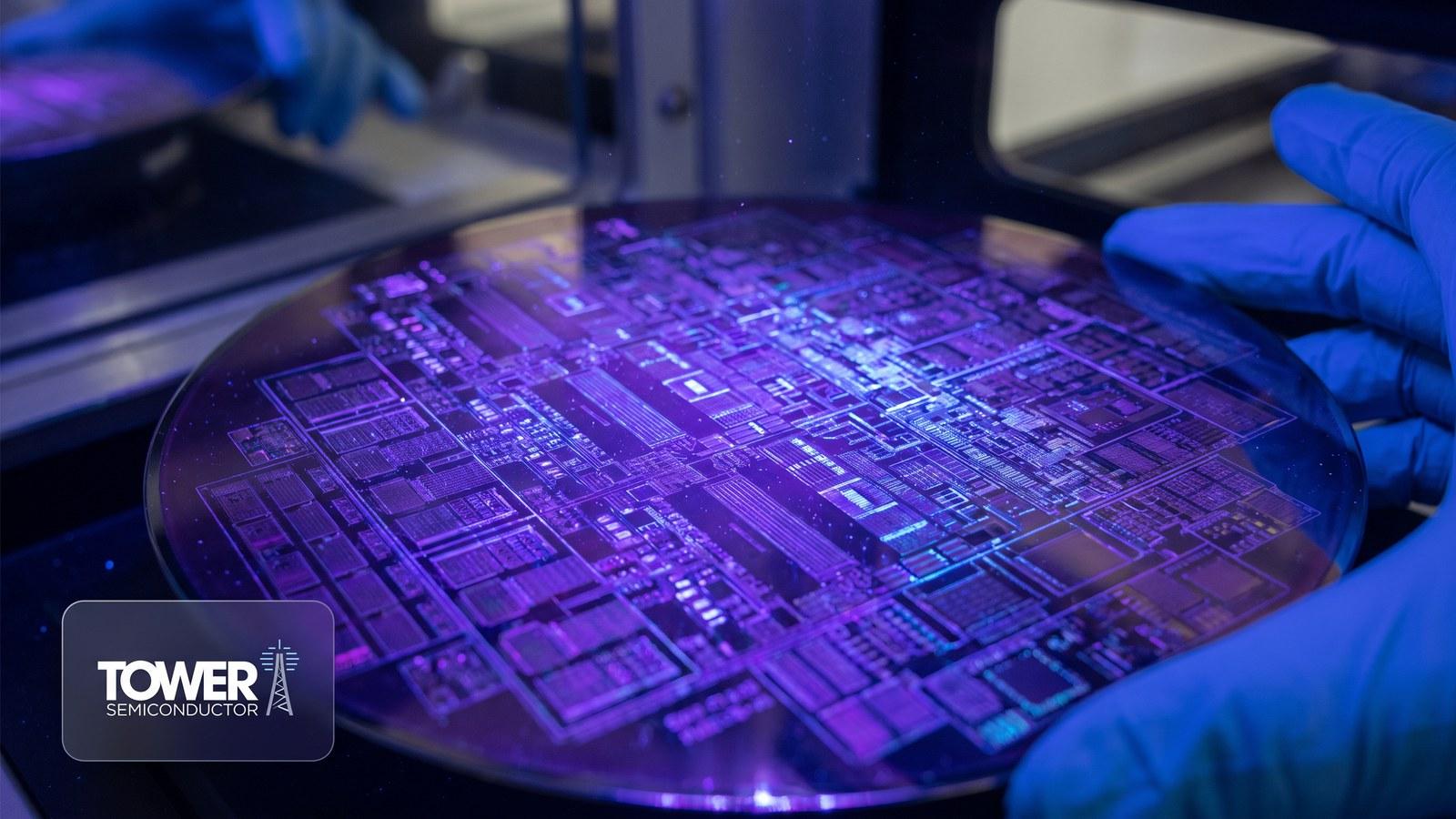
Tower Semiconductor reported third-quarter 2026 results on Monday, November 2, before the New York open. Revenue: $526 million, up 33%, and gross profit rose 92% to $179 million. The fourth-quarter guide is $600 million, and the stock closed down 6.7%.
Errors or inaccuracies are possible. Spotted something that looks wrong? Write to me and I will correct it.
What was reported
| ($ million) | Q3 2026 | Q3 2025 | Change |
|---|---|---|---|
| Revenue | 526.2 | 395.7 | 33%+ |
| Gross profit | 178.8 | 93.0 | 92%+ |
| Gross margin | 34.0% | 23.5% | 10.5 pt+ |
| Operating profit | 127.1 | 50.6 | 2.5x |
| Operating margin | 24.2% | 12.8% | 11.4 pt+ |
| Net profit | 120.3 | 53.6 | 2.2x |
| Diluted EPS ($) | 1.05 | 0.47 | 2.2x |
| Adjusted diluted EPS ($) | 1.15 | 0.55 | 2.1x |
Source: Tower's press release on third-quarter 2026 results, November 2, 2026, furnished to the SEC on Form 6-K as Exhibit 99.1 and also published on the Tel Aviv Stock Exchange. Net profit is attributable to the company. "Adjusted" excludes stock-based compensation and amortization of acquired intangibles and is a non-GAAP measure.
In the second quarter revenue was $460.1 million and operating profit $90.3 million, so the third quarter added 14% in revenue and 41% in operating profit. The guidance from the previous report was $520 million, plus or minus 5%, and actual revenue landed close to the middle of the range.
The release headline says "excluding non-recurring items", but the operating and net profit shown are identical to the GAAP lines in the report. Most of the 10.5-point jump in gross margin comes from revenue growing faster than cost of revenue: cost of revenue rose only 15%, to $347.4 million, while revenue rose 33%.
Silicon photonics and the guidance
Fourth-quarter guidance is $600 million, plus or minus 5%, that is $570 to $630 million. That is 36% above a year earlier and 14% above the third quarter, and it takes 2026 to about $2.0 billion: $1,399.9 million for nine months plus $600 million.
CEO Russell Ellwanger points to the source of the growth: infrastructure demand, led by silicon photonics and SiGe, which he says is driving exceptional growth in the high-speed connectivity business. The company's target is an annualized $1.1 billion run rate in silicon photonics alone in the fourth quarter, five times the segment's revenue for all of 2025. An annualized $1.1 billion is about $275 million per quarter, roughly 46% of the midpoint of total guidance (calculated from the reported figures; the target is a target, not a reported figure). Management adds that it aims to start 2027 without the usual first-quarter seasonality, with sequential revenue growth and margin growth, and that customer contracts are being extended through 2029.
Cash flow and advances
The quarter's profit did not reach free cash flow. Operating cash flow was $185.2 million, but $22.8 million of it was an increase in customer advances, and capital investment reached $190.7 million. Free cash flow for the quarter was negative, about $5.5 million.
| ($ million) | Nine months 2026 | Nine months 2025 |
|---|---|---|
| Operating cash flow | 872 | 356 |
| Of which: increase in customer advances, net | 305 | - |
| Capital investment | 534 | 326 |
| Free cash flow | 338 | 30 |
| Free cash flow excluding advances (calculated from the reported figures) | 33 | - |
Source: press release. Free cash flow is operating cash flow less capital investment, net. The 2025 advances are not detailed in the release.
The "deferred revenue and customers' advances" line (current) and the "long-term customers' advances" line together stand at $341.0 million, against $27.5 million at the end of 2025; the current line also includes deferred revenue, so the figure is not advances alone. The risk list in the release notes that the company has received advances from silicon photonics customers against minimum capacity commitments, and that failing to supply the capacity in full and on time could lead to compensation, penalties or repayment of advances. So part of the cash flow is money the company has committed to deliver against.
Capital investment for nine months was $534 million, against $326 million a year earlier, and net property and equipment reached $1,825 million from $1,463 million at the end of 2025. The company says the capacity expansion, including the 300mm build in Japan, is ahead of schedule. Cash and deposits stand at $1,472.9 million, and debt at $153.7 million.
The tax rate
Tax for the quarter was $19.2 million, 13.8% of pre-tax profit, against 12.5% a year earlier. Among its risk factors the release lists the OECD Pillar Two rules, which require a minimum effective tax rate of 15% and will add tax expense from 2026, mainly on Israeli operations, which enjoyed a preferred 7.5% rate until 2025.
The two sides of the debate
What the bulls see
A quarter in which revenue rose 33% and operating profit 2.5 times, a $600 million guide signalling continued growth, capacity contracts extended through 2029, and customer advances that finance part of the capacity expansion. A balance sheet with $1.5 billion in cash and deposits against $154 million of debt.
What the bears see
Free cash flow was negative for the quarter, and over nine months it is only $33 million excluding advances. By the target, about 46% of fourth-quarter revenue will come from one segment, some of whose customers paid advances against capacity commitments. The stock was already falling before the report, and the release details disputes with Intel and GlobalFoundries and the Fab 3 lease dispute.
The stock
The report came before the open on Monday, and the investor call was held at 10:00 a.m. Eastern, so the trading reaction is November 2.
The stock closed at $155.32, down 6.7% from $166.48 at the previous close. It opened at $161.02, rose to $164.28 and fell to $150.71. Volume: 6.2 million shares, against 6.0 million on October 30. On October 30, the session before the report, the stock fell 11.4% from $187.92, so over two sessions it fell 17.3%.
What will decide it
The first quarter of 2027. Management aims to avoid the usual seasonality, and the next report will show whether sequential growth continues.
Silicon photonics against capacity. The $1.1 billion annualized target depends on capacity being built now, and the advances oblige delivery.
From advances to real cash flow. Free cash flow excluding advances is the figure that will show whether growing profit turns into cash.
Margins. Gross margin (34.0%) and operating margin (24.2%) are above the previous quarter, at 29.9% and 19.6%, and above a year earlier; the question is whether they keep rising at $600 million of revenue.
Ilan Abramov, anyone on his behalf, or anyone on behalf of the authors may hold securities mentioned in this article, and holdings change from time to time.


