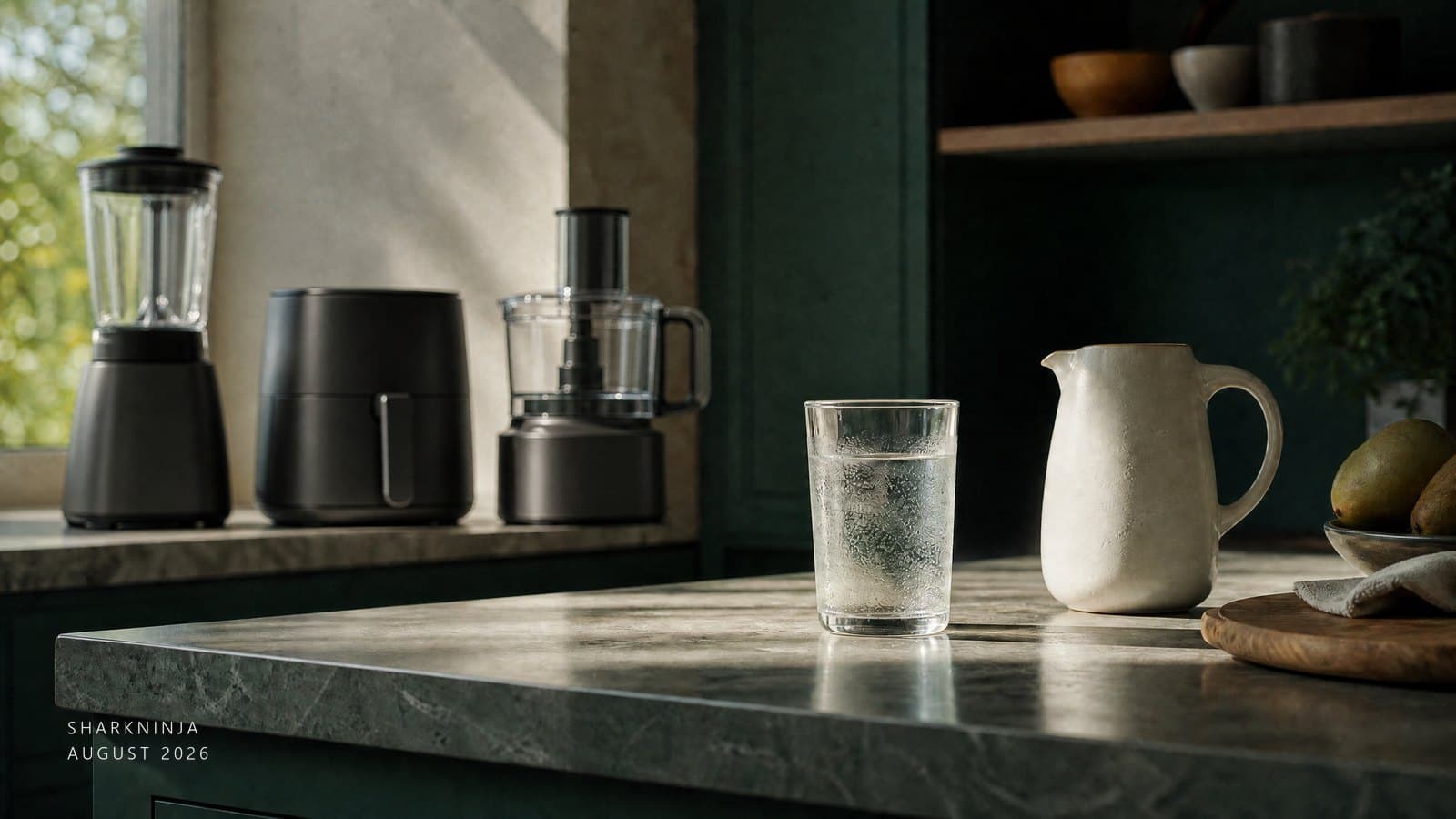
On 13 August Ninja launched a home water filtration system. It looks excellent, it costs $199.99, and it is very legible in the videos.
And that is not why this piece was written. The reason sits in the quarterly report of the company behind it - where there is a number many times larger than the product.
Errors or inaccuracies are possible. Spotted something that looks wrong? Write to me and I will correct it.
First - Who Actually Sells This
Ninja is not a company. It is a brand.
The company is SharkNinja, listed in New York under the ticker SN, and it holds two brands: Shark in cleaning, and Ninja in the kitchen. The company separated from JS Global and became a standalone public company, and describes itself in its filings as "a global product design and technology company".
And that is the detail that makes the story interesting: this is not a one-product company.
What the Product Does, According to the Company
The claims below are the company's own, from its launch announcement. I present them as claims, not as facts I verified in a laboratory.
| Ninja HydraSense | |
|---|---|
| Launch date | 13 August 2026 |
| Price | $199.99 |
| Replacement filter | $39.99 |
| Filter life | 120 gallons |
| Filtration claim | Removal of up to 99% and more than 80 contaminants |
| What the claim covers | PFAS, lead, pesticides, microplastics and pharmaceuticals |
| Speed claim | Up to 6 times faster than "the leading pitcher" |
| Further claim | Removes 10 times more contaminants than "the leading filter" |
| Standards | NSF 42, 53 and 401 |
| Also | Personalised hydration tracking and real-time filter monitoring |
And within that list there is one line that differs from all the others, and it is worth knowing why.
"Up to 99%", "6 times", "10 times" - these are manufacturer marketing claims, carefully worded. Note the word "up to", and that "the leading pitcher" and "the leading filter" are not named. That is entirely legitimate, and it also means the comparison cannot be reproduced.
"NSF 42, 53 and 401" is something else entirely. These are standards of an external standards body, and they mean: 42 - taste, odour and chlorine. 53 - health effects, including lead. 401 - "emerging incidental compounds", the category that covers pharmaceutical residues.
That is the only anchor point independent of the seller. And when reading about a filtration product - that is the line to look at first.
Why It Matters Commercially: It Is the Entry, Not the Product
Water is not the first category Ninja has entered from the outside, and that is exactly the point.
The latest quarterly report shows that engine at work:
| Segment, Q2 2026 | Net sales | Change |
|---|---|---|
| Cleaning | $522.0m | +4.1% |
| Cooking and Beverage | $499.0m | +36.5% |
| Food Preparation | $458.6m | +13.3% |
| Beauty and Home Environment | $285.8m | +65.3% |
The oldest segment - cleaning, where the company started - grows 4.1%.
The segment growing 65.3% is skincare devices and fans. And the one growing 36.5% rests, per the company, on an espresso machine and an electric cooking pan.
Which is to say: a company that started in vacuum cleaners now sells espresso machines, beauty devices, fans - and now water. And that is not random diversification, it is a method: enter a mature, boring category with a product that looks different, and take share.
So the question about HydraSense is not "is the product good". It is "does the machine keep working" - and that is answered in quarters, not in videos.
But the Quarter Itself Says a Second Thing
Second-quarter net sales rose 22.2%, to $1,765.5 million. Net income fell 7.0%, to $129.8 million.
| Q2 2026 | Amount | Share of sales |
|---|---|---|
| Net sales | $1,765.5m | +22.2% |
| Gross profit | $860.3m | 48.7% (against 49.0%) |
| Research and development | $109.3m | 6.2% |
| Sales and marketing | $441.5m | 25.0% |
| General and administrative | $130.1m | 7.4% (against 6.4%) |
| Operating income | $179.4m | 10.1% (against 11.6%) |
| Net income | $129.8m | -7.0% |
The operating margin fell 151 basis points.
And where does that come from? The company details it, in its own words: the gross margin erosion was driven "primarily by the cost pressures related to tariffs in the U.S. market", unfavourable foreign currency, and increased retailer activations.
And above it, general and administrative expenses jumped 40.8% - mainly because of a $22.6 million increase in share-based compensation.
In other words: every additional dollar of sales costs more to win and more to make.
And the Number That Made Me Write the Piece
Inside the company's outlook sits the following paragraph, which I quote almost word for word:
"In Q3 2026, SharkNinja submitted refund claims of approximately $247.1 million through the U.S. Customs and Border Protection refund process, and the CBP accepted those claims."
$247.1 million. As a reduction of cost of sales, in the third quarter.
To give that scale:
| A full quarter's operating income | $179.4 million |
| The tariff refund | $247.1 million |
| That is | 1.38 times a full quarter of operating profit |
| And in terms of the new product | about 1.24 million HydraSense units at list price |
And here the company did something worth noting: it split the refund by the period in which the original cost was recognised. The part arising from tariffs expensed in 2025 will enter GAAP results but is excluded from the adjusted measures; the part from 2026 enters both.
And above all - it quantified how much of the guidance raise is tariffs rather than operations:
| The guidance raise | Total raise | Of which tariffs |
|---|---|---|
| Adjusted EPS | +$0.45 | about $0.15 |
| Adjusted EBITDA | +$67 to +$69m | about $30m |
That is, about a third of the EPS raise, and about 44% of the EBITDA raise, are not an improvement in the business.
And this returns exactly to the pattern I described yesterday in the earnings night summary: Best Buy received about $34 million in tariff refunds, and Dollar General about 66 basis points of operating margin. Three entirely different companies, the same refund process, in the same quarter.
And the difference is scale. SharkNinja imports everything it sells, so it is both the one that absorbed the most tariff cost and the one getting the most back.
And the company also states what it assumes going forward: minimum tariffs of 10% for Indonesia, Malaysia and Cambodia, and 12.5% for China, Vietnam and Thailand - assumed to persist through the end of 2026.
The Full-Year Outlook, and the Balance Sheet
| For fiscal 2026 | New | Previous |
|---|---|---|
| Net sales growth | 16.0%-17.0% | 11.5%-12.5% |
| Adjusted EPS | $6.45-$6.55 | $6.00-$6.10 |
| Adjusted EBITDA | $1,357-$1,369m | $1,290-$1,300m |
| GAAP tax rate | 22.0%-23.0% | |
| Capital expenditure | $190-$210m |
And on the balance sheet, at 30 June: cash of $779.8 million, available revolver capacity of $489.8 million, and total debt of $718.9 million - that is, the company holds more cash than debt.
What I Will Check Next Quarter
| The operating margin | 10.1% today, against 11.6% - whether the erosion stops |
| The refund in practice | $247.1m is due to land in the third quarter |
| What is done with the money | The company stated an intention to reinvest it in the business |
| Cooking and Beverage | Where HydraSense will sit - and the segment growing 36.5% |
| International | +36.6% against +15.5% domestically |
| G&A expenses | Jumped 40.8%, mainly stock compensation |
הזווית שלי
דעה אישית של אילן אברמוב - לא ייעוץ ולא המלצה
I started this piece because of a product, and finished it with a number that has nothing to do with the product. And that is itself the lesson.
The product looks good, and the claims about it are well worded. NSF 42, 53 and 401 are a real anchor; "up to 99% of 80 contaminants" is careful marketing language. Both can live in the same announcement, and that is perfectly fine - it simply means it is worth knowing which line is a measurement and which is copy.
And what is genuinely impressive about SharkNinja is not HydraSense but the list that precedes it. A vacuum cleaner company now selling espresso machines, skincare devices and fans - and growing 65.3% in a category it did not previously have - is a company that does one thing very well: it enters.
And what I try to hold onto reading a company like this is two separate questions that are easy to conflate.
The first - does the machine work. The answer this quarter is yes: 22.2% growth, and the new segments are leading it.
And the second - how much of that reaches the bottom line. The answer there is less comfortable: net income fell 7.0% in a quarter where sales rose 22.2%. An operating margin falling 151 basis points during fast growth is a sign the growth is being bought.
And what unites both questions is one place: Washington. A company that imports everything it sells manages half its profitability against trade policy. The $247.1 million refund proves that from both directions - it is a large number in the company's favour today, and it is that large precisely because the cost that preceded it was large.
So if I had to pick one line to track here, I would not pick sales and I would not pick the new products. I would pick the gross margin - because it is the only place where you see the brand's pricing power and the customs bill at the same time.
(It is important to stress: this is my personal opinion only, and nothing herein constitutes a recommendation to take any action.)


