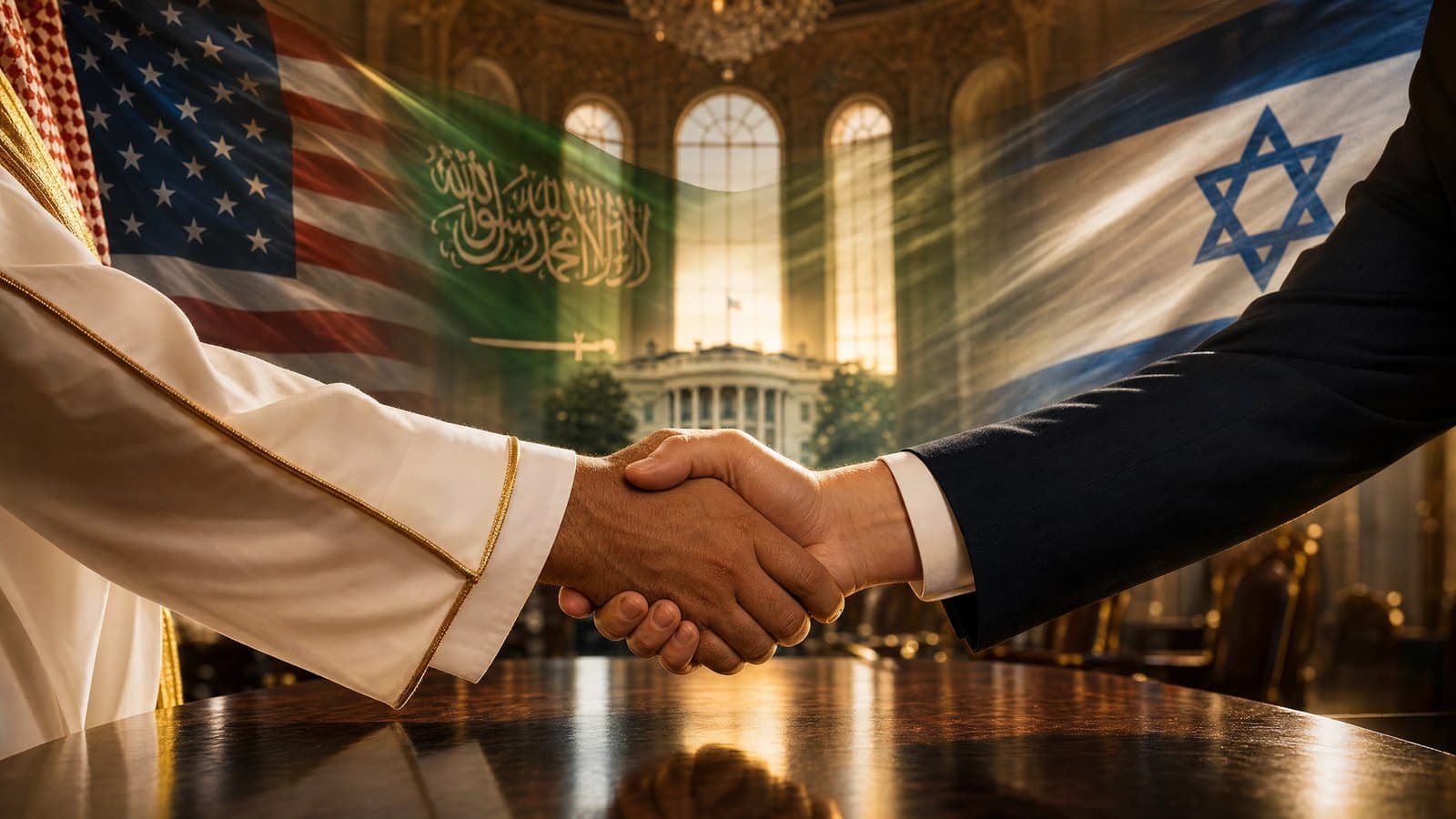
On July 23, 2026, U.S. President Donald Trump posted an announcement that may be one of the most significant in the Middle East in years: approval of the civilian nuclear deal between the U.S. and Saudi Arabia is "totally subject" to the Kingdom joining the Abraham Accords - that is, to normalization with Israel. Such a move, if realized, would reshape the balance of power in the region. But between the announcement and its realization stand real obstacles. We will conduct an orderly study here: what exactly was published, what the parties' positions are, and what the implications are - all on the basis of verified sources only.
What Exactly Was Published
Trump wrote on Truth Social that the nuclear deal "will be approved, but is totally subject to Saudi Arabia joining the very respected and successful Abraham Accords." This is a new condition added to a deal already announced the day before.
Details of the nuclear deal (announced July 22): the agreement was signed by U.S. Energy Secretary Chris Wright and Saudi Energy Minister Prince Abdulaziz bin Salman, and it is of the "123 agreement" type (a civilian nuclear cooperation agreement) alongside a bilateral safeguards agreement. Per the U.S. Department of Energy, this is the basis for a "multi-year partnership worth billions," expected to last about 30 years, with the involvement of American companies. The deal requires Congressional approval.
And here is the sharpest dispute - the uranium enrichment issue. Trump declared publicly "there will be no enrichment of material!", and that the U.S. supports "civilian nuclear facilities (without enrichment)." But per reports, the text of the agreement does not include a ban on enrichment - and may even allow American companies to build an enrichment facility in Saudi Arabia, subject to a joint feasibility study. In other words, there is a gap between Trump's public declaration and what the text of the agreement apparently allows - and that is the heart of the criticism.
Opposition in Congress. The agreement met opposition over the absence of enrichment limits. Senator Ed Markey called it "irresponsible and dangerous" and warned of a "catastrophic arms race," arguing that the administration abandoned the "Gold Standard" of nonproliferation - a ban on enrichment and reprocessing and enhanced IAEA oversight. Since Congressional approval is required, this is not a marginal note but a real potential barrier.
It is also important to be precise: per an Al Jazeera analysis, the condition of joining the Abraham Accords does not appear to be part of the original agreement - which created confusion about the terms. Saudi Arabia, for its part, did not respond immediately to the announcement.
Background: What Are the Abraham Accords
The Abraham Accords, signed under American mediation in 2020, created normalization between Israel and the United Arab Emirates, Bahrain, Morocco and Sudan. Saudi Arabia - the largest economy in the Arab world, guardian of Islam's holy sites, and the central oil kingdom - never joined, and was considered "the big prize": its joining would change the status of the accords from a regional achievement into a Middle-East-wide strategic move.
Saudi Arabia's Position: The Palestinian Condition at the Center
And here is the central obstacle. Saudi Arabia has made clear again and again that it would agree to normalization only in exchange for a credible path to a Palestinian state. This position hardened during the Gaza war, and per reports the Kingdom holds to it firmly. In parallel, Israeli Prime Minister Benjamin Netanyahu rejected the idea of a Palestinian state - and thus a circular deadlock formed: Trump asks Saudi Arabia to join the accords as a condition for the nuclear deal; Saudi Arabia conditions this on a Palestinian state; and Israel rejects that condition.
Beyond the Palestinians, Saudi Arabia has a further list of reported demands: U.S. security guarantees (preferably in the form of a formal defense treaty), U.S. help for its nuclear program, and technology cooperation, including in artificial intelligence. Netanyahu himself responded to the announcement on X, writing that Saudi Arabia joining the Abraham Accords "would be a historic leap forward for peace in the Middle East."
The Complex Backdrop: Gaza, Iran, and an Alternative Security Framework
Three factors complicate the move. First, the Gaza war damaged Israel's relations even with the existing Abraham Accords signatories, and raised the political price of normalization for Arab leaders. Second, the campaign between the U.S. and Israel against Iran, which began on February 28, 2026, changed the regional balance of power and the perception of risk. Third, in January 2026 Pakistan, Saudi Arabia and Turkey formed a draft trilateral defense agreement - a sign that the Kingdom is building an alternative regional security framework, one that does not lean directly on Israel. In other words: Saudi Arabia has more alternatives today, and less urgency.
The Economic Implications: What Is at Stake
Beyond the geopolitics, normalization has deep economic logic - and that is what makes it relevant to the investor too. The core is Saudi Vision 2030, the crown prince's mega-plan to wean the Kingdom off oil dependence. Here are the links normalization would open:
- Technology and AI. Israeli expertise in cyber, artificial intelligence and water fits directly into the Saudi goal of becoming a technology hub. Such cooperation could bring in investment and human capital.
- Trade and infrastructure. Normalization would open air routes, trade corridors, and regional connectivity - and also an alternative export route for Saudi oil that bypasses the Strait of Hormuz, the bottleneck we have covered in other contexts.
- Nuclear and energy. The civilian nuclear deal, if approved, would give American companies a share in a multi-year energy project, and strengthen the energy sector of Vision 2030.
- Israel's risk premium. A peace move with the central Arab country would lower the geopolitical risk premium - a factor that affects Israel's CDS indices, the appetite of foreign capital, and indirectly the local equity and bond markets.
On the other hand, there is also an economic risk in the opposite direction: as we saw, critics in Congress warn that the nuclear deal - whose text does not ban enrichment - could ignite a regional nuclear arms race, which would actually increase uncertainty. And as long as the Palestinian deadlock stands, investments that price in near normalization may be getting ahead of reality.
My Angle
A personal opinion of Ilan Abramov - not advice, not a recommendation
After we saw what the Abraham Accords did and what a positive catalyst they would be, a deal with Saudi Arabia could absolutely serve as a lever for the Israeli market - and just the kind we have been looking for. One that would significantly improve the state of the economy and open us to more avenues.
And precisely for that reason it is important not to get ahead of reality: this whole scenario is conditioned on the deal actually closing - and the obstacle I detailed above, the Saudi condition of a Palestinian state that Israel rejects, still stands. It is a real opportunity, but it is still a possibility, not a fact.
The Bottom Line: A Real Opportunity, a Real Obstacle
Trump's announcement is real and significant - it leverages the nuclear deal, the asset Saudi Arabia wants, to push for normalization. The economic logic for both sides is strong: Vision 2030 needs stability, technology and capital, and Israel needs a regional breakthrough. But between the announcement and its realization stands an obstacle that did not vanish in a declaration: the Saudi condition of a Palestinian state, which Israel's government rejects. As long as this equation is not solved, normalization remains a possibility - not a fact.
What is worth watching: Saudi Arabia's official response (not yet given), Congress's position on the nuclear deal, and any movement - one way or the other - on the Palestinian issue. These are the three axes that will decide whether this announcement becomes a historic moment, or another round in a long and ongoing process.
Sources: President Trump's announcement on Truth Social; reports of the U.S.-Saudi nuclear deal; and ongoing international coverage (including CNN, NPR, NBC News, Al Jazeera), as well as analyses by the Congressional Research Service (CRS) and the Atlantic Council - current as of the time of writing. Nothing herein is a political position or an expression of support for any side; the aim is to present verified facts and their economic implications.


