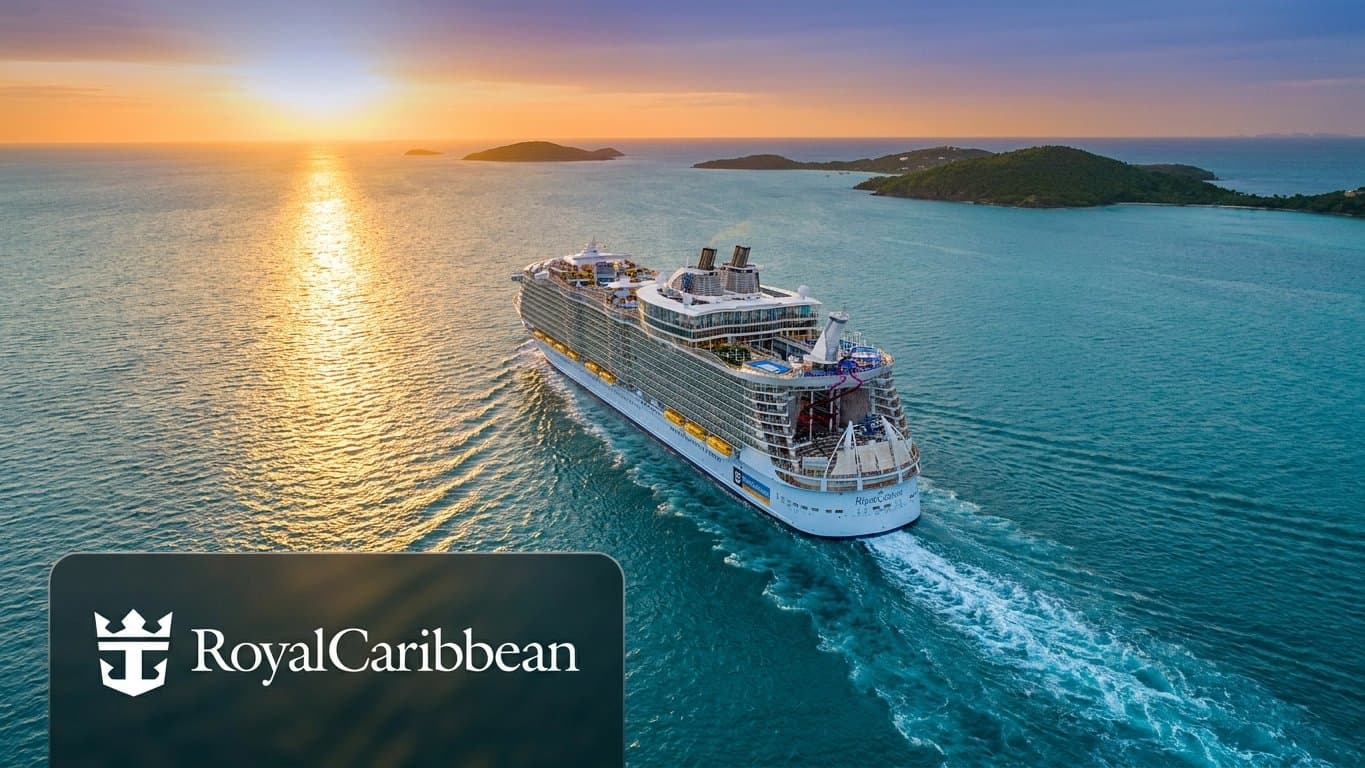
There are days when the gap between what happens on the screens and what happens in the businesses is especially wide. This is one of them: while South Korea's KOSPI plunged 10.84% in a leverage collapse and knocked down U.S. futures, the world's largest cruise company reported that its ships are full beyond capacity, that it beat its own guidance by a wide margin - and raised its annual outlook.
About the Company: The Model That Made Cruising a Different Business
Royal Caribbean Group (NYSE: RCL) is the world's largest cruise company, operating brands including Royal Caribbean International, Celebrity Cruises and Silversea.
And to understand the report you have to understand the model, because it differs from every other tourism segment. A cruise ship is a fixed asset with an almost fixed operating cost - the fuel, the crew and the maintenance are required whether the ship is full or half empty. The meaning: every additional guest above breakeven contributes almost the full price directly to profit. This is unusually sharp operating leverage
- for better and for worse.
And therefore the two variables that determine everything at a cruise company are the load factor and the yield per guest. If both rise simultaneously, profit surges far faster than revenue.
Beyond that, the model has changed in recent years: the large companies developed private destinations (islands and resorts they own) and pre-sold packages - which lets them charge more per guest and lock in revenue in advance.
What Was Reported: A Clear Beat on Every Line
Earnings. Adjusted EPS came to $4.21, and GAAP EPS to $4.20. And here is the important point: management's own guidance for the quarter stood at $3.83-3.93, and consensus at about $3.97. The actual result beat the top end of guidance by about 28 cents - a meaningful beat, not a marginal one.
Revenue. $4.8 billion, up 6%. Net income totaled $1.1 billion, and adjusted EBITDA $1.8 billion.
And the operational figures - here is the story:
| Metric | Value |
|---|---|
| Load factor | 110% |
| Capacity | +5% |
| Guests in the quarter | 2.4 million |
| Liquidity | $6.9 billion |
| Returned to shareholders | over $600 million |
Wait - a 110% load factor?
This is not an error, and it is worth explaining because the term is unique to the industry. In cruising, occupancy is measured against a nominal capacity of two guests per cabin. When families book cabins with three or four guests, the measure passes 100%.
The practical meaning: a 110% load factor says not only that the ships are full, but that families are booking denser cabins - meaning more people on the same ship, with the same operating cost. In a model of high operating leverage, that is exactly where profitability jumps.
The Annual Outlook Was Raised
| Metric | Updated guidance | Prior range |
|---|---|---|
| Adjusted EPS | $17.73-17.87 | $17.10-17.50 |
| Revenue growth | About 9% | - |
| Net yields (as-reported) | Up to 2.85% increase | - |
| NCC excluding fuel per APCD | About +0.4%; roughly flat in constant currency | - |
And the last row matters especially: operating costs per unit of capacity, excluding fuel, are nearly flat in constant currency. When revenue per guest rises and cost per unit does not move - the entire improvement falls straight to the bottom line.
The Connection to the Consumer Thesis
This report does not stand alone. It is the third link in a picture that has been forming for us over two weeks.
Last week American Express reported card-member spending up 9% - the fastest pace in three years - and that credit-loss provisions actually fell. This morning Coca-Cola reported volumes up 5% and margins expanding. And now Royal Caribbean adds the third layer, and perhaps the most meaningful one.
Why? Because a cruise vacation is an expense you can forgo. Nobody has to sail. When households not only keep booking but fill the ships beyond capacity, and book in advance at full price - that is far stronger evidence than routine consumption data. A consumer who books a vacation is demonstrating confidence, not merely ability.
Why this report matters today in particular
On a day when a leverage collapse in Korea knocks down markets worldwide, there is special value in separating two kinds of information. Stock prices respond to liquidity, to panic and to forced selling. Reports respond to what actually happened in the business. Royal Caribbean reported 2.4 million guests who paid and sailed - a figure unaffected by what happened in Seoul this morning.
The Bull Thesis
Whoever reads it positively will point to a strong combination: a beat of about 28 cents above the top end of management's guidance, a 110% load factor, nearly flat unit costs, and a raised annual outlook - the third. The growth implied by the new guidance stands at about 14%.
Beyond that: the balance sheet is strong ($6.9 billion of liquidity), the company is returning capital at a meaningful pace (over $600 million in the quarter), and the operating leverage works in its favor - every additional point of occupancy falls almost entirely to profit.
The Bear Thesis
Whoever reads it critically will recall first the sensitivity to the cycle. Tourism is among the first to be hurt in an economic slowdown, and that same operating leverage that magnifies profit in an upturn magnifies losses in a downturn. A half-empty ship costs almost as much as a full one.
Second, fuel and geopolitics. We saw this month how a spike in jet-fuel prices hurt Ryanair and Alaska Air. The same risk exists in cruising, and an oil environment around the $100 threshold is not supportive.
Third, the debt. Cruise companies emerged from the pandemic period with leveraged balance sheets, and although the situation has improved materially, the debt is still a factor requiring monitoring.
And fourth, the valuation. A stock that has delivered strong returns enters every report with high expectations; even a beat like this is already partly priced in.
The debate in one line
The bulls see a company that beat its own guidance by 28 cents, fills ships beyond capacity, keeps costs flat and raises guidance for a third time. The bears see a cyclical industry with two-way operating leverage, fuel exposure in a tense oil environment, and debt that is still material. Both sides are reading the same report.
My Angle
A personal opinion of Ilan Abramov - not advice, not a recommendation
What caught me in this report is not the profit - but the timing.
This report was published on precisely the day the world is staring at a red screen. And while everyone analyzes what the panic in Korea says about the economy, a company arrived and said: 2.4 million people boarded our ships this quarter, paid full price, and filled them beyond nominal capacity.
This is the reminder I return to on every turbulent day: a stock price is an opinion, a report is a fact. What happened in Seoul this morning changes stock prices; it does not change the fact that American households booked vacations in advance.
And what I take for the thesis file: a cruise vacation is one of the most honest gauges there is of consumer confidence. You can postpone buying a car, you can cut back at the supermarket - but someone who books a family sailing months ahead and pays a deposit is voting with money on how they feel about the future. Three reports this week - Amex, Coca-Cola and Royal Caribbean - say the same thing in three different languages.
And what I will follow: yield per guest versus cost per unit. As long as the first rises and the second stays flat, the machine works. On the day costs start climbing - especially if fuel stays high - the operating leverage will work the other way, and fast.
Summary
Royal Caribbean delivered a quarter in which a flaw is hard to find: adjusted EPS of $4.21 that beat management's own guidance by about 28 cents, revenue of $4.8 billion (+6%), a 110% load factor, 2.4 million guests, nearly flat unit costs, and an annual outlook raised to $17.73-17.87.
Beyond the company, this is a macro data point on the consumer: an entirely discretionary expense keeps growing, at full occupancy and full price. The question for the investor is not whether the business is strong - the report answers that - but how much of the strength is already priced in, and what happens to such a cyclical industry on the day the consumer decides to skip the sailing this year.
Sources: Royal Caribbean Group's official results announcement for the second quarter of 2026 (July 28, 2026), including revenue, GAAP and adjusted earnings, EBITDA, load factor, guest count, liquidity, the return to shareholders and the updated annual guidance; prior management guidance and analyst consensus as covered by Zacks and StockTitan. Data accurate as of the time of writing. The chart is shown in real time via TradingView. Nothing herein constitutes a forecast, recommendation or advice - see the full disclaimer at the bottom of the page.


