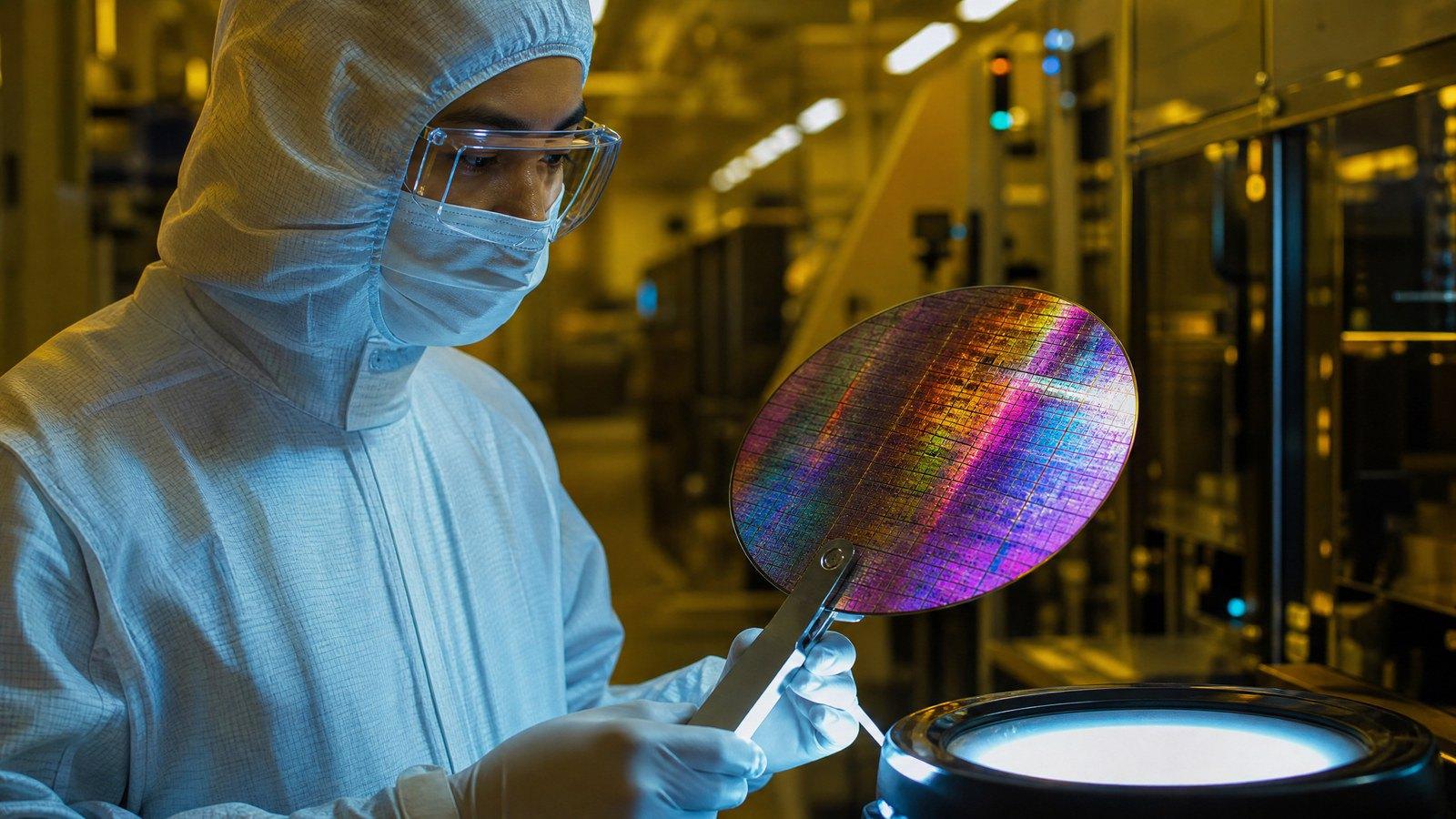
Every advanced chip starts in a machine that prints a pattern onto it with light. For the most advanced machines - those using extreme ultraviolet light (EUV) - the world has one maker: the Dutch company ASML. In October 2026 it raised its full-year sales outlook to EUR 44-45 billion, from EUR 34-39 billion in January, and wrote that even the supply it plans for 2027 and 2028 will not fully meet demand.
Errors or inaccuracies are possible. Spotted something that looks wrong? Write to me and I will correct it.
What happens in this link
A chip is built on a silicon wafer in dozens of layers. Each layer repeats the same cycle: coat the wafer with a light-sensitive material, project a pattern onto it, etch, deposit new material, clean and inspect. Lithography is the projection step, and it sets how small the features on the chip can be.
But lithography is only one station on the line. Around it sits a whole family of equipment:
- Deposition and etch, which add and remove material in thin layers. Applied Materials and Lam Research are among the companies here.
- Process control and metrology, which inspect every layer and find defects. KLA is a central name.
- Cleaning, implant and test equipment, made by further suppliers, among them Japan's Tokyo Electron.
This research focuses on lithography, because that is the station with a single supplier at the most advanced layer.
How the money flows
The customers of chipmaking equipment are the chipmakers: contract foundries such as TSMC, and memory makers. They buy machines and install them in fabs that are planned years ahead.
Their money comes from the designers: Nvidia, Apple, AMD and others pay TSMC for wafers, and TSMC turns those payments into a capital budget. In 2025 TSMC invested $40.9 billion, and its 2026 capital budget is $52 to $56 billion. According to its annual report, most of the 2026 spending goes to expanding 2- and 3-nanometer capacity.
An equipment maker's model has two streams. The first is the system sale, where revenue recognition depends on acceptance tests. The second is service, upgrades and spare parts over the machine's life. An order signed today therefore becomes revenue over years.
ASML's numbers
| 2025 | |
|---|---|
| Sales | EUR 32.7 billion |
| Gross margin | 52.8% |
| Net income | EUR 9.6 billion |
| EUV system sales | EUR 11.6 billion, up 39% |
| EUV systems recognized in revenue | 48 (44 in 2024) |
| All lithography systems sold | 327 (418 in 2024) |
| Year-end backlog | EUR 38.8 billion |
The last rows show where the market is moving. The total number of systems fell, while the number of EUV systems - the most expensive and most advanced - rose. In Q4 2025 ASML booked EUR 13.2 billion of orders, EUR 7.4 billion of them EUV.
And this year: in January 2026 the company expected sales of EUR 34 to 39 billion. In October it raised that to EUR 44 to 45 billion, with a gross margin of about 56%.
Where the bottleneck is
It sits inside ASML's own supply chain. In the risk factors of its annual report, the company writes that the number of lithography systems it can build is limited by the production capacity of one of its key suppliers, Carl Zeiss, which makes the optics. And in its outlook for Q4 2026 it wrote that planned supply for 2027 and 2028 will not fully meet demand.
Three further constraints:
- Customer concentration. ASML's largest customer bought EUR 7.8 billion of equipment in 2025, 23.9% of sales (16.6% in 2024). The two largest together were 38.0%. Decisions by a few chipmakers move the whole link.
- Export controls. ASML is subject to export controls, and the Dutch government expanded its rules in early 2025. At the same time, ASML writes that China was stronger than expected in 2025, both in lithography and across the wider equipment market, and that its non-EUV sales were driven mainly by China.
- Time. A new fab takes years, and machines are ordered ahead. A link like this responds to changes in demand with a lag, in both directions.
What pushes it forward
- Demand growing faster than supply, according to the maker itself.
- The move to advanced nodes. Each shrink needs more EUV layers and newer systems. ASML already sells its next platform, EXE, with a high numerical aperture (High-NA).
- A growing chip market: according to the Semiconductor Industry Association (SIA), world chip sales reached $791.7 billion in 2025, up 25.6% (February 2026 figure).
What could stop it
- Cyclicality. Equipment is the first link to feel a cut in chipmakers' investment, because it depends on decisions made a year ahead.
- Geopolitics. Further export restrictions could shrink the market in China, where demand was strong in 2025.
- Customer concentration cuts both ways: if a major customer delays an order, sales feel it immediately.
- Supply. As long as Zeiss limits the build rate, a higher outlook does not guarantee sales rising at the same pace.
Each side explains only part. The optimistic reading does not explain what happens to the backlog if chipmakers temper their capital budgets. The cautious reading does not explain why ASML raised its 2026 outlook and still describes a shortage.
Company map for this link
Factual mentions only. This is not a closed list and not a recommendation.
| Sub-link | Companies | Role |
|---|---|---|
| Lithography | ASML | DUV and EUV systems; the only EUV maker according to its own report |
| Lithography optics | Carl Zeiss (private) | Lenses and mirrors for ASML systems |
| Deposition and etch | Applied Materials, Lam Research, Tokyo Electron | Equipment that adds and removes layers |
| Process control | KLA | Metrology and defect inspection |
| The buyers | TSMC, Samsung, Intel, SK hynix, Micron | Chipmakers that install the equipment |
Further reading
- AI capex of the cloud giants: where the money flows in the chain - the master article of the compute and AI chain.
- Foundry and advanced packaging - the equipment's largest buyer.
Sources
ASML: Q4 and FY2025 results release and investor presentation (28.1.2026), 2025 annual report (20-F), Q3 2026 results release (14.10.2026). TSMC: 2025 annual report (20-F) and Q4 2025 earnings call (15.1.2026). SIA: release on 2025 worldwide semiconductor sales (6.2.2026).
Ilan Abramov, the author, or anyone on his behalf may hold securities mentioned in this article, and holdings change from time to time.


