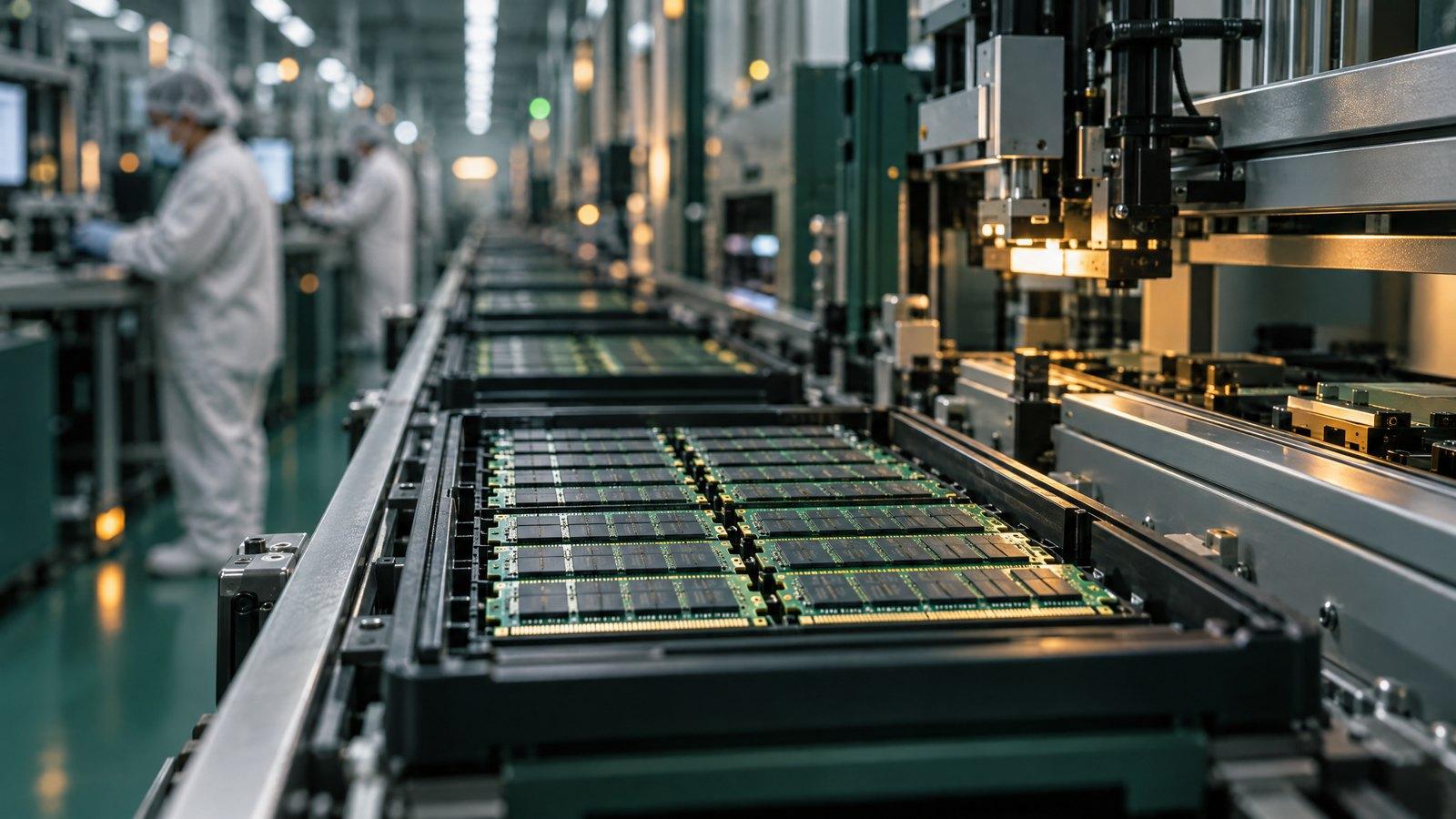
An AI accelerator is an extremely fast calculator that depends entirely on how quickly it is fed data. That feeding is done by HBM - memory stacked upward and placed right next to the processor, supplied by the world's three large memory makers. Micron, the smallest of the three, reports that most of its 2027 volume has already been sold under agreements, at significantly higher prices than the year before.
Errors or inaccuracies are possible. Spotted something that looks wrong? Write to me and I will correct it.
What HBM is, without the jargon
Ordinary computer memory (DRAM) sits on a separate module and talks to the processor through a relatively narrow channel. HBM - High Bandwidth Memory - removes that bottleneck in two ways. It takes several thin DRAM dies and stacks them, connecting the layers with tiny vertical holes through the silicon. And it places the whole stack on the same substrate as the processor, millimeters away.
The result is a very wide channel between memory and compute. In AI chips this is critical: a large language model has to pull billions of parameters at every step, and a processor waiting for data simply sits idle.
Generations are counted by number. HBM3E is what most of the market ships today; HBM4 is the generation entering production. According to Micron's annual report, 12-high HBM3E stacks were the majority of its HBM shipments in fiscal 2026. The company has also begun volume production of 36GB HBM4 and expects the HBM4E ramp in 2027.
How the money flows
The customer of an HBM maker is not the cloud giant but whoever designs the accelerator: Nvidia, AMD and the companies designing custom chips for the cloud giants. But the stack is not shipped straight to them. It goes to advanced packaging, where the processor and the memory stacks are placed on a shared substrate. TSMC, for example, offers this step as a service called CoWoS, alongside making the chip itself.
So a dollar a cloud giant pays for an AI server travels the chain like this: from the server to the accelerator designer, from there to the memory maker and the chipmaker, and from them to the equipment makers.
The size of the demand side shows in the filings. Nvidia reported $107.6 billion of data-center revenue in the quarter ended October 25, 2026, up 110% from a year earlier. At Micron, the cloud and data-center memory unit brought in $43.09 billion in fiscal 2026 (ended September 3), against $13.52 billion a year earlier.
What changes in the business model is the nature of the contract. Conventional memory has historically been sold into a market with prices that swing in sharp cycles. HBM is sold ahead. Micron wrote in its fourth-quarter prepared remarks that it has completed agreements for the vast majority of its calendar-2027 HBM bit supply, with significant price increases year over year.
Where the bottleneck is
The most important point appears in Micron's own annual report: to produce the same number of bits, HBM needs more silicon wafers and more cleanroom space than conventional DRAM on the same technology node. Every shift of capacity to HBM therefore reduces the amount of conventional memory the same factory can produce.
Three constraints follow:
- Supplier concentration. Supply is concentrated in three makers. An accelerator designer that wants to grow output depends on how fast they expand. Micron's annual report also lists a Chinese maker, CXMT, among its competitors in memory.
- Fit to a generation. An HBM stack is designed to work with a specific accelerator. A maker that is late to a new generation risks missing the accelerator built around it.
- Packaging. Even with memory stacks available, they need room on advanced-packaging lines. That is a separate link with its own limits, covered in the research on foundry and packaging.
The three makers
| Maker | What it reports on HBM (source: the company) |
|---|---|
| SK hynix | HBM revenue more than doubled in 2025. It supplies HBM3E and HBM4 in parallel, and completed preparation for HBM4 mass production in September 2025 |
| Samsung | Memory set a revenue record in Q4 2025 on HBM sales. It announced it was starting HBM4 deliveries in Q1 2026, with a base die on a 4-nanometer process |
| Micron | Most of its 2027 HBM volume under agreements. Q4 HBM revenue grew faster than total revenue. It expects industry HBM bit shipments to grow faster than conventional DRAM through 2028 |
SK hynix reported revenue of KRW 97.1 trillion and operating profit of KRW 47.2 trillion in 2025. None of the three publishes its HBM market share in its official reports, so no such number appears here. Figures circulating in the market are estimates by research firms.
What pushes it forward
- Demand is documented in contracts, not only forecasts. Agreements for 2027 volumes are already signed at Micron.
- Every generation needs more memory. Each new accelerator comes with more stacks or taller ones, so bits per chip rise even when the number of chips does not.
- A broader customer base. In fiscal 2026 no Micron customer reached 10% of revenue. A year earlier one customer was 17%.
What could stop it
- The same mechanism, in reverse. Micron writes in its risk factors that if HBM demand weakens and makers shift capacity back to conventional DRAM, conventional supply could rise significantly. In a market where prices are set by supply and demand, that hits price.
- The long-term path is unknown. This too is in the report: HBM demand rose because of AI, but the company writes that the long-term trajectory is unknown and demand may fluctuate.
- Competition for the next generation. A maker that delivers HBM4 on better terms could take share in the next cycle. Next-generation qualifications are still open.
- Dependence on capital spending. The whole chain rests on the cloud giants' investment budgets, which have risen for several years in a row. Each one's figures are in the chain's master article.
Each side explains part of the picture. The first does not explain what happens to the capacity being built if the pace of investment eases. The second does not explain why customers are willing to sign for 2027 volumes now.
Company map for this link
Factual mentions only. This is not a closed list and not a recommendation.
| Link | Companies | Role |
|---|---|---|
| HBM stacks | SK hynix, Samsung, Micron | Make the DRAM dies and stack them |
| Advanced packaging | TSMC and others | Place the stacks beside the processor on a shared substrate |
| Accelerator designers | Nvidia, AMD, custom-chip designers | The customers of the HBM makers |
| Final buyer | Amazon, Microsoft, Alphabet, Meta and others | Buy the servers, and so fund the whole chain |
Further reading
- AI capex of the cloud giants: where the money flows in the chain - the master article of the compute and AI chain.
- Foundry and advanced packaging - the link where memory meets the processor.
Sources
Micron: annual report (10-K) for fiscal 2026, Q4 results release and prepared remarks (30.9.2026). SK hynix: FY2025 results release (28.1.2026). Samsung: Q4 and FY2025 results release (29.1.2026). Nvidia: Q3 fiscal 2027 results release (17.11.2026).
Ilan Abramov, the author, or anyone on his behalf may hold securities mentioned in this article, and holdings change from time to time.


