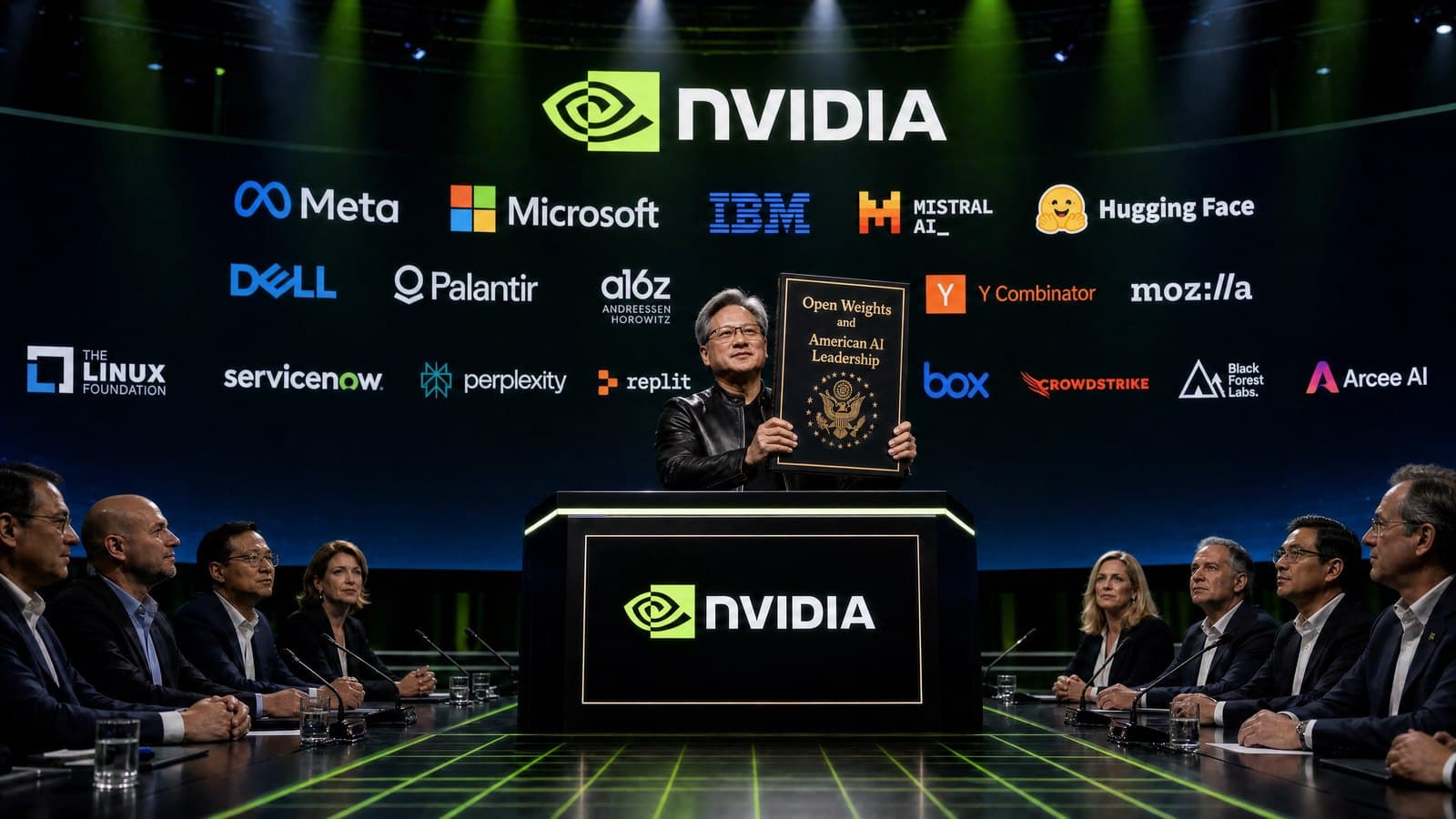
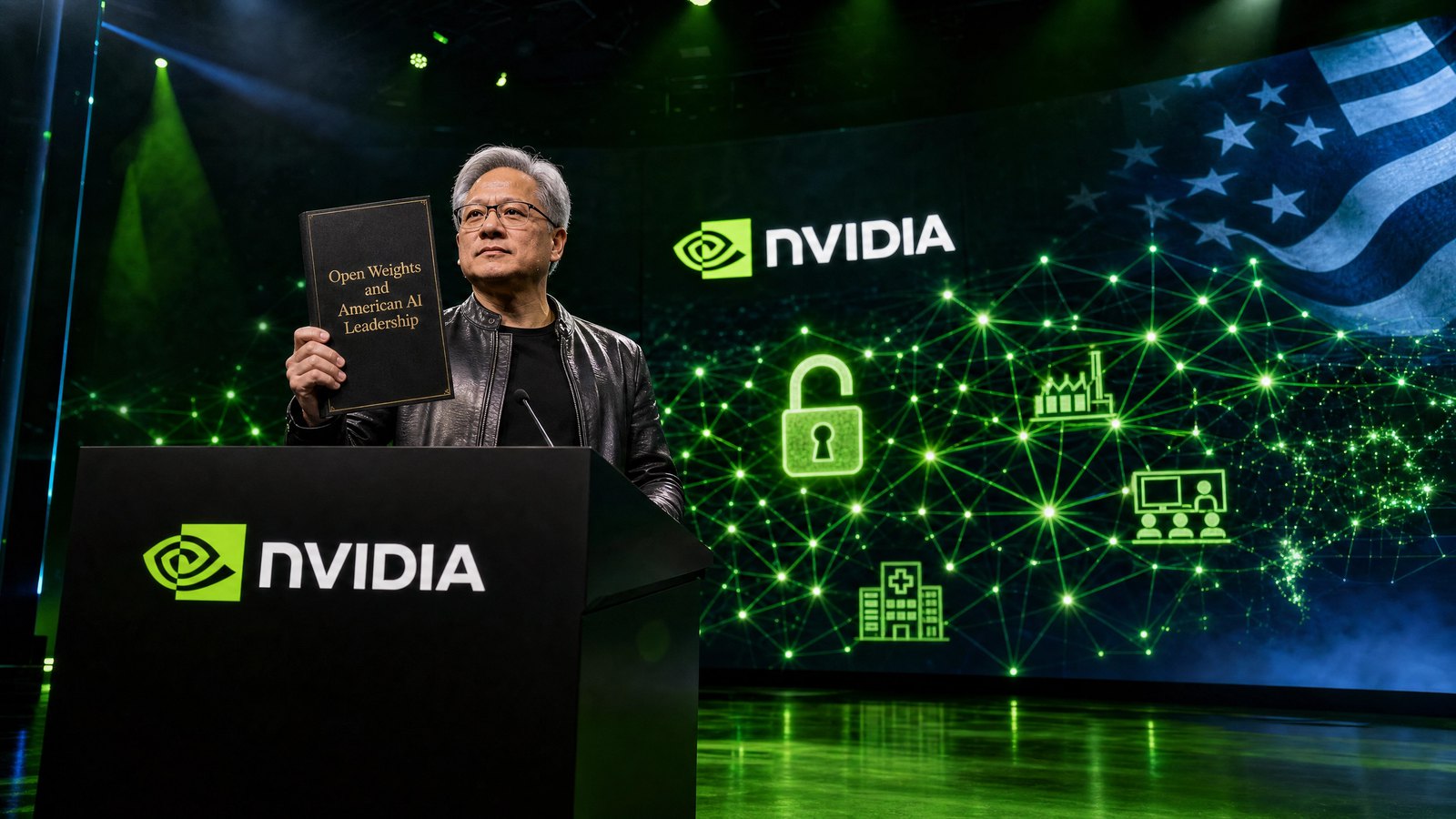
There are moments when the symbolism says it all. Jensen Huang, Nvidia's CEO - one of the most influential people in the world - posted this week for the first time in his life on X. And after years of silence, what did he choose to say? Not about chips, not about profits - but to share a joint document titled "Open Weights and American AI Leadership." That in itself is a story. But the real story, as always, hides in the details - and here, precisely in who did not sign.
What Are "Open Weights" Anyway?
First, some background. An AI model is built of "weights" - the numbers that encode everything the model learned. A "closed" model (like OpenAI's or Anthropic's) keeps the weights confidential; you can only use it through the company's interface. An "open weights" model releases the weights for download - anyone can run it on their own servers, modify it, and build on it. This is the difference between "renting a taxi" and "getting the engine." Meta (with Llama), Mistral, and Nvidia itself (with Nemotron) are among the leaders of the open approach.
What the Document Says
The document, published on July 24 and hosted on Microsoft's site, makes one central claim: America's AI leadership will not be determined by one frontier model, but by whether the U.S. builds an open ecosystem that diffuses into every sector. In the document's words: "America wins the AI era by diffusing it into the workflows of factories, hospitals, farms, classrooms, and main street businesses."
The five central arguments:
- An economics of matching. Open models allow you to "match the right model to the right job at the right cost" - reserving the expensive frontier models only for problems that truly require them.
- Competition as an advantage. A multiplicity of organizations developing and deploying advanced models increases competition - among developers, chips and applications - and lowers costs.
- Autonomy for the customer. Organizations get control over their data, can run independently, and avoid "vendor lock-in."
- Security through transparency. "Openness may be one of the most important paths to AI safety and security" - because when the weights are visible, researchers around the world can find and fix vulnerabilities faster.
- Protecting innovation. "Distillation" (using one model's output to train another) is a legitimate technique that must be distinguished from unlawful "extraction" - and regulated with a targeted law, not a sweeping ban.
On the policy side, the signatories call for: expanding access to compute for startups and researchers, investing in shared training assets, keeping a multiplicity of frontier models by avoiding "premature restrictions" on open models, and strengthening the application layer for "AI sovereignty."
The Big Story: Who Signed, and Who Stood Out by Their Absence
25 organizations signed - a broad and diverse coalition: NVIDIA, Microsoft, Meta, IBM, Mistral, Hugging Face, Dell, Palantir, Andreessen Horowitz, Y Combinator, Mozilla, The Linux Foundation, ServiceNow, Perplexity, Replit, Box, CrowdStrike, Black Forest Labs and more.
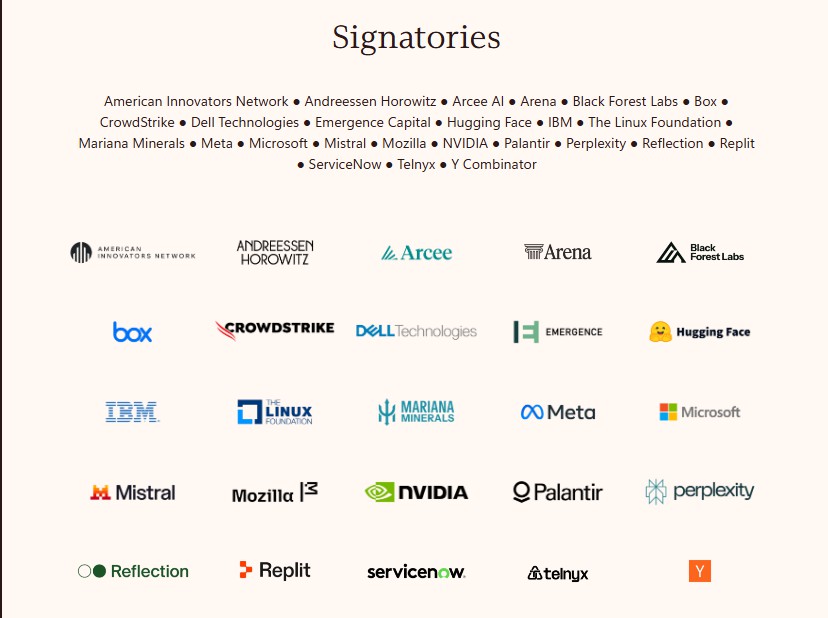
But the real headline is not the list - it is who is missing from it. The two large frontier labs, OpenAI and Anthropic, did not sign. And this is not forgetfulness: they are exactly the organizations most vocal in Washington about the danger of open Chinese models (like Kimi and DeepSeek), arguing that they threaten American AI leadership. In other words, this document is not "the whole industry together" - it is a map of a deep split:
- The "open" camp - Nvidia, Meta, Microsoft, Mistral, Hugging Face: the more open models run everywhere, the larger the whole market grows (and also, not coincidentally, the demand for chips and infrastructure).
- The "closed/cautious" camp - OpenAI and Anthropic: closed frontier models, a fear of uncontrolled distribution and of Chinese competition.
Huang himself does not hide his position - he even said recently that open Chinese models are "excellent" and should be embraced, not banned. This is a position diametrically opposed to his largest customers, OpenAI and Anthropic.
The Implications for the Investor
And here is the part that interests us. Beyond the ideological debate, there is economic logic here - and it is not by chance that Nvidia is leading:
- Nvidia - the transparent (and legitimate) interest. Open models run on independent infrastructure, everywhere, for everyone. More models = more compute = more Nvidia chips. The call for "openness" is also a call to expand Nvidia's own market. This does not invalidate the argument - but it is important to understand the motive.
- The application layer and sovereign AI. If the future is open, the winners are those who build on top of the models: Palantir and ServiceNow (which we covered), converting AI into business and government processes, and infrastructure players like Dell and Hugging Face. The "AI sovereignty" thesis - nations and organizations that want their own AI - gets a tailwind.
- Meta and Mistral as strategic winners. If "open" wins, Meta's model (Llama) and Mistral's become the infrastructure of half the world - an enormous strategic asset, even if it is hard to price directly.
- Regulation as the top risk. The whole document is essentially a lobby against restrictive regulation. If Washington nonetheless chooses to restrict open models (on national-security grounds), it would change the balance of power - and that is the risk the signatories are trying to prevent.
The Other Side: The Caution Is Not Baseless
And balance, as always. The absence of OpenAI and Anthropic is not a whim - there is a real argument on the other side. Open models, by their very definition, can be downloaded in China too, by hostile actors too, and adapted for dangerous purposes - without a "remote kill switch." The fear of uncontrolled distribution of frontier capabilities is legitimate, and that is exactly the debate: is openness a source of resilience (more eyes, more fixes), or a risk vector (more access for the bad actors). This document is one side of that debate - a very powerful side, but a side.
Summary
Jensen Huang's first-ever post is much more than a PR moment. It is a sign that the debate over the future of AI is moving from the technology stage to the policy stage - and that the industry is splitting into two camps with opposing interests. On one side, a broad coalition that sees openness as the path to American leadership (and, along the way, to a larger market for chips and infrastructure). On the other, the frontier labs that fear uncontrolled distribution. For the investor, this is not just a headline - it is a map of who profits from which future. And as we have been tracking the AI megatrend for months, the question of who will win - the open or the closed - is one of the big questions that will shape the decade.
Sources: the official document "Open Weights and American AI Leadership" as published on Microsoft's site (July 24, 2026), including the list of signatories and the direct quotes; Jensen Huang's X post; and international coverage (CNBC, Fortune, Axios, ANI). All data current as of the time of writing. Nothing herein is a recommendation or advice - see the full disclaimer at the bottom of the page.


