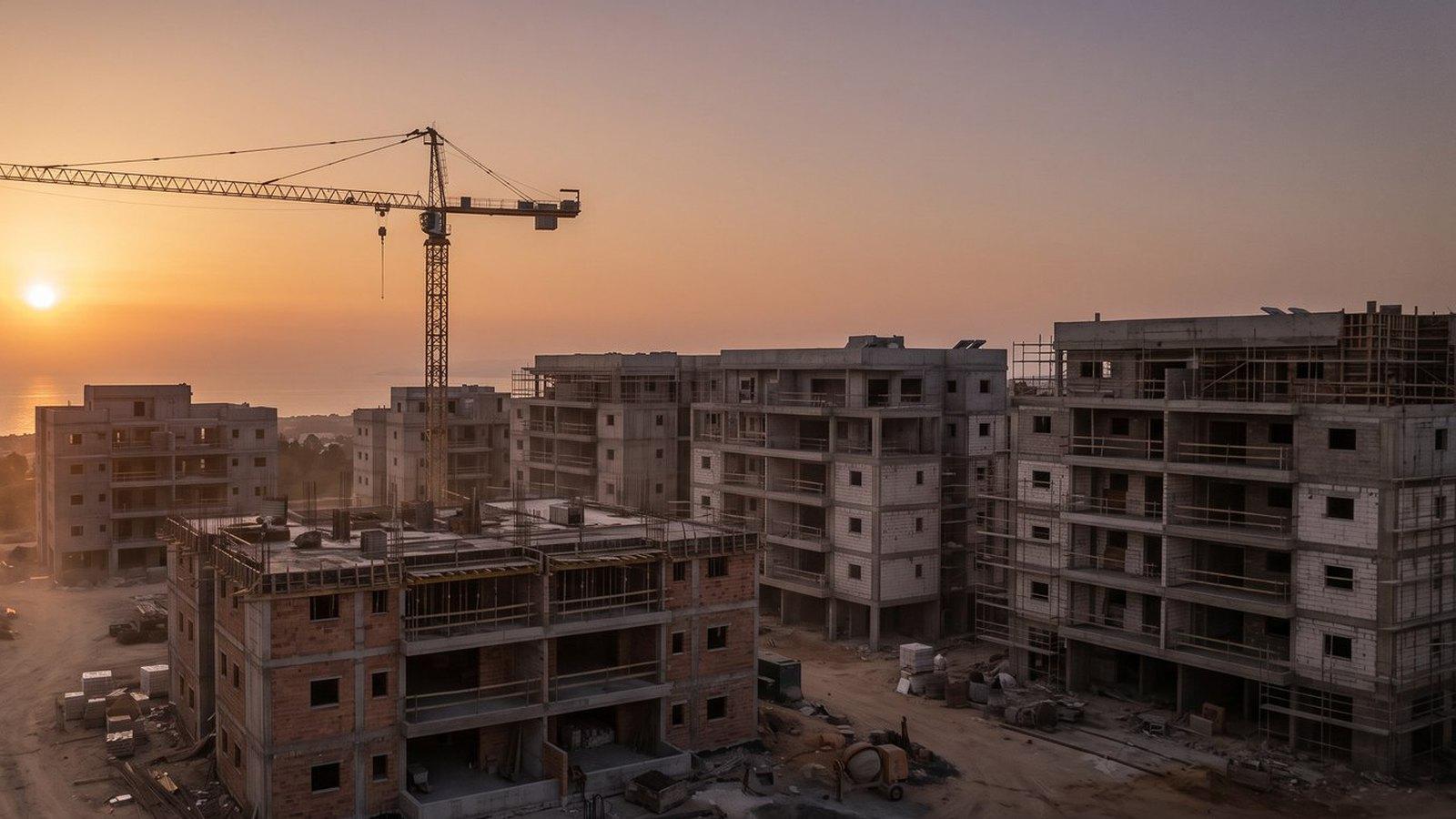
In 2025 construction began on about 80,000 homes in Israel, but only about 34,000 new homes were sold, and the stock of unsold new homes reached about 83,000 at year-end - a high level relative to the years for which data exist, according to the Bank of Israel. The CBS dwellings price index fell 1.5% in August-September 2026 from the same period a year earlier (provisional). These figures touch every link in the chain: state land, planning, developers, banks and buyers.
Errors or inaccuracies are possible. Spotted something that looks wrong? Write to me and I will correct it.
Why it matters
Housing is the largest component of the consumer price index: according to the Bank of Israel, its weight is 26.8% of the overall index (as of 2025). The housing component is based on rents, not home prices - the CBS dwellings price index is a separate indicator and is not part of the CPI.
On the credit side, housing loans totaled NIS 675.2 billion at the end of 2025 - 36% of the banks' on-balance-sheet credit to the public, and credit to the construction and real estate industry added another 19.7%. The State Comptroller describes the mortgage as the most significant financial liability of households.
On the employment side, the construction industry as a whole employed about 361,000 people on average in 2025, similar to the prewar number, according to the Bank of Israel.
How the sector works
The chain starts with land. According to the Israel Land Authority's 2021-2022 budget booklet, about 93% of regulated land in Israel - about 20.1 million dunams - is owned by the state, the Development Authority and the Jewish National Fund, and is managed by the Israel Land Authority (ILA).
| Link | Who | What happened in 2025 |
|---|---|---|
| Planning | District committees and the VATMAL | About 223,000 housing units approved, about 80% above the government target |
| Land | Israel Land Authority | Land marketed for about 60,000 homes, about 43,000 of them in tenders |
| Construction | Developers and contractors | About 80,000 building starts and 59,700 completions |
| Financing | Banks | Construction-project credit for residential projects of about NIS 69 billion at year-end |
| Demand | Buyers | About 91,000 transactions, about 34,000 of them in new homes |
According to the Bank of Israel, most approved plans came with significant conditions, and some cannot be implemented without supporting infrastructure - wastewater treatment, transportation, electricity and water. In other words, the effective constraint sits at the later stages, not in approving the plan itself.
In ILA tenders, the winner undertakes to complete construction within a defined period. The Bank of Israel notes that this condition, together with interest rates that make holding land more expensive, creates an incentive to start building even when demand for new homes is falling. To encourage marketing, the ILA cut minimum prices and subsidized development costs in some tenders, and according to the Bank of Israel this mechanism allows land prices to fall when home prices fall.
Most homes are sold before construction is completed, and the developer finances construction with a project-financing loan from a bank. The "absorption capacity" ratio expresses how far sale prices can fall before the bank incurs a loss on the project.
The state also takes part on the demand side. Purchase tax on a single home is levied in brackets: 0% up to NIS 1,978,745, 3.5% up to NIS 2,347,040, 5% up to NIS 6,055,070, 8% up to NIS 20,183,565 and 10% above that. On an additional home the tax is 8% up to NIS 6,055,070 and 10% above it - under a temporary provision that, according to a Tax Authority instruction from January 2025, is in force until December 31, 2026 unless extended. According to a Tax Authority instruction from January 2025, the single-home brackets were frozen and will remain relevant until January 15, 2028. Under the "Discounted Apartment" program, about 11,400 homes were allocated by lottery in 2025, compared with about 16,400 in 2024.
The players
- Israel Land Authority - manages state land and markets land for construction through tenders and non-tender allocations.
- Planning institutions - the district committees and the National Committee for Priority Housing Areas (VATMAL), which together approved about 223,000 units in 2025.
- Ministry of Construction and Housing - responsible for the subsidized housing programs, including "Discounted Apartment".
- Developers and contractors - buy land in tenders or through urban renewal deals, build and sell.
- The banks - finance developers through project financing and buyers through mortgages. According to the Banking Supervision Department, market shares in housing credit in December 2025: Mizrahi-Tefahot 36.3%, Leumi 22.8%, Hapoalim 22.0%, Discount 11.7%, First International 5.8% and Jerusalem 1.4%.
- The Bank of Israel - sets the interest rate and, through the Banking Supervision Department, restricts the structure of loans.
- The Tax Authority and the Finance Ministry - purchase tax, and the transaction data on which the Chief Economist Department's reviews rely.
Buyers divide into first-time buyers, upgraders and investors. Investors' share of total purchases averaged 12.2% in 2025.
Growth drivers
Demographic demand. According to the "Strategic Housing Plan" of the National Economic Council, cited by the Bank of Israel, the demographic need in 2026 to 2035 is about 65,500 housing units a year. The Bank of Israel assesses that in recent years the pace of building starts has been consistent with demographic needs.
Falling interest rates. The Bank of Israel rate stood at 4.25% after the November 2025 decision, and has been 3.25% since September 2026; at the November 23, 2026 decision it was left unchanged. New mortgage borrowing in October 2026 was about NIS 10 billion, seasonally adjusted.
Planning and land pipeline. The roughly 223,000 units approved in 2025 and land for about 60,000 homes a year create a large planning inventory. In January 2026 the National Planning and Building Council decided to advance National Outline Plan 55 for infrastructure hubs, intended to narrow the gap between the pace of planning and the pace of infrastructure.
Urban renewal. In 2025 construction began on 22,600 homes under urban renewal - about 28% of all building starts, about half of them in the Tel Aviv District. About 16,800 of them were under TAMA 38 and vacate-and-build projects.
Labor. The number of foreign workers in construction reached 75,200 on average in 2025, and the increase in foreign and Israeli workers offset about 90% of the decline in the number of Palestinian workers relative to the eve of the war.
Challenges and risks
| Indicator | Figure | Period |
|---|---|---|
| Stock of unsold new homes | About 83,000 | End of 2025 |
| Months of supply at the sales pace | About 30 | August 2025 - end of 2025 |
| Dwellings price index, annual change | -1.5% | August-September 2026 |
| Share of developer deals with a financing benefit | 45% | September 2026 |
| Average absorption-capacity ratio in project financing | About 58% | End of 2025 |
Unsold stock. The "months of supply" indicator - the time needed to sell the stock at the sales pace of the previous 12 months - rose from about 24 months at the end of 2024 to about 30 in August 2025 and remained stable. In its November 2026 rate decision, the Bank of Israel said the stock increased slightly and remained high. According to the Bank, excess inventory supports a decline in new home prices in the short term.
Financing promotions. In a "developer-subsidized" loan, the buyer takes a bullet or balloon mortgage and the developer pays the interest. According to the State Comptroller, cumulative credit in such loans rose from about NIS 453 million in December 2023 to about NIS 8.3 billion in August 2025. In April 2025 a temporary directive of the Banking Supervision Department came into effect: such loans are capped at 10% of quarterly housing loan executions, and project financing for a project in which more than 25% of contracts defer a significant part of the price to delivery receives a 150% risk weight. According to the Supervision Department's review, the share of homes sold with a non-linear payment schedule fell from about 31% at the end of March 2025 to about 28% at the end of 2025. But according to the Chief Economist Department, in September 2026 a financing benefit was given in 45% of developer sales in the free market in the five regions it tracks (in deals with delivery of a year or more) - up 15 percentage points in a month, and the highest level since March 2025. In the Hadera region the share reached 74%, and in the Be'er Sheva region 58%. The department says it does not have enough data to explain the jump. The Bank of Israel notes that deferring payments until delivery is an effective discount, so reported prices of new homes may be biased upward.
Developer leverage. Credit for financing residential construction rose about 40% in 2025, from about NIS 49 billion to about NIS 69 billion. The Supervision Department attributes this partly to the decline in new home purchases and to promotions that deferred payments, which required developers to finance more of the construction with credit. The average absorption-capacity ratio fell from about 70% to about 58%, and the share of credit to projects with absorption capacity below 40% rose from about 22% to about 33%. The Department notes that the ratio still indicates relatively wide safety margins. According to the Finance Ministry, developers' cash flow from selling new homes, net of inputs, totaled NIS 338 million in September 2026, down 45% from September 2025.
Labor and costs. Despite the return to the prewar number of workers, there were about 20,000 job vacancies in the industry in the last quarter of 2025, a rate of 8.8% compared with 6.8% before the war. Since October 2023 the residential construction input price index has risen 9%, and its wage component 13.8%.
Weak demand. In September 2026, 6,246 homes were purchased, down 10% from September 2025. According to the Finance Ministry, the number of free-market transactions was among the lowest recorded in any September since the early 2000s. Investor purchases fell 29%, and upgrader purchases 17%. The Bank of Israel also points to a negative migration balance and to government bond yields that are more attractive than rental yields compared with the years before COVID-19.
Urban renewal under pressure. According to the Bank of Israel, there is concern that some urban renewal projects in advanced planning stages will not be economically feasible, due to falling sales, interest rates higher than expected, rising costs and the benefits promised to residents. The number of urban renewal permits declined in 2025.
War. Operation Roaring Lion against Iran began on February 28, 2026, and in the first quarter GDP contracted at an annual rate of 3.8%. The Bank of Israel estimated that in October 2025 about 7,400 homes were still outside the effective housing stock due to war damage.
What to watch
- The temporary directive on financing promotions is in force until the end of 2026. In March 2025 the Bank of Israel wrote that it would examine the need to extend it, update it or take further steps. What will be decided for 2027?
- Will the share of financing benefits stay around 45%, as recorded in September 2026?
- The Bank of Israel's next rate decision is scheduled for January 4, 2027.
- The temporary provision on purchase tax for an additional home (8% and 10%) is in force until December 31, 2026. Will it be extended, and at what rates?
- The dwellings price index is published on the 15th of each month and reflects transactions from two to four months earlier. Will the stock of about 83,000 homes begin to decline?
- The "Discounted Apartment" program: since November 2025, tenders are limited to localities where the price per square meter is up to NIS 20,000 including VAT. According to the Bank of Israel, from 2026 the number of subsidized homes in high-demand areas is expected to decline gradually.
- The pace of implementation of National Outline Plan 55 and of the December 2025 government decision authorizing Mekorot to build wastewater treatment plants, one of the main barriers to implementing housing plans.


