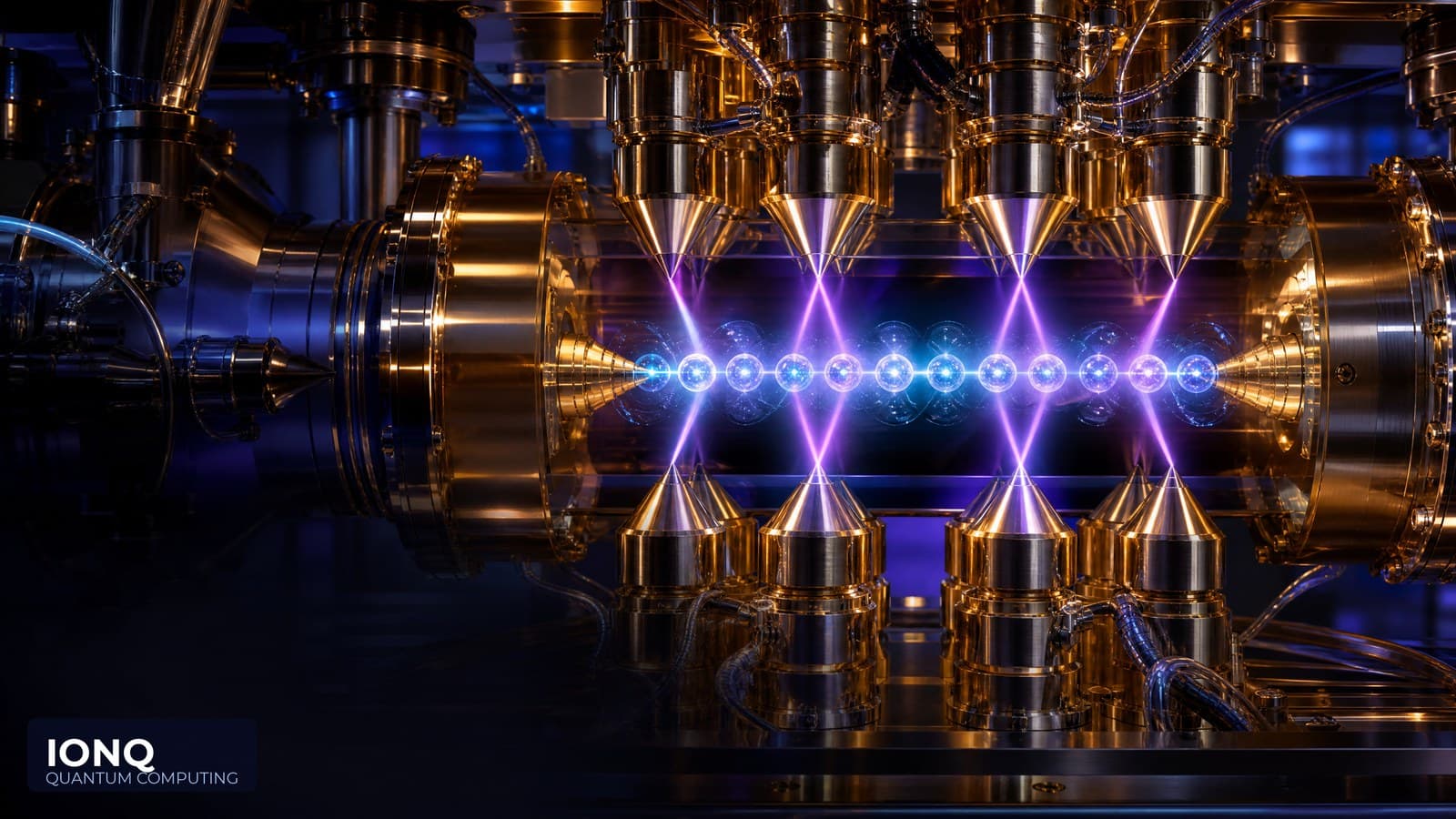
On 22 September IonQ announced what it describes as the industry's first end-to-end real-time quantum error decoder - running on a single standard computer processor. The stock rose in response.
I read the scientific paper the announcement is based on. There is a real engineering achievement in it. It is simply not what the headline says - and the difference between the two is exactly what an investor needs to know.
Errors or inaccuracies are possible. Spotted something that looks wrong? Write to me and I will correct it.
In brief:
- The quantum data in the research was entirely simulated - no physical qubit was involved.
- "A single standard CPU" is a MacBook Pro with an M4 Max chip, using 12 of its 16 cores.
- The architecture tested has not been built - the paper assumes a future machine.
- Google demonstrated real-time decoding against live hardware back in December 2024, and there too it ran in software on ordinary CPUs.
- And on actual hardware, IonQ has demonstrated four logical qubits. 408 is a simulated number.
Why Error Correction Is the Whole Game
A quantum computer errs. A physical qubit - in IonQ's case, a single ion trapped in an electric field - loses its state to thermal noise, vibration and magnetic fields. The more qubits you add and the longer the computation runs, the closer it gets to certain that one error ruins everything.
The answer is a logical qubit: many physical qubits encoding one protected unit of information. The ratio is not symbolic - in some codes, tens or even hundreds of physical units are needed per logical one.
And the hard part is measurement. In quantum physics, measuring a qubit directly destroys the information in it. So the information is not measured - "syndromes" are measured, indirect signals that betray that an error occurred without revealing the content.
And that creates a bottleneck that is entirely classical, not quantum:
The quantum computer spits out an endless stream of syndromes. An ordinary computer has to decode them - work out which error happened and where - and answer faster than new errors accumulate.
If the decoder falls behind, a backlog builds: every cycle adds work faster than the decoder finishes it, and the quantum computer has to stop and wait. That is a real, well-known problem, and it is what IonQ's research addresses.
What the Announcement Said
Per the company's 22 September release:
- An end-to-end real-time decoder running on a single standard off-the-shelf CPU.
- Tested across 408 logical qubits, 88 memory blocks and magic-state factories.
- More than 31.5 million operations.
- Added latency from decoding: 0.02%.
- Nicolas Delfosse, the company's quantum research lead: validating real-time decoding "across hundreds of logical qubits and over millions of logical operations is an important milestone".
(One term explained: a "magic-state factory" is a module that produces special quantum states needed for a certain class of operations. It consumes a large share of the resources in any fault-tolerant quantum computer, which is why it is counted separately.)
And What the Paper Itself Says
The paper is titled "Real-time decoder for a MegaQuOp quantum computer using a single CPU", by Min Ye, Andrii Maksymov and Nicolas Delfosse. It defines MegaQuOp as "a device capable of executing millions of operations on hundreds of logical qubits" - the milestone after today's noisy machines.
It was posted as a preprint on 25 August, with a second version on 3 September. So the 22 September announcement announces research that had been public for a month, and was covered in the trade press in August.
Five things that appear in the paper and not in the release:
- It is all simulated. The syndromes the decoder processed came from a mathematical noise model. There was no quantum hardware in the loop. This is a benchmark of classical software against simulated output.
- The processor, in the paper's words: a "single 2024 Apple M4 Max CPU in a MacBook Pro", using 12 of its 16 cores - eight for the error decoder and four for the outcome decoder.
- The architecture tested is called the "walking cat", a theoretical proposal for a fault-tolerant trapped-ion architecture. It has not been built.
- 0.02% is the good end of a range. The paper reports that at an error rate of one in ten thousand the overhead stays below 0.3% across workloads; at an error rate five times higher it reaches 11.53% on one of them.
- And the "first" claim is worded quite differently there. The paper's language: what has not been demonstrated is real-time "end-to-end decoding of a universal quantum computation at scale". And it immediately concedes that streaming decoding has already been demonstrated - for a magic-state factory with 15 logical qubits, and for measurements across 100 surface codes, using a network of FPGAs.
The words carrying the weight are "end-to-end" and "at scale" - not "real time".
The Physics Behind the Headline
This is the most important technical point in the story, and it barely appears in any coverage.
Ion traps - IonQ's technology - are slow. That is not a manufacturing defect but a property of the physics: operations are performed with lasers on individual ions, and the ions sometimes have to move physically within the chip.
The paper assumes a single measurement cycle takes between one and five milliseconds, and explicitly labels those as a "long-term" and a "near-term" timescale - an assumption about a future machine, not a measurement of an existing one.
| Platform | Measurement cycle time | Source |
|---|---|---|
| Superconducting (Google, Willow) | 1.1 microseconds | Measured, Nature paper, December 2024 |
| Superconducting (Rigetti, Ankaa-2) | about 1.7 microseconds | Measured, Nature Communications, June 2026 |
| Trapped ions (IonQ's assumption) | 1 to 5 milliseconds | An assumption in the paper, not a measurement |
| Trapped ions (published measurement) | under 200 milliseconds | A 2021 experiment |
The implication is simple: a decoder working against trapped ions gets, under the paper's own assumption, a thousand to four thousand times more time per cycle than a decoder working against superconducting qubits. When you have milliseconds instead of microseconds, a laptop really is enough.
And that is what makes the achievement more complicated than it looks: it rests on precisely the property that is the main competitive disadvantage of ion traps against superconducting qubits. Their fidelity is high; their speed is low. The easy decoder is possible because the machine is slow.
Who Has Already Done This - on Real Hardware
| Who and when | What was demonstrated | Against what | What the decoder ran on |
|---|---|---|---|
| Google, Nature, December 2024 | Real-time decoding, average latency 63 microseconds at code distance 5, over a million cycles | Live syndromes from the quantum processor | Ordinary CPUs. In the paper's words: "a parallel and optimized C++ software decoder" |
| Riverlane, Nature Communications, June 2026 | 0.44 to 0.79 microseconds per round, closing a full control loop in about 9.6 microseconds | Live hardware at Rigetti | An FPGA |
| IBM, October 2025 | About 480 nanoseconds to decode a qLDPC code | A circuit model - not a live quantum processor | An FPGA |
| IonQ, September 2026 | End-to-end decoding, 408 logical qubits | Simulation only | A MacBook Pro |
The first row is the story: not only was real-time decoding demonstrated 21 months ago - it was demonstrated against live hardware, and it too ran in software on ordinary CPUs. The difference is that Google worked against a real machine producing syndromes every 1.1 microseconds, and IonQ worked against a model producing them every one to five milliseconds.
And How Many Logical Qubits Actually Exist Today
| Company | What has been demonstrated on physical hardware |
|---|---|
| IonQ | Four logical qubits inside 18 physical ones, at or slightly above break-even (company paper, June 2026) |
| One logical qubit below the error threshold, at code distance 7 | |
| Quantinuum | Two on the strict definition - corrected, across 20 rounds, without postselection |
| QuEra and Harvard | up to 96 logical qubits active at code distance 4 (Nature, 2026) |
| IBM | Zero - components demonstrated, not a corrected logical qubit |
And high numbers circulating in headlines need care: the famous 2023 demonstration of "48 logical qubits" is error detection with postselection, not error correction.
So the gap between the headline and reality is not one or two years. It is two orders of magnitude: 408 in simulation, against four on metal.
What the Company Has to Sell Today
Per IonQ's own site:
- Forte - 36 physical qubits, available to customers in the cloud and on premises.
- Tempo - 100 physical qubits as the target. The algorithmic benchmark of 64 was achieved on a development system, and the spec page describes the system itself as "Planned 2026".
- Superion 256 - announced on 8 September. Orders are open, and customer deliveries are in 2027.
And the Financial Numbers
Here the picture is the opposite of the impression the loss headline creates.
From the second-quarter report, published on 5 August:
| Revenue | $80.1 million - up 287% year on year |
| Net loss under accounting rules | $1,867.7 million |
| Of which: warrant revaluation | $1,649 million - a non-cash accounting entry |
| Adjusted EBITDA loss | $120.3 million |
| Cash and investments | $3.0 billion (about $2.0 billion after the SkyWater acquisition) |
| 2026 revenue guidance | $450 to $460 million (raised on 8 September) |
And the explanation for the enormous loss is the least intuitive thing in the report: the company's warrants are recorded as a liability on the balance sheet, and their value rises when the share price rises. So a $1.65 billion loss was booked precisely because the stock climbed. Not a dollar left the till.
The real operating burn is about $120 million a quarter against roughly $2 billion of cash after the SkyWater acquisition. In other words: the company has time - at this pace, years rather than quarters. What it does not yet have is a machine with hundreds of logical qubits, and that is exactly what it sells as the vision.
And Where the Growth Came From
Here you have to read the filings rather than the releases. Guidance jumped on 8 September from $280-290 million to $450-460 million - and the company itself writes that the update includes SkyWater from 31 July through the end of the year. The jump is not organic growth; it is an acquisition.
What the company bought, per its own filings:
| Period | What was acquired | Consideration |
|---|---|---|
| 2025 | Six acquisitions - including Oxford Ionics ($1.59bn), Capella Space ($425m), Lightsynq ($306m), Vector Atomic ($182m) | $2,660.6 million - of which $2,538.0 million in stock |
| 2026 to date | Four acquisitions - including SkyWater (about $1.8bn), Skyloom, Nexus Photonics | about $2,094.6 million |
| Total | about $4.76 billion, overwhelmingly in stock |
And the price is paid in dilution. The share count:
- 197.7 million at the end of 2021, after the listing.
- 296.8 million in June 2025.
- 381.0 million on 29 July 2026 - plus 24.1 million shares issued two days later in the SkyWater deal, i.e. about 405 million in practice.
That is growth of about 28% in a single year, and roughly double since the listing. Alongside it, two equity offerings: July 2025 at $55.49 a share, and October 2025 at $93.00.
And what sits in the balance sheet matters just as much:
- Goodwill and intangible assets: $2.96 billion - 43.7% of total assets. So nearly half the company's assets are what it paid for acquisitions, not equipment or cash.
- The warrant liability: $3.05 billion - 89% of total liabilities, and larger than all shareholders' equity.
- Operating cash flow in the first half of 2026: minus $254.8 million, against minus $85.6 million in the same half last year. The operating burn tripled.
And two figures showing the business genuinely is improving: customer concentration fell - in the second quarter two customers accounted for 33% of revenue, against 65% a year earlier - and remaining performance obligations stand at about $485 million, roughly half of it expected to be recognised within a year.
And What the Risk Section Says
I read the risk factors in the annual report, and the absences are as interesting as the contents.
What is written, in the company's words:
"Our scalable business model has not been formed and it is possible that our latest technical roadmap will not be realized as quickly as expected, or even at all."
The company also spells out that "gate fidelity, error correction and miniaturization may not commercialize from the lab and scale as hoped or at all", and that "the photonic interconnect technology used to connect ion traps could prove more challenging and take longer to perfect than currently expected" - which would limit its ability to reach a large number of qubits in a single system.
And what is not there: a scan of the entire risk section finds no dedicated risk factor for failing to achieve fault tolerance, and the word "superconducting" does not appear in it at all. It does appear in the business description - where the competing technology is characterised as suffering from "short coherence times, high error rates, limited connectivity", with error-correction overhead of "1,000:1 to 100,000:1".
So in the same document: when it is about rivals, their disadvantage is itemised. When it is about the company itself, the matching risk is not listed as a factor. That is not a violation; it is a framing choice, and it says something.
And What the Roadmap Promises
From the company's roadmap page:
| Year | Physical qubits | Logical qubits |
|---|---|---|
| 2026 | 100 to 256+ | 12 |
| 2027 | 10,000 | 800 |
| 2028 | 20,000 | 1,600 |
| 2029 | 200,000 | 8,000 |
| 2030 | 2,000,000 | 80,000 |
The page header, in the company's words: "IonQ is delivering the world's most powerful quantum computers with 2 million physical qubits and 80,000 logical qubits by 2030."
Look at the 2027 row: from 256 physical qubits to ten thousand, and from 12 logical qubits to 800 - in a single year. That leap is what the entire thesis rests on, and the decoder announced this week is one software component inside it.
And the Market Reaction: The Jump Was Erased the Same Day
This may be the most interesting figure in the whole story.
IonQ's 23 September session, per market data verified against two sources:
| Previous close (22 September) | $40.74 |
| Open | $45.84 - about 12.5% higher |
| Day's high | $46.02 |
| Day's low | $41.63 |
| Close | $42.54 - up 4.41% |
| Volume | about 70 million shares, against about 18 million the previous day |
So anyone who bought at the open watched the stock fall beneath them all day. About two thirds of the jump was erased by the close.
(One brokerage also reiterated its rating on the stock that day. The report noting this does not tie the update to the decoder announcement, so I do not present it as a response to it.)
What I Would Want to See for This to Become Proof
- The same decoder against live syndromes from one of the company's machines - not against a noise model.
- A measured, published cycle time for IonQ systems, instead of an assumed one to five milliseconds.
- The logical-qubit count on hardware rising from four, without postselection.
- Actual delivery of the 256-qubit system to a customer - promised for 2027.
הזווית שלי
דעה אישית של אילן אברמוב - לא ייעוץ ולא המלצה
What I take from this day is that the distance between a press release and the paper behind it is exactly where the money sits.
The release says "408 logical qubits" and "0.02%". The paper says everything was simulated, that the processor is a laptop, that the good number is one end of a range reaching 11.53%, and that the architecture tested has not been built. Both documents are true; only one of them gets read.
And what interests me is what genuinely is here. The problem is real: a decoder that cannot keep pace stalls the quantum computer, and the whole industry is wrestling with it. But the reason a laptop sufficed is that ion traps are slow - which is exactly their weakness against superconducting qubits. The achievement rests on the disadvantage. Someone reading the headline gets precisely the opposite: an impression of an advantage.
As for the stock - this move is not a reaction to new information. The paper has been public since 25 August. What happened on 22 September is that the company repackaged it as a press release. The market reacted to the packaging - and gave back about two thirds of that reaction within a single session. The stock opened 12.5% up and closed 4.4% up. Whoever bought at the open paid the full price of the headline; whoever read the paper first did not.
And there is a second layer the numbers reveal and most of the discussion misses: revenue really did grow almost fourfold - but the guidance that jumped in September from $290m to $460m jumped because of an acquisition, and the company writes so itself. Over two years ten companies were bought for about $4.76 billion, almost entirely in stock - so the share count grew about 28% in one year, and nearly half the balance sheet is now goodwill and intangibles.
That is not necessarily bad. A company trying to build a complete quantum computer - ions, lasers, photonics and now its own foundry - is buying links in a chain that cannot be bought off the shelf. But read it correctly: a large part of the revenue growth was purchased with existing shareholders' stock, and negative operating cash flow tripled in a year.
And what should stay on the table in any discussion of this company: on one side, about two billion dollars of cash, a $485 million order book, and falling customer concentration. On the other, a computer with 36 physical qubits and four logical ones, against a roadmap promising 800 logical qubits as soon as 2027. That gap is the investment, and it is also the risk - and it does not close with a press release.
(It is important to stress: this is my personal opinion only, and nothing herein constitutes a recommendation to take any action.)
Ilan Abramov, the author, or anyone on his behalf may hold some of the securities or funds mentioned in this article.


